
We'd love if you'd leave us a 5 ⭐ rating & review and it's never been easier: www.ratethispodcast.com/suncast
Battery storage is becoming one of the most complicated sales conversations in residential solar.
Installers are now navigating different sizing requirements, shifting homeowner expectations, changing utility rate structures, evolving battery chemistries, and a flood of new products entering the market at wildly different price points.
And underneath all of it is a harder question:
Who can you actually trust to still be standing behind these systems years from now?
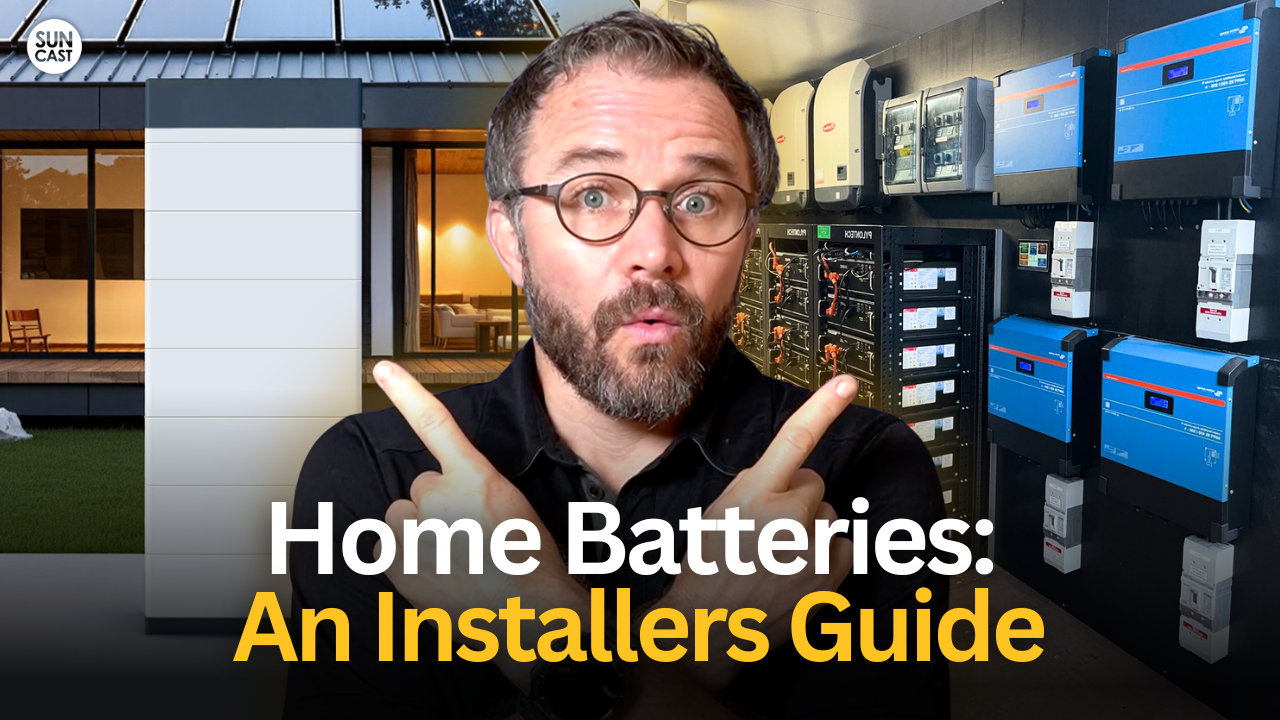
Sam Buffington, Business Development Manager at Pylontech, joins Nico Johnson for a deeply practical conversation about what installers should actually be paying attention to as batteries become a core part of the residential energy system.
Sam has worked across modules, distribution, and storage, and he’s even built his own off-grid home by hand. That gives him a rare perspective on how solar-plus-storage systems behave in the real world and where installers most often create long-term problems for themselves.
Expect to learn:
🔹 Why rising peak demand is accelerating residential battery adoption
🔹 What installers should look for in a reliable battery partner
🔹 The wiring and system design mistakes that create long-term warranty issues
🔹 How cold-weather performance affects real-world battery operation
🔹 Why VPPs could reshape installer economics and customer payback
This episode is not about battery hype.
It’s about how installers make smarter decisions in a market that is getting more crowded, more technical, and more financially important every year.
RESOURCES:
Connect with Sam Buffington:
Check out Pylontech:
"The best thing you can look for in a partner, whether that's Pylon or someone else, is you want a reliable product and good quality customer service, pricing is a factor." – Sam Buffington
This Podcast is Free For You
Thanks to Our Sponsors
The following are Corporate Partners who have helped make SunCast possible:
Platinum Sponsor
The following are Corporate Partners who have helped make SunCast possible:

Noteworthy Quotes:
Nico Johnson 00:00
Battery storage is quickly becoming one of the most important pieces of the residential energy system, but as more and solars add batteries to their offering, the real questions start to emerge. How these systems perform in the field, how they are designed, and what makes them reliable for homeowners become the most important component of the decisions that you're making. Sam Buffington has worked across the solar value chain, from modules to distribution to energy storage. He's even built his own off-grid home with his own hands, from which he is coming today to talk with us on the show. I think Sam brings a rare perspective on what actually works when solar and storage meet the real world. Sam, great to have you,
Sam Buffington 00:41
Nico. As always, it's great to see you, buddy.
Nico Johnson 00:43
I'm curious, as storage has moved out of kind of a niche add-on and becoming more of a core component to our energy systems, in particular Resi, what are you seeing in terms of trends that are driving homeowners and installers towards storage, and how do they maybe even those two different markets think about product selection.
Sam Buffington 01:06
The primary trend driving energy storage is, of course, rising energy costs, but you have to understand where those rising energy costs are coming from. So one is the sun setting of net metering 2.0 and the advent of net metering 3.0 So now you're not banking your energy necessarily, customers are selling it at a much lower, reduced rate, or not able to sell it back at all. The other one, which is probably even more pressing than that, is peak demand. So you're starting to see peak demand, usually in conjunction with other large projects in states. Don't cause any negative annotations to what some of those projects may be, but we all know what they are when we look at the industry that can in some states drive energy costs higher for consumers, not all, right? You're seeing some states really protect their consumers in that way, and the homeowners, but not all of them do that. And just in general, the grid is aging, right? So now you're seeing higher stress periods, especially in states like Texas in the afternoon, and that really is both for the commercial and the residential customer, where they go from 15 or 20 cents a kilowatt hour now to 4050, cents a kilowatt hour, and being able to have energy storage that is discharged in those peak demands on a daily basis can save 1000s of dollars a year on high demand applications, even, you know, in emergency response to where now you, you know, you have a generator or something go offline, so that the driving factor is really peak demand, and that is being addressed mostly through the use of virtual power plants, or VPPs. Is
Nico Johnson 02:32
there anything with regards to product selection? You know, you have spent a lot of your career helping folks make decisions around exactly how to build out the architecture of the system for their home, for their business, for their utility scale project. At the time that you were at Srina, what do you notice right now around product selection, and how, in particular, installers, the folks downstream from you, are filtering the wheat from the shaft.
Sam Buffington 02:59
Product wise, it's usually going to come down to ease of installation and procurement. A lot of manufacturers don't want to keep a lot of inventory. Obviously, you don't want to have too much aging inventory. Batteries have a lifespan if they sit on a shelf, all sorts of problems associated. So, you know, manufacturers, you need to have proper forecasting with your customers to be able to keep enough inventory to where if something pops up, you can react to it, but not so much that the inventory ages out or requires some sort of maintenance or charging cycle while it's in storage. The other side of procurement with that is still VPP, though. Right? There are programs that you can offer to installers to get a portion of that VPP money back, so it's not just the homeowner who takes advantage of that. Oftentimes installers can do that as well, but if I had to pick a hardware one, it would be ease of installation. The more stuff you have in the box, the more complete everything is. That's really kind of the key to making this work, and proper conduit knockouts, that sort of thing. All the all the little stuff that can shave four to 10 hours off of an installation, because you've got it all there and you don't have to make more trips.
Nico Johnson 04:06
What about the tenuous nature of supply chain right now? How does that impact the procurement choices, especially on the residential side for installers?
Sam Buffington 04:16
It definitely does have an impact. The biggest thing is it drives fear, because you see a lot of worry about tariff that's kind of calmed down in the last three months, but before the beginning of the year it was an everyday thing. You would get asked about how are tariffs going to affect this, what's the chances this change? Things have seemingly stabilized in the last few months, to where everyone just kind of understands it's a risk and they're trying to simply buy as much as they need right away, and again, good forecasting helps with the fear side of that, because if I know that an installer is doing, you know, let's say 500 kilowatt hours a month, and they're clear with me about their installation rate and how big their crew is, I can keep 550 or 600 kind of backlog for them. Maybe they don't even necessarily have to put a deposit on it, because they've been reliable over the last year, and I know they're going to buy it, so the fear of not having inventory is causing some people to kind of shift their focus a little bit.
Nico Johnson 05:14
How do you, as a business development manager, think about the conversation that you have to navigate with folks who are simultaneously trying to scale their business, but also looking for a good partner who maybe isn't on the finance AVL of their favorite provider.
Sam Buffington 05:29
The AVL side of things, that's a long road. Our team has been working actively on more and more AVLs all the time, and different approval lists. The best thing you can look for in a partner, whether that's pylon or someone else, is you want a reliable product and good quality customer service. Pricing is a factor, right? That's always something, but it's a little easier to get in the dirt with other competitors than people might think, as long as they're able to manage that scale. So, if they've got the capacity to install at scale, yeah, they're reducing their margins a little bit, potentially not having the financing options, but in the end they're still able to be very functional, you know. If I were back at Missouri Wind and Solar, and I was a small company looking to try to grow in some way, what I would be looking at would be failure rates on the batteries, because that's really what's going to be a deal killer, the standards in the industry, it varies based on who you talk to. In my experience, residential products are going to experience some type of a warrantyable event in about 1% of installations. That's kind of the standard that I've seen. Some people tell you it's a little closer to three quarter or half a percent. Again, you know, I've been doing this nine years I've seen the lithiums go up and down in terms of warranty,
Nico Johnson 06:44
so one in every 100,
Sam Buffington 06:46
yeah, roughly one in every 100.
Nico Johnson 06:48
You've had the opportunity through your non-pilot tech experience and through conversations with installers who have themselves had bad experiences to kind of get perspective. What does a bad battery partner, look like if, if I'm an installer, what am I trying to filter out?
Sam Buffington 07:05
The number one thing that you're, you're trying to filter out right out of the gate is something that's not got the proper UL listings, because that type of product does still exist in the market. I won't name names, that's a bad place to put yourself as a, as a company, but if you're careful, what you'll see is, if you, you know, their data sheets may say this is ul you know 1741 on an inverter or 9540 on a battery, but then when you ask for the certificate, that can gets kicked down the road and it doesn't show up. That's not very common anymore. It was really common about three years ago. But the other one is, what does the warranty procedure really look like,
Nico Johnson 07:41
yeah,
Sam Buffington 07:42
a lot of times that warranty is prorated to where they're going to give you a credit based on x number of factors, and they're going to try to disqualify that warranty. That would really be the thing that I would look for if I was an installer, would be read the warranty paperwork and see what type of a deal you're really getting into. Another one is going to be net terms, right? Some companies are unwilling to do any sort of net terms whatsoever, so that's the other one that I would look at. So, warranty and net terms are your biggest concerns.
Nico Johnson 08:10
Sam, batteries are created in these lab conditions and often tested for UL and everything else in what might seem like ideal, perfect conditions, but they're placed in some of the harshest environments, not just in our homes, like garages and basements, oftentimes outdoors and in extreme climates. What are the real design challenges for resi batteries, and particularly North America, and especially as we creep higher into the colder regions of the US, North, and even into Canada? How are these systems evolving to handle
Sam Buffington 08:40
it? There's always this balance between system efficiency and cold weather capacity at a rudimentary level, that you know the average person listening to the podcast will understand. If you've got, and you may have heard this, of lead acid batteries, right? If they're frozen, you can't charge them, so you have to understand that most electrolytes are in some way water-based, and any battery in the market, I don't care what it is, if it's LFP or anything else. Traditionally, with lead acid batteries, you would see a reduction in overall system voltage and capacity. There's an entire curve and voltage calculations that can be done to address that and to fix it. LFP, you can actually see cell rupture if you try to charge them when they get too cold, so having sufficient heating capacity, usually through resistive heat tapes, blankets, that sort of thing, to be able to keep the cells at an operating temperature that is optimal for their, you know, for their particular chemistry, because there's lots of different little tweaks that manufacturers will do to LFP to give it potentially a little better cold weather performance without heat, trying to optimize that, and then not lose 30 to 40% of your system efficiency in a day is really the challenge. The natural inclination from people is to add insulation, but most of these places that get really cold also get really hot. I mean, if I just on a road trip, I was. In southern Iowa, and on my way through there, it was 90 degrees in March. Well, it would have also been minus 25 in December. So, if I insulated that battery and then put it outside where it normally is going to be required to be installed in a lot of locations here in the US for NFPA compliance, suddenly now I've insulated it and I've made an oven, and now I get cell temperatures that are too high, so that that really, that balance of how do you heat it, and then also keep it cool enough, because you get both extremes, and you need a product that's suitable for the entire US,
Nico Johnson 10:30
and what are some of the answers that we have, is it cooling fans, is it, is it like a liquid system,
Sam Buffington 10:37
usually it in the residential market it's cell shape and layout that allow for conductive cooling. Right, if I take a, if I take 100 amp hour cell, I can make a nice little neat block, or I can make a large pouch that's very flat and has more surface area. That surface area has the impact also of increasing C rate,
Nico Johnson 10:58
and define C rate.
Sam Buffington 10:59
So, C rate is your, your charge and discharge rate. Industry standard varies. Most manufacturers are going to be between half and 1c
Nico Johnson 11:07
You know, you've worked across different verticals, even built your own off-grid home. I'm curious, similar to what you're kind of some of the things you're talking about in cold weather climates. What are some common mistakes you see installers make when they first start designing solar plus storage systems.
Sam Buffington 11:22
Insufficient wire size is the big one, where you know you get these installations where, for some reason, the inverters are further away from the batteries than you might like, and the other side of that coin is then not wiring the batteries appropriately. A lot of installers, when they first get into it, they think, okay, you know, I've got the SAM phenol connector, I've got a ring terminal, it says it's rated at 100 amps, I have x number of batteries, I, and I've got two stacks, so I'm going to run a set of wires from each stack, and that's not necessarily the right way to do it, you have to look at the actual demand of the system, and sometimes they get away with it, right, if it's just a home backup system, and it's only ever working hard when the power goes out, which is very uncommon, system inefficiencies and balances don't necessarily occur, but with the growth of all these VPPs, it's becoming really important, because now you've got the heat of the day, for example, in Texas, you have 100 plus degrees, now you've got the inverter working at maximum capacity, and you're pulling really hard on the batteries at a high discharge rate, that's when those problems tend to occur. So you know, making sure that if you aren't sure as an installer, right, so knowing what you don't know, that if you question a part of an installation, you need to ask whoever that battery manufacturer is, whether it's us or someone else, and you need to get a hold of the technical team and do the calculations with them,
Nico Johnson 12:41
right?
Sam Buffington 12:42
You know, the tools for calculating voltage drop are readily available on the internet. You can download an app, your phone, they're free. It takes 30 seconds to input the data, and if you'll do that, you'll have a lot less warranty issues and customer callbacks three to five years down the road, which is where those problems usually occur with imbalanced cells. So, you know, as far as the problem of battery wiring that ends up causing long-term cell failures and premature warranty issues. Oftentimes, manufacturers will still warranty it, but you get kind of a slap on the wrist as an installer. Hey, you shouldn't have done that. Well, now you've put out 500 installs over the last three years, and you either have to decide, okay, some of these are going to have warranty, and I have to fix it, or you know you're going to see other issues. So, doing it right the first time and making sure that you fully understand whatever brand of product you're installing is going to help you long term.
Nico Johnson 13:34
What do you think the average solar installation will look like? Let's, let's contain it to residential for now, five years from now.
Sam Buffington 13:41
I think your average solar residential system is going to lean a little less heavily on solar than it used to. Obviously, solar module efficiency will intend, will continue to improve, but based on the load growth in the country of reindustrialization data centers, that sort of thing, you're going to see continued increases in energy costs, but you'll see windows of low demand, right. So, as the population in the country continues to grow, obviously, air conditioning, food, heating, all that stuff, but you will, your big energy spikes will be the driving factor of energy costs, right. It globally, you already kind of see this with brownouts and other nations generally considered third world nations, but that trend will continue. The amount of energy necessary for our country to meet all these demands is in excess of what we produce currently as a whole, right? So the building of transmission, all that is it, that's its own animal, but the easiest way to solve it is distributed generation and storage. I mean, you see, even now this trend may grow significantly. There are utilities in Texas that will offer consumers free electricity in the middle of the night and then charge them out the nose through the middle of the day. So those types of installations, your batteries could pay for themselves in months, if not years, right? I mean. Be very quick in those types of environments, and so my installers are very successful there because of that very reason, right. So the payback period becomes two years, right now, but if energy costs continue to go up, that's just gonna drop. I mean, the energy prices are rising faster than any inflationary effects are having on battery costs.
Nico Johnson 15:18
It's fascinating, and the energy hedge is exactly the underlying business model that you see, like Haven Energy, who we had their CEO on. I mean, so many other battery companies that are managing effectively these virtual power plants and aggregating that supply rather than aggregating the demand, they're aggregating supply that can feed into the utility you mentioned VPPs at the outset, so maybe I'll wrap with this. How do VPPs change not just the business model for homeowners, but for installers in the coming five years?
Sam Buffington 15:55
There's going to be more and more competition for VPPs to provide higher revenue amounts to installers, so the, you know, they offer energy as a service to the utility, is an easy way to understand it, and most VPPs have some form of a credit that they will give back to the individual installer that is in their network. I think you're going to see that market get much more competitive as energy costs go up, and the amount of credit that they're able to generate increases, so I think that's going to be it'll become a brand loyalty thing, of you know, one person likes this truck, that person likes the other truck, it's going to be the same, where they've got this best deal in their mind with this particular VPP, and that's who they stick with, because they've already, they're already so invested with them at that point,
Nico Johnson 16:40
same, I am fascinated with the not just the depth, but the breadth of knowledge that you have managed to acquire in the short time that you've been relatively active in our sector. Glad to have you on. We'll have to have you back in a bit and hear how things are evolving for you. Sam Buffington is the business development manager at Pylon Technologies, a battery supplier to the Resi and US commercial industrial space. Sam, thanks for joining us.
Sam Buffington 17:10
Nico, thank you. You give me too much credit, I'm just an old boy out here in the woods, but I appreciate it.
Nico Johnson 17:16
That was Sam Buffington, business development manager at Pylon Technology. You know what stands out to me in this conversation is just how much the battery conversation has matured over the years. This is no longer just about backup power, it's about peak demand, it's about energy costs skyrocketing, and it's about how we can leverage virtual power plants. Increasingly, the conversation lingers around whether installers can design and install systems that outperform or even perform reliably for homeowners over the long term. Think Sam made it clear that the details matter, everything from wire sizing and voltage drop to warranty terms, and whether the darn thing is UL listed. We get into procurement planning, cold weather performance, even ease of installation. They all shape whether a system becomes a long-term asset or a future service headache for installers. The takeaway should be rather simple: storage is fast becoming central to the residential energy offering, but the winners will be the teams that understand the technology deeply enough to design it right the first time and avoid costly service mistakes. Thanks again to Sam for contributing to the show. Hope to have you back again soon. And thanks as well to our sponsors, they pay the bills, so all we ask you to pay is attention. You've done that yet again, and I am grateful. Remember, you are what you listen to. Thanks again for showing up, Solar Warrior. It's half the battle.

Nico Johnson
Entrepreneur & Podcaster
In my 20 year career, I've worked with dozens of entrepreneurs, intrapreneurs and professionals in transition to clarify their mission, set or stretch their goals, and work through the barriers to their growth.

Latest episodes
We’re Excited to Hear from You!
Don’t hesitate to reach out—whether you’re here to learn, share ideas, or work with us, we’re ready to connect.