
We'd love if you'd leave us a 5 ⭐ rating & review and it's never been easier: www.ratethispodcast.com/suncast
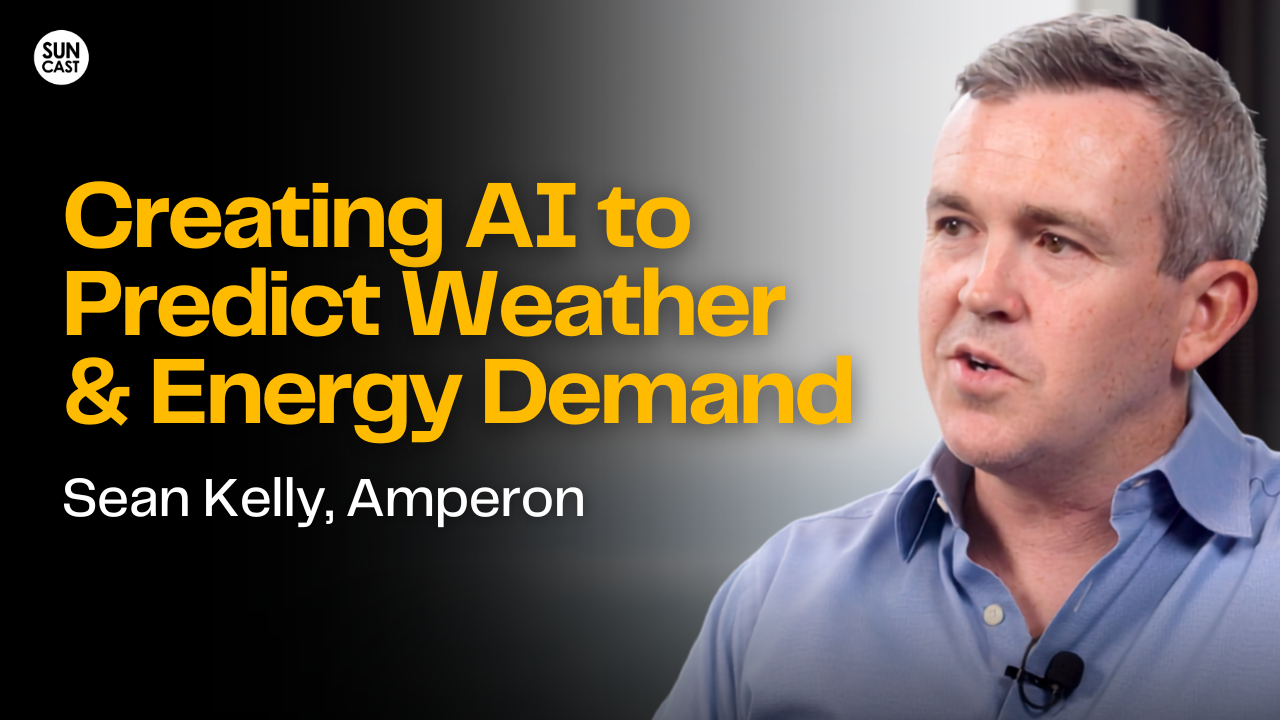
For decades, the energy industry has treated its biggest challenge as building more power.
Sean Kelly thinks that's the wrong question.
As CEO and co-founder of Amperon, Sean spends his days helping utilities, traders, generators, and some of the world's largest electricity users anticipate what's coming next. And what he's learned is surprisingly simple: the grid's biggest challenge isn't producing enough electricity. It's knowing when, where, and how demand, weather, and renewable generation will collide.
That shift is changing everything.
In this Tactical Tuesday conversation, Sean explains why Amperon is moving beyond traditional deterministic forecasting toward probabilistic forecasting, giving customers a range of possible outcomes instead of a single answer. More importantly, he makes the case that the future of the grid won't be won by building for all 8,760 hours of the year. It will be won by managing the handful of hours that matter most.
Expect to learn:
🔹 Why deterministic forecasting is giving way to probabilistic decision-making
🔹 How AI, data centers, and renewable generation are changing the way power markets operate
🔹 Why flexibility may create more value than simply adding more generation or transmission
🔹 How better forecasting gives utilities, traders, and large energy users something even more valuable than certainty: time
Whether you develop projects, operate assets, trade power, or simply want to understand where the grid is headed next, this conversation offers a practical new lens for thinking about the future of electricity.
Now press play, and see if Sean changes the way you think about the grid.
RESOURCES:
Connect with Sean Kelly:
Check out Amperon:
"If you're a trader, your goal is to make money. If you're a utility, your goal is to not lose money." - Sean Kelly
This Podcast is Free For You
Thanks to Our Sponsors
The following are Corporate Partners who have helped make SunCast possible:
Platinum Sponsor
The following are Corporate Partners who have helped make SunCast possible:

Noteworthy Quotes:
Sean Kelly 00:00
Energy is the cool topic right now, but everybody's got to get aligned and work together to solve this. This is the hardest problem I do believe that we've faced in our lifetime. We're either going to win or we're going to lose bad, and that's where I really think that cooperation is really the key
Nico Johnson 00:22
for nearly two decades, our next guest has worked at the intersection of energy trading, power markets, and power generation. Before co-founding Amperon, he traded power across North America markets, managed generation portfolios that included nuclear assets, and worked directly with large energy customers navigating complex energy decisions, and it was precisely those energy decisions that he wanted to fine tune. We've had Sean Kelly of Amperon on this show before, but it's been a while, and I wanted to talk a little bit about how the nature of his current business, which is forecasting, so that you and I and energy developers broadly can answer the question, what's going to happen next. It's changing, and I want to talk about the nature of how it's changing. So, decided to bring Sean back. And if you're new here, I want to thank you for giving us the only non-renewable resource you've got. Of course, that is your time. We are going to absolutely maximize the value of that time today. I think you're going to like Sean if you haven't met him before. We're going to dig deep. If you have any questions, make sure you reach out to us team at SunCast. If there's someone like Sean that you think should be on the show, let us know. We're still always looking for great founders like the guy you're gonna meet right now, Sean. Welcome back to the show.
Sean Kelly 01:43
Thanks so much, Nico. Great to be here. And fun fact, june 1, 2005 was my first day at Tanaska, so here we are, turning 21 today. That is why career is drinking age,
Nico Johnson 01:55
21 years in the biz.
Sean Kelly 01:58
I know,
Nico Johnson 01:58
and you don't look a day older.
Sean Kelly 02:00
Yeah, that's where all the gray hairs from. Just happy it's here. It's here.
Nico Johnson 02:03
Well, the gray, the gray hair is, you know, raising a family and raising money and building a team all at the same time.
Sean Kelly 02:10
It definitely is the
Nico Johnson 02:12
concept of forecasting, weather, power, demand, availability, nodal pricing, etc. Like this is something that's it's commonplace in energy markets. How have you and Amperon approached it differently than the way forecasting was traditionally being done?
Sean Kelly 02:32
Yeah, I think the first thing is to take a step back and Amperon is an AI-powered data company served as software, and that's how it's been since we went live in January of 2018 and so we're not AI because it's convenient for fundraising now. It's literally how we were founded, and that sense was really AI from a machine learning standpoint, as all of our models are very in depth, and there's no forecast that's right all the time, and so, because of that, you're getting an ensemble of multiple forecasts, and then what we produce is electricity demand when solar price in ERCOT and PJM coming soon to a trade floor near you, and then we're active in the entire continental 48 Alberta, Ontario, Australia, and 16 European countries. Per your customer base, we can stand up wind and solar absolutely anywhere, and so those intermittent generation assets is what allowed us to last year things not on my 2025 bingo card, Estonia, Latvia, and Jordan. Wow, were places that we stood up for customers. So, you just need lat long, sun is sun, wind is when, and everybody needs a forecast. What is deterministic forecasting? So, deterministic forecasting is what I thought 2018 Sean thought was the correct answer, because I, so I was a trader from 2005 to 2016 If you tell me something and then you're wrong, then I can yell at you, right? But if you give me a range of outcomes, then I really can't yell at you. So, like, my goal was to always be able to be like it's your fault, and so I wanted to give the customer like I told you this was the answer, and then our team internally was like, well, it was or it wasn't, and this is our mean absolute percent error, is what we use for demand, because solar dips negative, we use CNM, which is capacity normalized mean absolute error, it allows you to dip down negative at times, and which is, which is helpful, doesn't burst the calculation model, and so that's that's how I thought the world needed to be viewed.
Nico Johnson 04:52
Yeah,
Sean Kelly 04:52
now,
Nico Johnson 04:53
and why did that work reasonably well? For
Sean Kelly 04:56
the, it
Sean Kelly 04:56
worked really well. We got 165 customers, so something's something's cooked. Second, but I really think weather's weird. It's crazy. We're way crazier. I mean, we have a one in 100 year event every three months, and it could be, I mean, hurricanes hitting the coast of California, not supposed to happen, wildfires way too much. I mean, you obviously got.. I live in Texas, and so Winter Storm Yuri was a complete mess. Fern most recently took the entire.. I mean, like 34 states were at or near highs. I mean, for North Carolina, you had Winter Storm Elliot losing power on Christmas Eve, can't black people out on Christmas. Yeah, and so that's where weather just got hard, and so probabilistic, we feel, is not the correct answer, but it's another answer, and obviously, when you have a lot of customers, everyone views the market a little different, and that's where you really need to meet people where they're at. Help me understand the difference, then, because you just introduced probabilistic as a terminology, why does
Nico Johnson 06:00
probability matter, and in contrast with deterministic forecasting.
Sean Kelly 06:04
Great question. So, we give you a range of outcomes, and so you're going to catch the craziness out there, and then catch the beyond boring. Absolutely nothing happens, and then the worst case scenario happens, the tail events that we keep hearing about, and so probabilistic lays out all of those. We just released a 46 day forecast, and we give you all 51 members of the European ensemble, and so you're getting 51 forecast, and then you get to go look at the P 99 the P 95 the P 90, P 50, like whatever you and your like management team, risk team like deems the most appropriate, so that's where probabilistic stacks up. If you ask five customers what probabilistic, how to do it correctly, you're going to come up with three different answers. So, again, deterministic, this is the answer, and probabilistic, again, there's a range of outcomes.
Nico Johnson 06:56
Is this customer driven, market driven? What's the underlying, what's the undercurrent leading you to a more probabilistic approach,
Sean Kelly 07:04
customer focused, and so, so when I got out of school in oh five, most of the people that were trading, and I ran about three dozen or so power plants, most of us, more than half, were finance econ majors, like bike markets, things of that nature. Now you've got a ton of comp sci majors, you've got a bunch of data science, you've got a bunch of just programming who are coming into trading. That's awesome, because the world gets more confusing. Excel doesn't work, and that was the thesis of starting Amperon. Excel doesn't work.
Nico Johnson 07:38
Yeah,
Sean Kelly 07:39
Python works, Clod code works. There's a whole variety of things that are moved significantly faster and processes much more data, and so the customer really spoke and said, the way I look at the world and the way that I model with my algorithmic trading style, I need probabilistic.
Nico Johnson 07:56
Yeah,
Sean Kelly 07:56
85% of the intraday market in Europe is programmatically traded its algorithm, algos. No one's sitting there pushing the button. They are literally watching these balancing authorities and have built a really great program to try and monetize that as much as possible.
Nico Johnson 08:16
Can you give me a practical example where probabilistic forecasting is making a difference, it's, it's moving the needle for a customer.
Sean Kelly 08:25
So, with Winter Storm Fern coming, it came in the 20s of January. It originally looked like it was going to come MLK weekend again. The last two MLK weekends were pretty tumultuous, and so we picked this up the week of Christmas, so we're a month out, we're able to see, hey, something's up here, and not all the bands caught it, but it was like there's enough to start looking at it, and so there's a really good case study on the Amperon website about how to trade the midterm forecast, like three plus weeks out,
Nico Johnson 08:57
yeah,
Sean Kelly 08:57
and goes way more in depth than then I'll go here, but literally it shows that it started trending toward colder and colder and colder.
Nico Johnson 09:06
Yeah,
Sean Kelly 09:06
and so people started paying attention to it, and then lo and behold, we had a pretty rough event in the scheme of things. Texas didn't get had as bad as, like, a winter storm. Yuri, Nashville lost power for a week plus. So, I mean, it was definitely one that people are going to remember,
Nico Johnson 09:21
how are customers using that data to their advantage in that midterm? So, there's
Sean Kelly 09:27
two ways customers look at things. If you're a trader, your goal is to make money. If you're a utility, your goal is to not lose money, and so you say that, and it's, it's actually quite different. One is opportunistic, trying to say, "Hey, I can go buy $50 power and hope it goes to 500 and make money. And then other people are saying, "I'm going to keep the lights on, I need to make sure that I'm properly prepared, that I brought enough gas for generation, or that if the.. if it's not going to be as sunny, or if windy is expected, and so I'm. Just trying to keep everyone safe,
Nico Johnson 10:01
yeah.
Sean Kelly 10:01
And so that's what's really different, is we have customers who we really refer to as risk mitigation strategies, and then others as like profitability strategies, just based on the customer persona.
Nico Johnson 10:13
I've heard you say that forecasting is buying time. How does understanding these probabilities better than just having the singular answer help your customers buy time,
Sean Kelly 10:21
I mean, more data, that's what the whole world is moving to right now, is just more data, and so this is giving them more opportunities to see what the market is going to do, see where things are going to move, if it says it's going to get cold, you may not have to catch the entire move, some people are, some people are only allowed to buy power, some people, most people are allowed to buy and sell power. So, you can buy when the weather model says it's getting cold, and then it can hit a number that you like and sell it out there, or you can just let it keep going. So, there's a number of ways that people can actually use this, and this is what I think a pretty strong advantage that Amperon has had, as myself and a few of our early key hires have this background, and so we sat in the seat and actually did this before, so we really understand what our customer is going through,
Nico Johnson 11:12
what's going on inside the Amperon office, or on your cell phone in December, as your internal models start to pick up things that aren't necessarily getting picked up in the more sort of in the common vernacular, common conversation.
Sean Kelly 11:28
In what way?
Nico Johnson 11:29
Yeah, like, how does the ampuron machine start to wake up and tell you and the rest to take notice? I imagine that there's a lot that is happening that's automated, but like, how do you know when something is afoot?
Sean Kelly 11:47
Yeah, I mean, we have a very, very good relationship with our customers, and we just very proud just came back with our NPS score, so that's net promoter score. Do they like you? And almost everyone came back with eight nines or 10s, we came back with a 58 on the net promoter score, and so very, very proud of that. And so it's getting out in front of them, and we don't want to be looked at as a vendor, we very much want to be looked at as as a partner, and so because of that, so many people said they appreciate our partnership on that feedback, and so that's what really means a ton to me is we want to work with them, and I haven't been been clean for 10 years, I haven't touched ice, haven't made a trade, and so with that, it's fun to be back in the game without fully being back in the game of just helping people like walk through what they need to make the best decision to, I mean, do the best for their job and their company, and also their constituents.
Nico Johnson 12:41
I love, I love that you just framed it like a junkie. I, because, believe it or not, in this interview I was like, do I ask him, do I not ask him, because he fallen off them.
Sean Kelly 12:52
Haven't traded any power since literally march 31 of 2016
Nico Johnson 12:58
Wow, yeah. Well, in that time the power market has changed, transformed in incredible ways. Just in the last two years, with the introduction of low growth hyperscalers and data centers, how has the market evolved in a way that you didn't forecast?
Sean Kelly 13:20
About two years ago, it started getting more difficult for us to get the GPUs that we needed, and so that was a little bit of a precursor. We have a pretty sizable cloud bill, as happens when your model retrains every single hour, and I think that was the precursor to obviously what's happening now, and now it is just trying to figure out how the heck do we get there, because you've got, I mean, you've got middle schoolers sitting there playing on Chat GPT and Claude, and everything like that all day long, and that was definitely not something that I saw coming in. This massive compute, this massive compute, and the fact everyone's talking about it. I, one of our very first investors was SV Angel, and they had a really cool, really cool founder forum two weeks ago in San Francisco, and got to sit down and listen to, like, the thoughts of Sam Altman and Brett Taylor. Brett Taylor interviewed Sam Altman, and then got to listen to Bill Gates talk about the future, and just that's like those are the rock stars these days, that's crazy. Yeah, and so it's just fun to be in something that early in my career, especially like growing up as a kid in Houston, they said, Why are you in electricity and why are you working at night? It's like, because you got to keep electricity on at night, why are you not in oil and gas? What's wrong with you to I was like no, just on the real time desk, and now this is all anybody wants to talk about, and I also think that it is, I do believe it is an actual security issue for the country, and I think that I mean it also feels that AI is something that we're seeing that's by part. And that everybody can get behind and be like we've got to figure out a way to crack this, we've got to figure out affordability, we've got to figure out how to make sure that the right people pay for it, and it's not going just to the end users, we've got to make sure the reliability that we can actually get the power like where we need it. I'm fortunate to be an advisor to Emerald AI, which is really working on that, backed by Nvidia and others, and so I mean that's where this is the prime thing people are looking at, and then people are looking at how do we power this thing. The one of the things I've heard multiple times is that we don't know how this movie is going to play out, but the main character's energy, and that's what's so important, because natural gas that wait time for those combined cycles is pretty stinking long right now. Solar, get that stood up like pretty reasonable time. I think we're like in Texas, we're pretty good on wind. We have about 40 plus gigs of it, so feel good about that. But solar is really where I think we have a lot of ability to do that because it works so well with colocation and also with with batteries.
Nico Johnson 16:06
Yeah, I completely agree. There's still a lot of room, in particular, I mean, there's still there are assets we were just talking in a previous conversation about so much opportunity on the grid where there isn't congestion, and where there are lots of existing solar assets, where we have surplus of electricity and curtailment,
Sean Kelly 16:28
100%
Nico Johnson 16:29
Yeah, the
Sean Kelly 16:30
stranded assets are back, like if you go co-locate or near locate a data center, that's amazing. You then have that the grid is so complex and so confusing, and the backbones 100 years old.
Nico Johnson 16:44
Yeah,
Sean Kelly 16:44
and so if you put a solar installation and you think it's about to go mothballed, it's not. Find a data center, even edge computing. A lot of people in Texas are trying to build these 9.9 megawatt data centers, because you can. It's almost plug and play,
Nico Johnson 16:57
right?
Sean Kelly 16:58
I love that. I'm a big fan of where that's heading, and also all the renewable IPPs again, who have something that just worked out when they built it, but isn't working out currently, like they can go back and salvage those products.
Nico Johnson 17:11
Yeah, I was talking to David Holmes, and he said that the distributed, the distributed compute in three years' time is going to be all anyone talks about.
Sean Kelly 17:20
It's gonna be everywhere.
Nico Johnson 17:20
Yeah, it'll
Sean Kelly 17:21
be, you can put up a whole bunch of little data centers, and that's what I think, that's the thing I.. that's the underserved market I think that we're missing is everyone wants to have the press release just super sexy to say it's a gigawatt, right? Yeah, but at the end of the day, a whole bunch of 510, 1520s, megawatt that can get the job done, and also you can disperse them a lot better if you, you build 1000 megawatt site, you are in it to win it.
Nico Johnson 17:47
It's also, yeah, the most common size today is like 15 to 25 megawatt totally. That's been that's been the data center world. If I'm a developer, speaking of missing opportunity, if I'm a developer trying to bring a large load online today, what's the biggest forecasting blind spot that I probably have
Sean Kelly 18:05
bringing the load on today? I think that's twofold, one that we don't deal with, and one that we do deal with. And so the one that we don't deal with is interconnection queue, like forecasting when the queue is going to work, what's being double counted. Obviously, all the ISOs are in the middle of trying to figure out how not to have insert big private equity name here. Have I mean 1520 different projects in the queue, and being planning on building three to five of them. And so that's one of the things I think that's really hard to forecast is the queue. I wish there's a solution. Kind of glad I don't touch it. I don't know what the solution is. And then on the second piece is when you come online you are a very large flexible load resource, you are able to be demand response, you are able to save the grid essentially, as we saw again this winter in both Texas and PJM, little bit in my SON SPP as well, you can come on and save the day, you can be the hero, as opposed to just the villain for the rate payers being concerned about it, and so that's where we really tie in. We offer coincident peak alerts, so that tells you different rules for different ISOs, but the underlying theme is very similar, beyond good behavior at the hardest time of day, and so that's where Amperon really thrives by giving out those coincident peak alerts. We've been doing that for five or six years now. I think this will be the fifth or sixth summer that we've been offering those, and so large loads have been looking at those, and they should look at those. And then next is really understanding the market that you're in, I know not everyone from a hyperscaler standpoint is that price sensitive, but let's be honest, if prices start getting to $500,000 to be a good steward of the grid and to be a good neighbor, you need to be flexing down, moving your compute from a Chicago to a Virginia or vice versa. Or wherever, and so that's where they really need to be good stewards and make it easier for their PR teams.
Nico Johnson 20:06
If you could wave, wave a magic wand and accomplish one of these three things, which would you rather: more generation, more transmission, or more flexibility? Which creates the most value over the next five years?
Sean Kelly 20:19
It's more flexibility, I think, if you look at it, there's 50 to 100 hours that we were going to have an issue. There's 8760 hours in a year. We're only concerned about 5050, if it's mild year, 100 if it's big year, and that's it. And that's what we need to look at, and those dollars we need to be concerned about. So the other two are great and very underserved and very difficult to build, but flexibility, it's not that bad. Yeah, Amperon is really fortunate to have Tim Healy on our board. So, Tim Healy, for those who don't know, was co-founder and CEO of Internoc, which I say, and he likes it when I say this, essentially invented demand response and started the company, I believe, in oh one, sold it in 17 and ran that whole thing, had to go deal with lobbyists, deal with like letting the regulators know what this meant, and that was flexibility for large commercial industrial, and now everyone's in a demand response program. It just, it is what it is. That's what I think we're going to see going forward from a flexibility standpoint. It's going to take a minute, because I know that your compute is obviously the most important compute, but can you be a little easier on this? Can you maybe do you really need it right now? Can you wait? Can we run at 4am when nobody else needs it? So those are the things I think. Again, the flexibilities is definitely the right solution.
Nico Johnson 21:38
If folks only remember one thing from this conversation, what should it be?
Sean Kelly 21:42
I think the biggest thing is energy is the cool topic right now, but everybody's got to get aligned and work together to solve this. This is the hardest problem I do believe that we've faced in our lifetime, and we're either going to win or we're going to lose bad, and that's where I really think that cooperation is really the key across all the different customer segments, across all the different political parties, across everything, like we need to know this is the goal, and I think that's the, that's the takeaway that I would definitely leave people with, just all work together, why can't we all just get along,
Nico Johnson 22:19
just gotta be friends,
Sean Kelly 22:21
exactly.
Nico Johnson 22:22
I'm glad that you consider our friendship strong enough that you would drive across town. Thanks for coming. Meet us at the Houston Club. Shawn Kelly is the CEO and co-founder of Amperon, one of the hottest startups in the energy sector.
Sean Kelly 22:36
Thanks, man. I appreciate it. Always a pleasure.
Nico Johnson 22:38
Always pleasure. Thank you. Twice weekly, we deliver conversations with founders and leaders on the front lines of the clean energy transition, and we're here bringing this content to you each and every week, free of charge. Of course, it's not free; our sponsors help pay the bills and keep the lights on, so that we can help you build your legacy in the clean energy transition. And so, if you'd like to say thank you to them, or learn more about what it is that they bring into the world, or perhaps see how you could reach 1000s of listeners twice a week, just like they do. Check it out at SunCast dot media forward slash sponsor. Remember, you are what you listen to. Thanks again for showing up, Solar Warrior. It's half the battle.

Nico Johnson
Entrepreneur & Podcaster
In my 20 year career, I've worked with dozens of entrepreneurs, intrapreneurs and professionals in transition to clarify their mission, set or stretch their goals, and work through the barriers to their growth.

Latest episodes
.png)
We’re Excited to Hear from You!
Don’t hesitate to reach out—whether you’re here to learn, share ideas, or work with us, we’re ready to connect.