
We'd love if you'd leave us a 5 ⭐ rating & review and it's never been easier: www.ratethispodcast.com/suncast
Last year, solar and storage accounted for more than 80% of all new power generation capacity added in the United States.
So why does our industry still behave like the underdog?
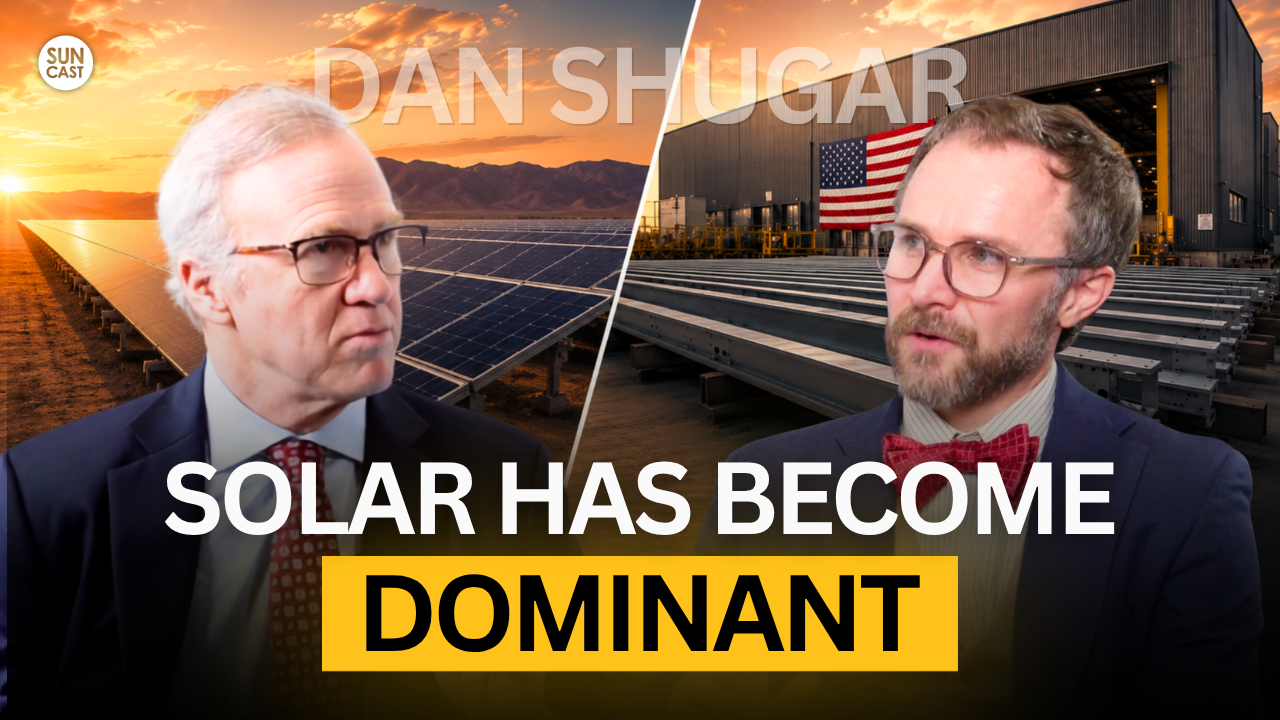
In this special collaboration between SunCast and Energy Empire, Nico Johnson and Jigar Shah sit down with Dan Shugar, one of the most accomplished entrepreneurs in solar, to explore a question that reaches far beyond technology, manufacturing, or policy.
Perhaps our biggest challenge isn't building projects...
...it's learning how to lead?
Dan has spent four decades helping shape the modern solar industry. In this candid conversation, he explains why solar has already won on economics, why domestic manufacturing became a strategic imperative long before it became political, and why the industry's greatest opportunity now is changing how it communicates with policymakers, communities, and the public.
The conversation also explores the leadership principles that have kept Dan's core team together across multiple companies, how semiconductor thinking helped him see around corners before the rest of the market, and why culture remains one of the most durable competitive advantages in business.
Jigar adds another important dimension, arguing that clean energy's biggest challenge is no longer proving the economics.
It's winning the narrative.
Together, they make the case that the next decade won't be defined by better technology.
It will be defined by better leadership.
Expect to learn:
🔹 Why Dan believes solar is no longer "alternative energy"
🔹 The COVID-era decision that reshaped his manufacturing strategy
🔹 How semiconductor thinking helped him anticipate solar's cost curve
🔹 Why keeping the same leadership team together for decades became a competitive advantage
🔹 Why communications, not technology, may be the industry's next great challenge
🔹 What it means for clean energy to stop thinking like an underdog and start leading like the dominant force it has become
It’s our turn. Are we ready?
RESOURCES:
Connect with Dan Shugar:
Connect with Jigar Shah:
Check out Nextpower:
Check out Energy Empire:
"We need to transition our thinking from being alternative energy to we are the mainstream energy." - Dan Shugar
This Podcast is Free For You
Thanks to Our Sponsors
The following are Corporate Partners who have helped make SunCast possible:
Platinum Sponsor
The following are Corporate Partners who have helped make SunCast possible:

Noteworthy Quotes:
Dan Shugar 00:00
About three years ago, one month ago, we went public, and at that moment our backlog at Nextpower was 2.1 billion. Today it's well over 5 billion. So I would say we're not being held back, because in part we've won on economics. Solar is the lowest cost way to generate power pretty much everywhere on earth, and now that we have storage that's very affordable, and at four to six hours now as storage it can work pretty much everywhere as firm power.
Nico Johnson 00:35
If you've been watching the growth of the clean energy sector for any length of time over the last year to 20, you've no doubt had a chance to see in action the two folks I've got beside me, legends in the industry, Jiger Shaw from Multiplier, and Dan Sugar, CEO, co-founder of Nextpower. I'm Nico Johnson, your host at SunCast, but today we're doing a special collaboration episode for Energy Empire Diggers New Podcast with our friend Jamie Nolan. Dan is the protagonist of the conversation today, and Dan, I wanted to start, first of all, welcoming you back to North Carolina. Thank you for all the many ways you've contributed to the growth of clean energy in my home state, but in our industry, and I wonder, as from the place where you sit, as one of the most well-known and important infrastructure companies building the current energy sector, what's holding us back right now?
Dan Shugar 01:36
Okay, well, thanks, Nico, and really appreciate what you've done with SunCast with leadership and congratulations, Jiger, for your new podcast, Energy Empire. Really looking forward to this conversation. It's great to be here in North Carolina at the UNC Clean Tech event, which is a fantastic event. What's holding us back? Well, I would argue we're, we are up into the right as an industry, and are going very, very strong, despite a lot of noise to the contrary. If you look, for example, in the United States last year, 83% of the new power generation capacity was solar and storage, so it is working us as a company as a yardstick. About three years ago, one month ago, we went public, and at that moment our backlog at Nextpower was 2.1 billion. Today it's well over 5 billion, so I would say we're not being held back in terms of like getting because in part we've won on economics. Solar is the lowest cost way to generate power pretty much everywhere on earth, and now that we have storage that's very affordable, and at four to six hours now as storage it can work pretty much everywhere as firm power. Terms of getting to the next level. Where do we go from here? How do we? I think we're really limited, mostly by our imagination and our talent, and so we're trying to bring the best and the brightest into our industries and really evangelize our message. We need to transition our thinking from being alternative energy to we are the mainstream energy. We need to start acting that way, investing more in public education, public policy, getting evangelizing our message out there, not only at home but abroad. We're in 45 countries around the world, so I would say we're doing great. We can do better, and we are part of the solution for affordable, reliable energy and play nicely with other power generation technologies.
Jigar Shah 03:50
Now, in terms of getting the best and the brightest to join our industry, I mean, you and I were best and the brightest at some point in our career, and I started Astro Power in 1995 you started at PG&E and have been working on solar since 1980s You know, how do you get the best and the brightest to choose our sector? Like, what was your journey? How did you decide that this was going to be your path?
Dan Shugar 04:14
Right, I'll answer that, but again, I'm going to do a quick, a quick tangent, which is there was a golden moment. Jiger, you founded Sun Edison. We were at Powerlight at that point. What we were both focused on was the right thing, which was drive down the levelized cost of energy, which then allows project donors to have the highest unlevered project rates of return, right. Okay, and so I think keeping true to that, and you carried that thought through all the way through the awesome investments you were making in your tenure at the Department of Energy, and thanks again for your incredible service there. So, for me, I think staying true. Through to a vision, which is solar renewables works for all, and we're going to deliver no compromise high reliability energy that wins it all the above merits. Those are the things that attract the best and the brightest, so we've been able to, I think, deliver on that last year. Nextpower, sorry, this sounds a little promotional, but I think it's helpful in answering your message. We're the top performing renewable stock, but also beyond renewables in all mid-market cap companies, we're in the top 10, right, and so folks are like, "Wow, this is not just good for the planet, but this is a really smart business, and that's driven by satisfying customer needs, which are people need power that's reliable, that's available, and so we've been able to now, in order to deliver a fulsome solution, we've brought in, for example, robotics, where we have inspection robotics that are doing vision, predictive analytics, digital O and M. So to support that business, we brought in a bunch of, you know, fantastic machine learning teams and things like that, so if you look at the scope to deliver, take our products and services to the next level, we need the best and the brightest, and our team is the most important thing in order to innovate, execute, and deliver those kinds of products and services for our customers, so I think we need to stay true to our vision, our mission, articulate that, but deliver exemplary operational performance where folks see this as a real industry that's a first order thing. Does that make sense? It does, but I still
Jigar Shah 07:00
think you dodged. I want to know all of the like uncles who told you that you were wasting your life by going into solar power or working for the electric utility.
Dan Shugar 07:10
There have been a lot of naysayers
Jigar Shah 07:11
along the way, right? But those naysayers are also telling the best and brightest not to join like your firm, right? I mean, the real question is like, what did you say to convince them that, like, you were still invited to Thanksgiving dinner?
Dan Shugar 07:25
That's funny. I did this whole video series called Dinner with Dan. Yeah, because I'd had this - I was at a wedding and some guy was like renewable power, and it was like, although, well, that's not reliable. The panels are all made in China, and you know, why don't we do nuclear, and those types of objections, but I think what we need to do is really have it's about communications, that's the number one place we as an industry have underperformed very consistently.
Nico Johnson 07:57
Yeah,
Dan Shugar 07:57
and so I've, we've leaned in, not just at Nextpower, but in our industry associations, I serve on the American Clean Power Board. You know, we've taken the comms budget up from a few 100,000 to, I believe, north of $10 million a year to really evangelize those messages. One of the things we did was this manufacture clean energy manufacturing jobs tours that we've done, we've done nine public factory openings, and there it's very popular, and it really helps transcend the political, unfortunate politicization that's happened with some of these energy tax. Everyone loves the fact that, you know, we took a former Bethlehem Steel facility in Pittsburgh, and converted that into a modern manufacturing facility that's shipping hundreds of trucks a week of finished goods, and rinse repeat. We're doing that with electronics in California, where we've got a bunch of - we're making advanced frames for solar panel using US steel in the United States, so I think for me the manufacturing story has been really important to cut through, evangelize the message, make it a message that everyone signs up for, but also really hitting now the affordability that we're delivering the lowest cost power, so it's a ground game we need to again grow up as an industry, while not alternative, we're mainstream. Let's start investing and call us dominant. 3% feels like a dominant position last year. That's a great word, I, you know, but we, I think earn what we are basically have created, which is basically through a lot of hard work. This tech works, the project returns are happening. We're supporting hundreds of projects across the United States and the world, and so. I think by really being very factual and concrete about that, that's what's attracting talent and supporting our industry. One
Nico Johnson 10:10
of the things, then, that I've been most impressed by watching the last 20 years of your growth from Power Light through to Nextpower is the continuity of the team. I think that it's interesting in an industry that's as fast growing as ours has been. It's.. I don't think it's so common to see that level of fidelity to the same or to a core team. I mean, there's like eight co-founders, I think, to Nextpower, maybe nine. How does that unified experience not only accelerate growth and value for shareholders, but serve as a beacon for folks that are looking at the industry? Like, how do you think about that internally as a management team?
Dan Shugar 10:55
Yeah, thanks for saying it. I mean, it sounds like, you know, apple pie, but the culture really is the most important thing. Drucker said culture eats strategy for breakfast every day, so and people can read through, they can really see that. So, what do I mean by that? Like, what are some of the things that culture.. so one of the things we say at almost every all hands meeting is we encourage people to like do the right thing for the customer, do the right thing for your business, take risk. If you make a mistake, that's okay, the company has your back. We can make a mid course correction, but what we don't want to, what's unacceptable is analysis paralysis, being afraid to make decisions, and what we do is when we bring people in company, we don't give them a rule book, you know, as thick as an encyclopedia, and say here's all the stuff you have to follow the company. We boil it down to one thing: we say, please make every decision at the company like it's your own money, your own company, and 99% of the time that'll be the right thing to do, right. And so, having those types of that type of culture also a strategy that people can articulate. If you walk into 80 90% of the companies around the world, and you ask someone to walk down the hall, what's company strategy? Most time people will say, I don't know. I'll tell you what our.. but if you walk into Nextpower, you ask someone, what's company strategy, they'll say it's Ice T. Well, what does Ice T stand for? It stands for innovation, customers, execution, and team innovation that delivers value that customers understand incredible customer focus to make sure whatever their needs are met, relentless focus on execution with everyone we touch, and building the best team, and so being able to have a clear strategy that's transparently articulated, a culture that allows people room to grow in their career, and an example: our Chief Operating Officer at X Power started three companies ago as a clerk in the Project Construction Department. A few years later, when it became time in 2004 to build the world's first 10 megawatt system, which was in Germany. We looked around and said, Who's the most qualified person? It was Marco Miller. So he did that, and he has a senior project manager, and he's elevated. So, if people work hard, they're diligent, and they deliver the results. You need to provide upward mobility within the
Nico Johnson 13:38
company in an industry that has had so many up and down cycles, it's often difficult to provide the kind of upward mobility and growth that that that talent desires, and so they end up eventually moving away to others. Like, think one of the things that we've struggled with as an industry is being able to gather enough capital around the idea and enough commercial success, which you're fantastic at, to be able to create something that feels like it's a balloon lifting everyone off the ground. How do we address that in at the time? Like, it seems like right now there are some headwinds, but we have a lot of tailwinds as an industry. So, how do we address the capital requirements to make sure folks have a job in two, three years.
Jigar Shah 14:24
Well, I think this goes back to what Dan was saying before. I think that part of this is a narrative challenge when you look at the employment in the solar industry since the tariffs that was put on by President Obama in 2012 and then 2015 and all the other things has been up and to the right. Yeah, we've consistently hired more people every single year to meet the needs of millions of homes that decide to go solar, right? Hundreds of 1000s of commercial and industrial facilities decided to go solar, utility-scale solar. Now we're adding batteries to all of those projects. People are busy, people are really, really busy. I look, there are going to be companies who fail to execute. It, and they're going to go out of business, and those folks, unfortunately, are going to lose their jobs. Yeah, but they are absorbed by the rest of the companies who make good decisions, and you know, still need that talent to go to the next level. I think our biggest challenge right now really is a narrative challenge, like we are in a situation where we are in the middle of one of the largest energy crises we've had since the 1973 oil embargo.
Nico Johnson 15:22
Yeah,
Jigar Shah 15:23
right. In 1973 we didn't have the solutions that we have today to be able to get through this energy crisis. Today, we not only have the solution, we have billion dollar companies that are providing those solutions at scale, and we can meet this moment, right. And so that means that the narrative has to change, people have to understand that, like putting in a backup diesel generator, right, is a cost center. Putting in a backup battery can become a profit center for you and your family, while protecting your family. These are narrative challenges, and it leads to us not growing as fast as we absolutely could, even though, as Dan suggests, we are still going up and to the right, so Dan, let's go back to Covid. Right in Covid, you had a presidential election. The president that came in at the time was all about onshoring and re-shoring, right, which President Trump had been, you know, starting in 2016 And I think the solar industry was slow, frankly, to getting that message, I think they sort of took until 2024 and 2025 where they were like, "I guess people are serious, we're gonna have to onshore and reshore. You were never slow, like you went at this,
Dan Shugar 16:30
you know, like head on, right in the middle of Covid, figuring out exactly how you're going to onshore and reshore this capacity. What exactly is it that, like, triggered in your mind early to understand that this was a lasting trend, one that you had to take seriously, one that you had to attack. Yeah, I appreciate that. Sometimes there are those moments you don't have perfect information, but you need to do sort of pattern recognition and make a decision and go forward. And so for me, at the very early part of COVID, there was a global meltdown in the logistics industry. Yeah, and so prior to that, you could move a container pretty much from point A to point B anywhere in the world, from any port, for about $2,500 to $3,000 We saw logistics triple in a quarter and a half, Warren Buffett came out and said all my portfolio companies were caught completely off guard by that, and we also saw steel double in that period. What for our company at the time, we were largely protected on the steel side through our business practices, but the logistics was a huge hit. We absorbed over $100 million of cost, honoring every single contract we had with customers. We absorbed those costs over two years, but I just, I took a step back and I said, time out at this phase of my career, there's no way on a go forward we're going to be subjected to those kinds of uncertainties for delivering materially reliably to a schedule to a customer site based on a COVID mandated shutdown in a far away port or congestion at the Port of Long Beach or strikes or all the other things that were happening, so we just made a decision based on fundamentals of delivering material reliably to customers, on shoring, creating this narrative around not just the narrative, but the concrete facts on the ground. We stood up like over 35 factories across the United States, and so,
Jigar Shah 18:39
and it matters, right? People notice that you've done that, and I think it's actually led you to get more market share, and you know, and more enthusiasm for your customers. Like, I appreciate some of those, sort of like
Dan Shugar 18:51
I will, but let me finish. So, back on like that decision, I'm a student of, I don't like to like agonize about the, but I try to learn from what was our decision process at the time, and it was really driven by satisfying customer need, and so what everybody else was looking at, or many people were looking at, they're like, "Hey, wait till we get through Chinese New Year's, the things will decongest, and "or wait till this happens, or "wait till that happens, we're gonna.. I'm like, "No, we're moving forward on a massive build out, and I thought at the moment of like we're gonna build out 10 gigs of capacity, so we started doing that. I thought that was a lot, and then I was like, it took it, frankly, was harder to do in the US than we thought it was going to be. So we said, okay, we're going to 25 then we said we're going bigger than that, and so we made, we pulled that trigger that ended up being a defining moment in the history of the company. It was the right thing to do, and so, so then it engendered, we were able to radically simplify. The whole logistics part of our business, and give customers, oh, buildable megawatts by block in a predetermined sequence, where they had visibility on all the materials, and hit unbelievably high on-time delivery. Where, when we do QBRs with EPCs, we ask, have we slowed you down on any project over the last few years, have you been waiting with people in the field for any material? They look around and the answer is no. We've been delivering it, engendered a lot of, and we were able to reduce lead times. A side benefit we hadn't really even thought of was the how much cleaner the US steel is, right? And so this electric arc furnace steel uses a fraction of the energy that a blast furnace does, it has a fraction of the carbon content. So we're able to use, you know, really do that and build incredible relationships with three of the top mills in the country with Nucco, Soil Dynamics, and US Steel. So I think it, we did the right thing. It was really predicated on satisfying customer demand and customer satisfaction. It then engendered a lot of confidence, respect, but we're able to completely re-engineer our supply chain operation, save a lot of costs, deliver on time, and bring a whole range of new benefits to the table.
Nico Johnson 21:21
Dan, it's been amazing to see how, as Nextpower executes, gets bigger, it brings more of a focus to the industry. A lot of folks like to joke that you're the industry rock star, you actually are a literal rock star with groupies and everything, with groupies and everything. We were standing around in the hallway, Jiger, and people were walking up, going, "You're the guitar guy. No, he's known as the guitar guy, as much as the CEO of Nextpower. I guess I have a couple of things that I wanted to pull threads on, because you mentioned what ACP is doing. Jiger mentioned that the narrative is really the most important thing. My question was going to be, "What's the most important thing to get right over the next five years? I think it is the narrative, but why don't we see a more CEOs like you on CNN, and how do we get them there? And then B, why don't we see more companies and CEOs leading with their checkbook to create the kind of political power that we need? What's that going to look like over the next five years? Yeah,
Dan Shugar 22:22
well, I think you know, giving a shout out to some of our brethren and, and sister companies in the space. I mean, amazing leadership from David Carroll at NG, from Sandia at EDPR at, you know, next year has really stood up and and done great work with John Ketchum and and what Silicon Ranch has done regionally in the Tennessee Valley area, Leeward has done in in their realm, Desiree, and all these companies, we've seen some really great leadership folks stepping up to really tell our our story about delivering reliable power that can happen quickly, affordably, and and create a lot of employment, so we are seeing increased engagement and leadership with folks getting out there and doing it, and I think we, but I really want to encourage anyone that's a participant in this industry to really lean in on this and be confident about telling the story of what you're doing with your products and services, and we really want to see the everyone be successful in this, the the enemy is not the renewable energy company down the street that might be a competitor. The enemy is really on old ways of thinking, and us not really, because we are the, we're not alternative energy, as we've been discussing, we're mainstream energy, and we need to start acting like that.
Jigar Shah 24:06
What does that look like, though, Dan? I mean, like, just to finish up here, I think when you look at the state that we're in right now, in North Carolina, we have over 7000 megawatts of operating solar farms in the state, most of which are have a power purchase agreement with Progress, which is now part of Duke, or Duke, right, and you know, like they have just issued a 15% rate increase to do things the old way. The new way would be to take Amazon up on their offer to build batteries at all of these, these, these sites and build capacity that way, right? At some point, I guess. What I'm trying to understand is there's narrative, and then there's the fight, right? This is a public service commission. It's an actual, you know, docket at, you know, the public service commission. The vertically integrated utility says, you know, I want to do it the old way. You're saying we're 90% cheaper if you do. The new way, right, the data center companies are like, we'd rather do it the new way, because we don't want to get blamed for a 15% rate increase, you know, like, but as that fight progresses, right, you've got a governor who may not be a PhD in electricity regulation, right, like, how, how do we as an industry help to get those better outcomes?
Dan Shugar 25:18
Yeah, right, well, I think I really think a number of the folks you mentioned are trying to lean in. Governor Josh Stein will be here today. I have the pleasure of introducing him, and they, he has been a champion for clean power for a decade, going back to his work as Attorney General. He's participating in this conference with a, with an address, and these investor-owned utilities, we're trying to lean in to make it a win-win for all the participants. Sure, we've been serving the data centers with the corporate off-takes, has been.. it's not a new thing, it's probably one of the dominant drivers of demand, and let's make it a win for these utilities. I think what we're really focused on also is the engineering around interconnection, making sure the inverters keep, you know, stay with the grid and keep supporting it. I think there's so much opportunity with, with our technology is a much better way to generate power and control the grid than a rotating machine. We're just, we've engaged with NX Power, we've engaged with NEC SIP to basically, we're working on an engineering level to essentially show, wow, the flexibility of these inverters for ancillary services, voltage support, ride through frequency regulation to be able to do those things and pair with batteries. There's a tremendous opportunity. So we again, we're mainstream energy now with solar and storage. Let's start doubling down our investments with all the stakeholders you mentioned and really be a solution that also they can win with their current business models, they want to keep the lights on, and I don't blame them. I used to work at Utility, so I really think we're part of the solution, and we're going to do our best at Nextpower. We're building some additional labs, we're working collaboratively with those stakeholders to really continue to innovate to find solutions that are frankly lower cost, higher reliability, but create more economy, faster to market, and, oh, yes, better for the environment than those legacy ways of generating power.
Jigar Shah 27:33
What's that, Dan
Dan Shugar 27:35
Chigger? Thanks for all your amazing work. And congrats on Energy Empire Podcast. And, Nico, always a pleasure to work with you.
Nico Johnson 27:43
Thanks, Dan. Thanks, Jigar.
Dan Shugar 27:44
Give it up.
Jigar Shah 27:45
Thank you, sir.
Dan Shugar 27:46
That was great.
Nico Johnson 27:48
Twice weekly, we deliver conversations with founders and leaders on the front lines of the clean energy transition, and we're here bringing this content to you each and every week, free of charge. Of course, it's not free - our sponsors help pay the bills and keep the lights on, so that we can help you build your legacy in the clean energy transition. And so, if you'd like to say thank you to them, or learn more about what it is that they bring into the world, or perhaps see how you could reach 1000s of listeners twice a week, just like they do, check it out at SunCast dot media forward slash sponsor. Remember, you are what you listen to thanks again for showing up, Solar Warrior. It's half the battle.

Nico Johnson
Entrepreneur & Podcaster
In my 20 year career, I've worked with dozens of entrepreneurs, intrapreneurs and professionals in transition to clarify their mission, set or stretch their goals, and work through the barriers to their growth.

Latest episodes
We’re Excited to Hear from You!
Don’t hesitate to reach out—whether you’re here to learn, share ideas, or work with us, we’re ready to connect.