
We'd love if you'd leave us a 5 ⭐ rating & review and it's never been easier: www.ratethispodcast.com/suncast
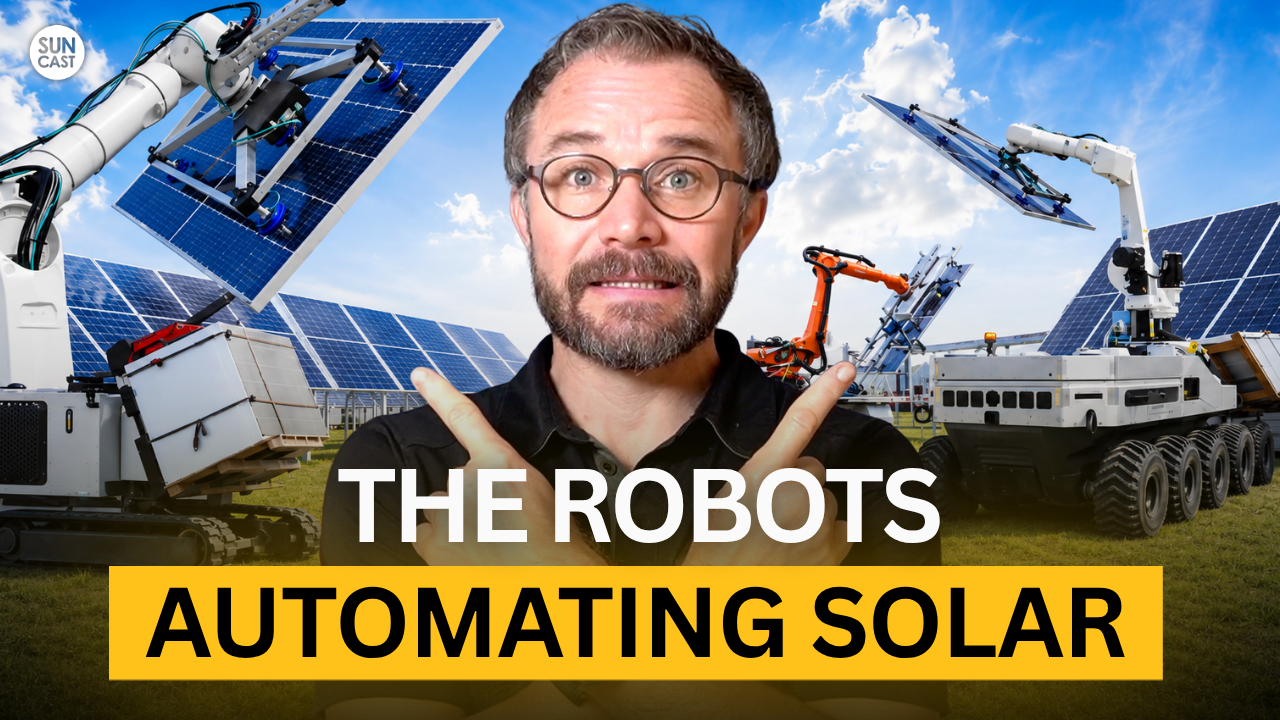
Solar construction has always depended on experienced crews adapting to whatever the jobsite throws at them. But what happens when the industry needs to build more projects than its best crews can possibly cover?
Cody Houser has spent much of his career on the other side of that problem. Before becoming Director of EPC and Constructability at FTC Solar, he spent eight years running his own construction company, driving piles, building trackers, managing crews as large as 250 people, and experimenting with automated pile driving years before today's wave of solar robotics.
His argument for automation starts with something more fundamental than replacing labor: predictability.
Robotics can give EPCs a more reliable baseline for daily production. But Cody also explains why the opportunity starts upstream, with trackers and construction workflows designed to make installation simpler and more repeatable, whether the work is performed by humans today or increasingly automated tomorrow. FTC says its Pioneer tracker is already producing 15% faster mechanical installation by human crews, an example Cody uses to show how constructability can translate directly into EPC economics.
This conversation explores the shrinking pool of experienced field labor, safety, constructability, AI, and what Cody believes the increasingly autonomous solar jobsite could look like over the next decade.
The bigger question isn't what robots can do. It's what happens when we design solar construction around greater consistency from the start.
RESOURCES:
Connect with Cody Houser:
Check out FTC Solar:
"There will be a moment that if you're not on the train, you will get left behind." - Cody Houser
This Podcast is Free For You
Thanks to Our Sponsors
The following are Corporate Partners who have helped make SunCast possible:
Platinum Sponsor
The following are Corporate Partners who have helped make SunCast possible:

Noteworthy Quotes:
Cody Houser 00:00
When I look at these robots and I look at everyone, you know, I could say from laying out a pile to putting a torque tube in to putting rails on to mounting modules and securing modules. I see it from start to finish. Yeah, there will be a moment that if you're not on the train, you will get left behind.
Nico Johnson 00:16
Over the course of the last several hours, I've had the chance to see how these robots behind us operate, but it's one thing to see and hear the folks that are creating it tell you what they're what they're building it for. It's quite another to have someone who has a decade plus of experience in driving piles and driving people to completion on projects talk about the implications of what this technology can do to build our projects and our industry at a velocity that we desperately need. Cody Houser is one of those folks who has been building these projects at lightning speed. FTC rightly brought him in house to adapt that knowledge to the constructability of their product. Cody, I've had the chance to hear you talk throughout the day about the nature of these products. Could you first tell us the role that you serve at FTC and what about your career gives you the insight and the background to be able to bring such knowledge to bear at FTC? Yeah,
Cody Houser 01:16
sure, Nico. So for me, I started in the sales team. Realized I have a gift that's probably a little further than sales, and understanding, you know, how labor is built out in the field, how trackers truly get built from the field perspective. Moved into more of the technical sales because I can speak so well around the tracker, you know, the components, the advantages. We have some major advantages for FTC and Pioneer. That for us, you know, when I look at it in the field, it makes it really easy and really simple. So, evolved into a role that's kind of new for us-a hybrid role, you know, really exciting as the director of EPC and constructability. Right. So I will actually help to be the glue guy between the actual sales team, yeah, the engineering team, pricing, all the way to just how we enter a potential design and like really go to engineer the whole site from the get go. Yeah. So I'm the in between reviewer. I say, hey, you know, an engineering team wants to do it like this, but how does the EPC want to do it? Yeah. For me, how does the EPC want to approach a project? And they'd much rather work with us in the sense of how they view it. Yeah. And how labor crews are truly built out, and how the system would you know ultimately give them some major advantages from the mechanical install, but simplicity with the the workforce and labor force today. So my new role, you know, basically I am the guy that helps bring the real world to FTC and more or less review as an EPC reviewer to our team to ensure that we're providing a solution that's actually what we would prefer to build ourselves and with our partners.
Nico Johnson 02:47
Give me some context for the experience, the breadth of experience you bring to this role.
Cody Houser 02:52
Yeah, so I personally owned a company prior to this. I was with some big EPCs before that, but for about eight years, owned and operated a small company, drove piles. Ended up building a lot of rack. I've touched every rack out there myself.
Nico Johnson 03:05
Yeah.
Cody Houser 03:05
So as you can tell, for me to sell Pioneer, you know, 1p against competitors, I built says a lot. When I took the role, I said I want to come build it first before I even join FTC. The day upon completion of building it, I was full FTC. Wow. So, we got really advanced in pile driving. For me, pile driving sets the stage of a good tracker build.
Nico Johnson 03:26
Right.
Cody Houser 03:26
So, from the core, I was the foundation guy.
Nico Johnson 03:29
Yeah.
Cody Houser 03:30
I implemented eight years ago. I was the first individual outside of Vermeer and Trimble. I partnered with all three to run a pilot program where I had pile drivers, as we see today, physically moving themselves from point to point. So I was the guy that saw it. So I saw it far in advance. I spoke with Tom with Siv.
Nico Johnson 03:48
Yeah, I
Cody Houser 03:49
saw what he was doing. We were using these kind of advancements and using technology to go build, you know, very efficient and very lean with you know high quality installs. So for me, eight years of driving piles, started building rack, and then I had developers and EPCs see what I was doing, and I started consulting at the almost gigawatt level as a small guy, but teaching people these efficiencies that now we're trying to blend a tracker to be really efficient long term via robotics, and that was my vision since day one. So do I see the tracker, you know, from my past being built in whole by various, you know, you know, robotics companies in the near future, absolutely fantastic, exciting for me and where I came from. I can
Nico Johnson 04:30
only imagine, and you've managed crews up to you know hundreds. Yeah, what is
Cody Houser 04:34
250 guys before? You know,
Nico Johnson 04:36
what is what? What would having this kind of technology for you back then, have done for for the efficiency or effectiveness of the team. Like, what does it add to a to a company like yours?
Cody Houser 04:47
You know, it effectively creates a known baseline day to day that you can reliably stand behind.
Nico Johnson 04:57
Yeah.
Cody Houser 04:57
So when you go to estimate a project and you. Look at schedule. You anticipate daily install rates, but all of a sudden you get workers in that are all temporary workers that are local that have never seen a tracker. For instance, you know. So for me, after lunch, you're tired. People are getting hurt. 3o'clock to 5o'clock. You may as well send people home. Yeah. When I look at a robot, it doesn't have feelings. It doesn't have emotions. I don't have people complaining. They don't have a funeral or wedding to go to.
Nico Johnson 05:26
Yeah.
Cody Houser 05:26
So for me, the reliability of saying I did this job aggressively. Right. Are we going to hit the mark by the end of it? And if so, being aggressive in winning more projects within that. So for me to take a labor force and make it more reliable from the non-physicalities, but the ultimate output of completing what was due every day on your board, and like basically effectively with the highest quality. Yeah, to where an owner developer long term can look back and say, "Well, we know based on the install, we had the highest degree of product, you know, completion is available at the time. So,
Nico Johnson 06:05
I was reflecting on a project I was consulting on early, sorry, late teens. It was a project up in Northern California, and on December 13 of a what was effectively like a 27 day sprint to turn on by the 31st, the foreman, the main main job supervisor, who was essentially running all day on site, slipped on ice, broke his back, effectively ruined his career.
Cody Houser 06:31
Right. Yep.
Nico Johnson 06:32
I was sort of watching the technological advancements here and how, if we had these devices in 2018 when that accident happened, it wouldn't have happened,
Cody Houser 06:41
right?
Nico Johnson 06:42
Because the crews would have been able to take the same pace all day long. The robots are doing the heavy lifting. The foreman isn't running around like a turkey with his head cut off, right? I feel like there's a level of the industry of how we've built in the last decade of chaotic momentum,
Cody Houser 07:01
right?
Nico Johnson 07:02
Right, and everyone's sort of falling forward.
Cody Houser 07:04
That's it, and the road
Nico Johnson 07:05
rising to catch them in many ways. Like just the momentum of the industry, we're at a place now that we're we're at a press in the press was in the industry where the the needs for the industry are are vastly outstripping our human capital, not our not our resources, but our human capital. As you've gotten deeper into the robotics sector, where do you see the robots specifically? And maybe you can name some of the folks that you see here having the greatest impact over the next 12 months.
Cody Houser 07:32
First off, I'll touch on this with you real quick, and then I'll fall back. Yeah, sure. Our current labor force.
Nico Johnson 07:37
Yeah,
Cody Houser 07:38
that we're seeing right now in the next 12 months, I've seen it in the last two years. These guys have been in it for 20 years. The best of the best.
Nico Johnson 07:46
Yeah,
Cody Houser 07:47
you don't have many of those shoes getting filled again. Yeah. First of all, second of all, there's a lot of other areas you can go make good money now without being in the sun physically
Nico Johnson 07:56
working. Yeah.
Cody Houser 07:57
And so as I see the loss in the labor force, I think we're to answer your question. This this kind of falls back in is you're going to find that when the bigger companies start taking on more megawatts and more projects, you never have the A team that you're known for on the projects that you normally say. Wow, when they show up, they're always the A team. Well, that's not the case. You do have the C team now, so to revert back and implement the leaders that have to teach those massive teams, those leaders can now revert over to something that's so consistent that they can always rely on, and it's not physically based in the field on an hourly basis. It's supporting in a machine, a robot that's potentially going to go do all of the heavy lifting for it, so now it's more sophisticated around how do we structure our workflow with in the next 12 months with the panel placement machine, for instance. How do we implement that into our daily workflow that's not based around labor and crews, but actually purely in the field? Start building out a structure that relies on this task is done in the next 12 months, and we're going to build the flow of our entire company's field structure around that. Yeah. So, so that's where when I look at these these robots and I look at everyone, you know, I could say from laying out a pile to putting a torque tube in to putting rails on to mounting modules and securing modules, I see it from start to finish.
Nico Johnson 09:24
Yeah.
Cody Houser 09:25
So will that be 12 months? Maybe not. But should the push, the openness to the potential of what it could be from the tracker side, from the EPC side, there will be a moment that if you're not on the train, you will get left behind. So that's kind of the 12 month outlook is I expect to see a lot more panel placement for sure.
Nico Johnson 09:45
Yeah,
Cody Houser 09:45
how do we do some time studies and understand what consistent 24 hour running for layout looks like? You know, so there's a lot of things that I I'd like to say in the next year we will see really come to light. As to what the like key potential reduction in labor, increase in efficiencies in daily production looks like.
Nico Johnson 10:08
Do you see the technological advancement improving intangibles in the bid, like insurance?
Cody Houser 10:14
Absolutely. When I look at the safety-related insurance potential items that can be had within a project when things go really wrong, just from a lack of supervision, people pushing people too hard in the heat, guys doing simple labor that maybe piles are big and they've lifted them too far and they fall down, and your face all of a sudden, and you know it it cascades the more you push people.
Nico Johnson 10:40
Right,
Cody Houser 10:40
and for me, when I look at insurance premiums, when you have a reliable system that is so safe that you've never put a human in the way of a potential danger mechanically, at least, you know, I think that you're going to see a lot of EPCs realize that their safety rating and winning jobs on their EMR rating is
Cody Houser 10:58
as important from a quick review from a major owner developer as anything.
Nico Johnson 11:02
One of the things that I'm surprised by is just how advanced the technology is. But more importantly, I was talking to I remember Aussies, the guy from Aussies, were saying they've deployed just in the U.S. over 4 million modules with their module placement machine. And he said, and he was very specific to say, and that's not including India, where they basically don't have rules around this, or laws, or restrictions.
Cody Houser 11:22
What do
Nico Johnson 11:23
you think people are underestimating about how fast this is all moving?
Cody Houser 11:28
I think a lot of the field techniques these days are still old school, as I would call it. That the superintendents and foremen that know how to do it,
Nico Johnson 11:36
yeah,
Cody Houser 11:36
same way are sometimes hard pressed, a because their labor force diminishes. Some maybe it's people that they want to have a job, but more so, I just think that your, you know, your overall efficiencies that are the output of these machines is just you cannot deny where it's going. And if an EPC doesn't want to at least accept it right now, I think you're you're very foolish to do so.
Nico Johnson 12:02
I would describe Pioneer as robotics ready. Is that fair?
Cody Houser 12:05
Yeah, very fair. I think when we look at design and even our future roadmap right now of components, it's like I said, the robotics teams are, you know, trying to collaborate with us. Well, we we are doing the same in reverse, and for us to not be on the cutting edge of how every piece could be installed and understand how to illustrate that to the guys that can help us do that, we're only hurting the entire industry ourselves by making the labor force continue to do some of the hard tasks.
Nico Johnson 12:34
Yeah, I remember when I was at Trina, there were some things like being PID free or having a certain Pascal rating and a wind uplift rating, like you couldn't install in Miami-Dade County without 140 mile per hour wind rating on the rack and on the module, right? A certain Pascal rating on the module. Do you envision a future where RFPs and EPC requirements have a level of robotics readiness?
Cody Houser 12:58
I know they're going to favor the groups that do.
Nico Johnson 13:00
Uh huh.
Cody Houser 13:00
So,
Nico Johnson 13:01
what does that look like?
Cody Houser 13:03
You know, it's funny you say that. I talk to a lot of the tier ones on a weekly basis. You know, everyone being as intrigued as they are, showing up to this event speaks for itself.
Nico Johnson 13:10
Right.
Cody Houser 13:10
I think most of the historical robotics involved in solar has been putting a panel onto a rack.
Nico Johnson 13:18
Yeah.
Cody Houser 13:19
I think when I look at the full circle, start to finish. If you don't have every task robotically at least considered in some form or fashion right now, that you're probably behind the ball.
Nico Johnson 13:29
Yeah.
Cody Houser 13:30
So for me, when I look at Pioneer, everything we've put on it is basically has got the capability of a robot building in every step. So for me, that's a huge potential that we have not unlocked within the UPC partnerships. So when we can collaborate at that level, and I can start showing the benefits of the install rates, we're seeing 15% by humans faster with Pioneer on the mechanical lineup. Yeah, for me alone, I mean, I get chills when I say that.
Nico Johnson 13:57
Yeah.
Cody Houser 13:58
So for me alone, streamline that from the start of the clock to the end of the clock every day, yeah, and run that out over days, years, those efficiencies build margin into an EPC, and that margin either helps you get aggressive because you know where those margins are, and now you can go bid a project really aggressively with more margin because you know a certain rack is going to get you to an efficiency level that no other rack will. So for me, that piece isn't talked about. And what if they don't pass that margin on and get aggressive?
Nico Johnson 14:29
Right.
Cody Houser 14:29
What if they keep it in house? Now we've juiced a margin to a level that the company's got bonuses and making money that they haven't seen on a normal solar project yet by simply taking a rack and pairing it with the right robot,
Nico Johnson 14:42
you know one thing that was oddly underplayed. I'm gonna say downplayed today. AI,
Cody Houser 14:49
AI was massively down. People are getting so used to it,
Nico Johnson 14:52
yeah,
Cody Houser 14:52
that you don't even realize everything within the working pieces has fully brought it in house and is just on almost all these machines. Yeah, like.
Nico Johnson 15:00
Nobody was leading with AI in their descriptions today, and yet none of these companies exist without AI.
Cody Houser 15:06
None at all. Yeah, yeah. Could I say what's going to happen in 12 months to five years? And I, I don't know, but where we could be, gosh, it's it's hard to hard to believe that we're here. I've waited for 10 years for this moment. So
Nico Johnson 15:20
I'm glad you said that. So, finish this sentence, and we'll finish with this.
Cody Houser 15:23
Got it. And
Nico Johnson 15:24
10 years, we will think it was crazy that
Cody Houser 15:30
that a group of humans could remotely interface from their office or home,
Nico Johnson 15:40
yeah,
Cody Houser 15:41
as not only operators but just oversight to fully autonomous material handling, layout, insulation, QA, QC, 24 hours a day.
Nico Johnson 15:51
Yeah,
Cody Houser 15:53
and someone is remotely overseeing all that to the point that safety goes away.
Nico Johnson 15:58
Yeah,
Cody Houser 15:59
that you have a few leadership members out there, a few owners really happy. Yeah, and you've got a schedule that never misses.
Nico Johnson 16:05
Yeah,
Cody Houser 16:06
so that's that's where it will be. And could it be even further? Gosh, I sure think so. The
Nico Johnson 16:11
way things were done for the last 15 years in this industry are going to look like Stone Age.
Cody Houser 16:17
They
Nico Johnson 16:18
are in 10 years.
Cody Houser 16:18
I think we're going to see an exponential ramp.
Nico Johnson 16:21
Yeah,
Cody Houser 16:21
in the capabilities,
Nico Johnson 16:23
yeah,
Cody Houser 16:23
through the physical capabilities, but also AI-based,
Nico Johnson 16:27
yeah,
Cody Houser 16:28
like being able to interpret quick things in the field, and the robot continues its workflow. Yeah, that's that's the moment that everything begins to be believable as an NPC that you trust in the machine climate. So the trust and comfort becomes the key moment when everyone's jumped off the ledge. All the EPCs agree this is working, and then you're going to see the influx of cash into the space even harder, and then you see the ultimate result, and that's fully autonomous built.
Nico Johnson 16:55
And the true emphasis of the lexicon of the word, Amen. Yeah, be safe. Got it. Yeah, thanks, Nico.
Cody Houser 17:03
Thanks.
Nico Johnson 17:04
Twice weekly, we deliver conversations with founders and leaders on the front lines of the clean energy transition, and we're here bringing this content to you each and every week free of charge. Of course, it's not free. Our sponsors help pay the bills and keep the lights on, so that we can help you build your legacy in the clean energy transition, and so if you'd like to say thank you to them, or learn more about what it is that they bring into the world, or perhaps see how you could reach 1000s of listeners twice a week just like they do, check it out at Suncastmedia forward slash sponsor. Remember, you are what you listen to. Thanks again for showing up, Solar Warrior. It's half the battle.

Nico Johnson
Entrepreneur & Podcaster
In my 20 year career, I've worked with dozens of entrepreneurs, intrapreneurs and professionals in transition to clarify their mission, set or stretch their goals, and work through the barriers to their growth.

Latest episodes

We’re Excited to Hear from You!
Don’t hesitate to reach out—whether you’re here to learn, share ideas, or work with us, we’re ready to connect.