
We'd love if you'd leave us a 5 ⭐ rating & review and it's never been easier: www.ratethispodcast.com/suncast
An 800-megawatt solar project can require hundreds of truckloads of equipment. Deliver them too early, and materials overwhelm the site. Too late, and construction crews sit idle. At that scale, execution matters as much as the equipment itself.
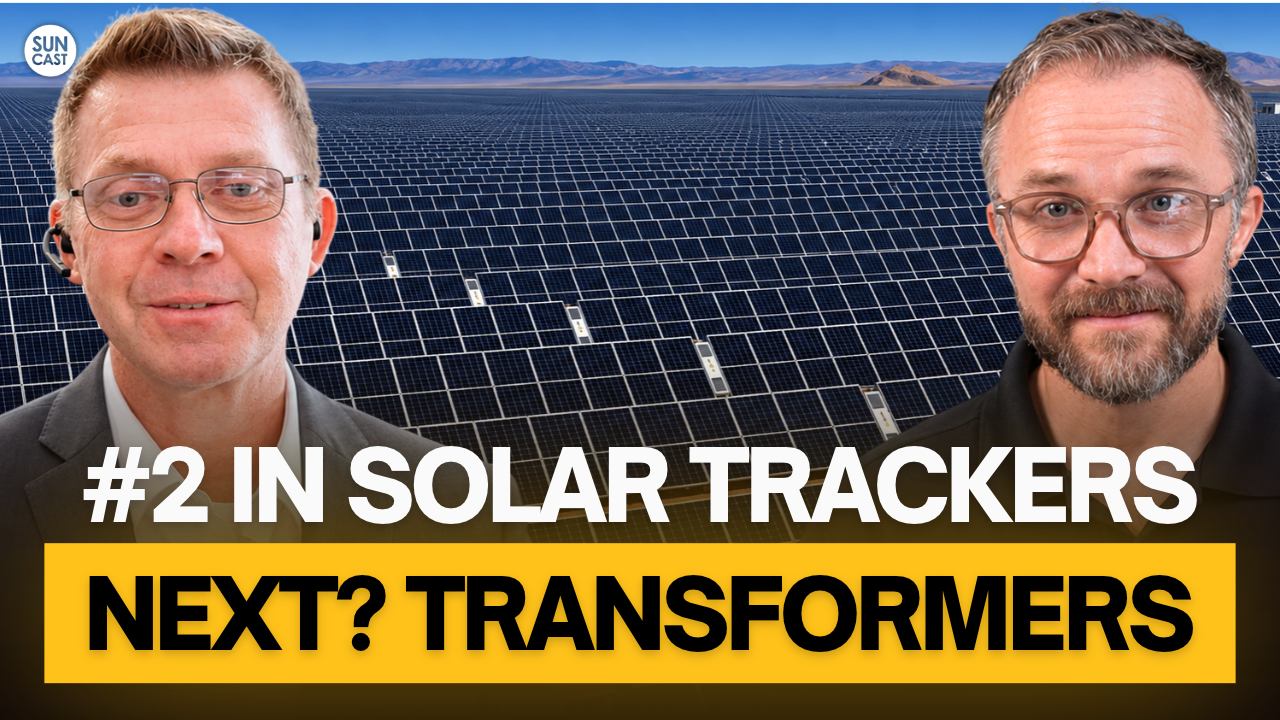
GameChange Energy has grown into the world's second-largest solar tracker supplier, with a rapidly expanding global business. But how did they build the systems, teams, and customer relationships required to deliver at that scale?
CEO Phillip Vyhanek brings decades of manufacturing and leadership experience, including time at Ford, Honeywell, and Solectria. He's applied lessons from those businesses to help GameChange grow while maintaining the flexibility that large energy projects demand.
In this Tactical Tuesday, Nico explores the operating decisions behind GameChange's growth, from manufacturing quality and supply-chain management to building an entirely new transformer factory and empowering teams across international markets.
Expect to learn:
🔹 How manufacturing rigor and better logistics prevent costly construction delays
🔹 Why GameChange chose to build a transformer factory instead of acquiring one, and what makes a new supplier credible
🔹 How engineering flexibility, equipment reliability, and serviceability affect project economics over decades
🔹 What it takes to build and lead global teams that can consistently deliver on customer commitments
For developers, EPCs, asset owners, and business leaders, this conversation offers a practical look at what it takes to scale an organization without losing the ability to execute.
Listen in for the lessons behind GameChange's growth and what you can apply to your own business.
RESOURCES:
Connect with Phillip Vyhanek:
Check out GameChange:
“You focus on the fundamentals, and you do them very well.” - Phillip Vyhanek
(00:00) Scaling Partnerships in Solar Manufacturing
(02:13) From 1 MW Projects to Gigawatt Scale
(07:08) Applying Automotive Rigor to Solar Hardware
(11:55) Logistics and Staging at Massive Scale
(17:50) The Operational Shift from COO to CEO
(21:23) Unlocking the Transformer Bottleneck: Build vs. Buy
(27:55) Speed and Capital Agility of Private Ownership
(32:40) Proving Bankability and Clean-Slate Factory Design
(39:49) Integrating EBOS to Eliminate Construction Headaches
(42:26) Designing Trackers for Dynamic Module Changes
(45:40) Mitigating Extreme Weather and Hail Risk
(48:38) Expanding Internationally Through Empowered Local Teams
(52:46) Transactional Discipline and Manufacturing Culture
(55:43) Bipartisan Education and Domestic Manufacturing Policy
(1:01:14) Earning Customer Trust Before Revenue
This Podcast is Free For You
Thanks to Our Sponsors
The following are Corporate Partners who have helped make SunCast possible:
Platinum Sponsor
The following are Corporate Partners who have helped make SunCast possible:

Noteworthy Quotes:
Phillip Vyhanek:
And they came to tour our facility. They were like, who is this game changer? Are you guys really in this market? Right. And they see our factory, and they're like, oh, oh, you're in this market. They're like, we have never seen a transformer factory that looks like this before.
Nico Johnson:
A solar equipment purchase comes with a promise about cost, delivery, performance. How do you judge whether the company behind those promises is gonna deliver? How do you scale your business with the right partner? I hear that conversation a lot as I talk to developers.
And today, I wanted to talk to someone that I've observed in the industry for more than a decade, be a partner to developers from power electronics to infrastructure and beyond. is the CEO of GameChange Energy, which today sits in one of the top spots globally as a solar manufacturer. Phil has led businesses across manufacturing and solar, including many of you remember his time at Selectri, a company that sort of established what it meant to be an American manufacturing entity at a time when that wasn't the du jour thing to be. I wanted to understand how that experience shapes the decisions that he interfaces with every day from his team to their partners downstream, how it influences the growth of a company that, for many, has seemingly come out of nowhere to be a global dominant player, and how developers and project owners can learn from the many ways that Phil and his Phillip Vyhanek have seen the market expand, grow, contract, and reform.
We'll get into things like constraints around transformers and overlooked project costs, engineering for extreme conditions that many of you are facing today, and the leadership required to make customer commitments credible. This episode is one that I've looked forward to for a long time. Phil, welcome to Suncast.
Phillip Vyhanek:
Thanks so much, Nico. I am, I'm thrilled to be here, and I'll tell you with that introduction, I am so excited to hear you talk about partnership because that is one of our founding principles, is we really do, and I and I don't say this lightly, we fundamentally believe we are a partner for our EPCs. We are a partner for the the independent power producers and the owners. We are here...
Yes. Of course, we wanna succeed. Yes. We wanna grow our business, but we want to see our partners be successful.
Nico Johnson:
Indeed. You have watched solar grow from what many might say is a cottage industry in your inverter days into a massive global industry that it is today. I'm curious what changed most in your view about what a customer needs to trust as they're committing to a project and a supplier.
Phillip Vyhanek:
So I have been in this industry for, I think, since 2010. So about sixteen years now. And I and I and I I don't often reminisce about the past because there's so much to do today. I don't have time to talk about the past.
But it is fun to think about, like, those early days at Selectria of making inverters in The USA. And I'm telling you, like, if if we were doing, you know, a small rooftop job or a one megawatt job, a one megawatt job was just amazing. Like, that was...
Like, it was just showstopping that we were doing a one megawatt job. You know? And, you know, and today, we've got game changers. We've got, you know, 65 gigawatts of projects that are deployed.
You know, we'll we'll do 10 gigawatts in the in The US. And and if you look at in The US alone, average sizes are 250 megawatts. So, you know, the scale of where we were at sixteen years ago to where the industry's at today is just...
It's a it's a bit mind blowing.
Nico Johnson:
It's massive. I know I was, I was an early acolyte of, sort of all that. So, like, Trio was doing, you don't know this, but Allison and I deployed those 250 kilowatt NEMA four x inverters to the Target stores in Hawaii back in Yeah. God, 2009, like, year before you even joined Selectria.
You've been a part of the kind of leadership that it takes in our industry to make bold decisions to to champion credible path forward and even how to build a bankable brand around a category that investors are still trying to get comfortable with. And trust sits at the at the center of that. I think that that was something that, you know, I have, been able to observe over the years that those brands like GameChange, Selectria, that have been able to scale, have scaled their capacity for delivery, sure, but their capacity for building trust in an environment where, you know, things run tested.
I'm curious how you think about the leadership component of that as you're asking your team to go into a market and gather information and plant seeds that lead to the kind the kind of credible long term partnerships that you've been able to build.
Phillip Vyhanek:
Yeah. So so you you you really think about the industry, and you think of how many players, especially over the last sixteen years, that have come into the business and have exited the business. And that bankable partner look at...
When we build in a solar asset, right, this is a thirty and forty year asset that should generate power, create energy for the grid for many, many, many decades. Right? And so having the right partner who not only is standing behind you during those initial phases of the design, of the engineering of delivery and commissioning, but also for the ten to twenty to thirty years after that to support those job sites because they need to be supported. They need to continue to operate.
You know, I think we we...
Again, we think about it as a partnership, but really a lot of it comes down to very fundamental things. Right? I I think about businesses is not incredibly complicated. Right?
A lot of it is positioning yourselves in the right place in a market that you truly believe in, and I think one of the things that our employees at at at GameChange, we really we really have a passion for what we do. We believe that what we do in the solar industry is good. So, yeah, it's good for business, but it's also good for the planet, and and repowering the planet is something I think that that so many of us live by and are motivated by on a on a daily basis. I think it becomes really fun, but it also becomes just doing the fundamentals.
Do the basics. Right? What do we need to do? We need to engineer a solid product.
We need to constantly focus on costs and making sure that we're delivering a cost effective solution. We need to partner with our EPCs to make sure that construction goes simple, goes fast, goes seamlessly. Right? It's not just, oh, it can go together fast, but do you have the right parts at the right time to to build the site without interruption?
Right? And then long term, it's partnering with our owners and saying, are we delivering the most energy? Are the sites operating reliably at a at a...
At an extremely high level of availability and doing that for the long haul. That sounds very simple. Like, it sounds like basic stuff. I I...
There's no there's no revelation that anybody's gonna be writing down and said, wow. There's the secret sauce. Right? But I fundamentally believe that you do the fundamentals.
You focus on the fundamentals, and you do them very well. And if you if you do that, you don't need to do anything all that fancy to be incredibly successful.
Nico Johnson:
So you have a lot of, what some might think, you know, think on as, like, large corporate experience all the way back to your Honeywell days. I'm curious. When you reflect back on your presolar days, is there someone early in your life or career that taught you sort of the fundamentals around the... How to take responsibility and leadership as you build a team or, build and run a business?
Phillip Vyhanek:
So if I think back again, if I if I think about where I started, right, I started out as an engineer at at the University of Wisconsin, mechanical engineering. I started working at Ford Motor Company. And I have to say I've loved every company that I've worked for, and I've...
I I have nothing but good things to say about all of them. But at Ford, it really taught they had fundamental training programs of fundamentals about manufacturing, about engineering, about, you know, design for manufacturing, manufacturing expertise, statistical process control. So there was just...
In the automotive industry, there's just an enormous amount of manufacturing rigor. And I and I have taken that with me my entire career, and I think Yeah. So so most recently, like, if if I think about coming to game change and the evolutions that we went through from gen one trackers to what we produce today, so much of this was instilling manufacturing discipline, expertise, metrics, you know, when there was a failure in gen one, going down to root cause analysis, driving that down. Like, I I can remember being with with our our contract manufacturing partners and being with them on a weekly call, like, going through them, like, I wanna see first pass yield.
I wanna see exactly everything that failed. I wanna see a root cause of what happened on the factory floor and what's the corrective action, and how are we doing it, and how are doing controls? So, like, it's like...
So at Ford Motor Company, there was just this manufacturing discipline and rigor that I take through in in what I go through it. Then I went to Honeywell, and, of course, I finished my MBA at Michigan. And so because I had my MBA, of course, I had to move into finance because that's what she had to do. Right?
So I so I moved in...
I...
Of course. Right? But you moved into a role now where you started to look at not just the manufacturing discipline, but the but the finance and what was the implications of stuff. And and I worked kind of as an internal consultant in Honeywell and and worked with the factories and talked about building down their cost structures and understanding what was their cost and where were they making money where they weren't making money.
Right. And that just set a a baseline for how do you make good business decisions? Wow. Where's good investments to make?
Where do you not make them? What are the things that that that matter and don't? So so that, again, was just a base on experience and understanding that I that I continue to carry through, and it and it influences all the decisions I make on a on a daily basis. I was running a factory and then doing supply chain management.
I was the director of supply chain for Honeywell. And that was, again, a lot of negotiations and partnerships. Like...
And I and I really do even in those days that, you know, we're going back.
I'm not gonna tell you how many years because too many years ago. But there was still...
Like, it was a partnership. Right? I thought about the vendors and relationships. Why do you pick certain people to be your partners, and and how do you manage those long term relationships?
Those were all critical. So there's there's not one person, I think, who stands out. It was all those experiences that build on each other one after another after another.
When I came to to New England... I live in New Hampshire today. I've lived up there for twenty five years, but I moved there originally to to run a wireless company for a private equity firm, and that became... That was a real entrepreneurial spirit.
Now this is a a much smaller business than what what I had at Ford and Honeywell. Not much infrastructure. So the...
You are you are picking yourself up by your own bootstracks, but it really now...
Now now you're really in an entrepreneurial environment and making decisions quick, but it's still is the same fundamentals of, you know, the disciplines about manufacturing, the disciplines about design, and then the and then the partnerships both with our supply chain and and with our customers. So so much of it. At the end, I I I think a lot about what you can train, and you can train a lot of people on products, designs, systems, but the interaction of how you deal with with people. Right?
Your parents taught you that. That's...
You you you learn that at home. Yeah. So so that's that's probably the only...
That...
That's where you guess...
You gotta give credit where credit is due, so that's where that goes.
Nico Johnson:
You know, so much of scale and growth is change management, as you point out. For many, for every OEM, those that have survived and those that have gone out of business in the last fifteen years that we've been able to observe, they've had to put the wings on while the airplane is, you know, flying. Because in many ways, we're, you know, building an entire new industry, and the smart companies have leveraged, executives who have deep experience in supply chain manufacturing from automotive and other, other sectors.
I think that if you sense us, the industry, those of us that have been around a while, companies like GameChange, you know, homegrown brands taking on already sort of existing incumbent manufacturers in the industry, really were emblematic. I think Game Change is one of those companies that's, like, emblematic of the solar industry spirit, this sort of, like, almost cowboy ish, like, approach of, like, we can do anything we put our minds to, and we are gonna change the world. I think it's easy to say that sort of...
That that Game Change and and others like it have have really championed this sort of can do spirit and will. Some of the things we're gonna talk about today, it's, like, still mind blowing to me that you guys, like, have grown in the ways that you have. What I...
What I'm curious from where you sit is at some point, a company evolves and it has to change. I think for many, myself included, I think I shared with you on our call, I was blown away when I found out that GameChange was number two in the world. I was like, wait a minute. How did I miss this?
Like, how did that happen? What had to change inside of the company to deliver at the scale that it does today?
Phillip Vyhanek:
Yeah. So, I mean, first off, let me let me give credit to... So so Andrew Wharton, who's our founder That idea of anything is possible, and we can do anything. I mean, it it really... It... It's just it emanates from every part of him. Yeah. Right? He has a fundamental belief and confidence both in himself and in the team that we we have here that we can do at... We can do the... We can be the best.
And so if you think about how game change started, really, it started when Andrew was developing jobs
And buying racking solutions and was so frustrated with what he could buy, what the...
What it cost, the quality that he got, that said, like, hey. I'm gonna I'm gonna just build one for myself, for my own job because I just...
I'm so frustrated. And so he did, and he realized pretty quickly, he's like, I can build a better product at a better cost than anything I can buy today. And and he had the belief that he's like, we, GameChange, can be the best in the world at this. Like, we can do this better than anyone else even though we weren't a a racking company.
We weren't a steel company at the time, but he fundamentally believed we could. And, you know, as you said today, we're we're number two in the world, and and somehow we've we've gotten to that point. Yeah. And this is a comp...
Thing that many companies go through from being that entrepreneurial, let's just go get it done, right, to scaling to the number two in the world, supporting the the largest IPPs and the EPCs, you know, in in the planet, right Is scaling the systems and processes. Right? So so you've got to start getting to the point where you can empower more team members to make decisions, where you've delegated authority to people, and you've put processes and systems and rigor in place that allow you to execute at a scale never imagined when you first started the business. And I think that's that's that's something that I think I'm really proud of what game change has done over the last, you know, ten years of scaling those systems, those processes, putting in a disciplined, rigorous ERP system.
One of the things that that we've just invested in enormously is just how we deliver product. So if you think about a a solar site, more trucks are gonna come from the tracking company than anything else. Right? That's...
The vast majority of the material that's gonna be delivered to that job site is gonna be is gonna be Because
Nico Johnson:
of the scale of the product itself?
Phillip Vyhanek:
Because of the scale. You've got to deliver all of the posts, all of the foundations, all of the torque tubes, all of the the purlins or the rails, the drive systems, controllers, all this stuff. So we're gonna deliver hundreds and hundreds and hundreds of trucks to a job site. Yeah.
And they need to be staged in sequence. So if I think about large job sites, we're gonna deliver an 800 megawatt job site. Right? You may have multiple lay down areas.
You're gonna build that out in a phased approach. So you've gotta have a rigor and a discipline of how you, first of all, deliver those parts. Deliver them in the right sequence. Deliver them not so early that there's no storage space to put them, but also make sure they're never late.
Because if they're late and you idle a construction crew, it's it's just...
It's...
The cost is incredible. Right? So you you can't do that. So investing in the rigor, and that means a partnership both of our system investment, but then communications and a uniform system where there's one source of truth for all of our factories, for our project management, for our customers' project management, for the logistics companies that are delivering that material to the job sites so that everyone's on the same page all the time.
Yeah.
You know? And and then just the engineering discipline of...
You know, we're engineering massive, massive projects. Right? Are all the engineering calcs correct? Are we doing this stuff?
We're the engineer of record on the on the vast majority of sites. So when we're doing all those stuff, there's just a level of discipline, rigor, and thoroughness that has to be done on on every single job. And I think I'm really proud that we've evolved from that entrepreneurial side to, you know, one of the one of the world's largest manufacturers.
Nico Johnson:
Yeah. It's remarkable. I wanna I wanna draw sort of a connection.
When you came out of sort of mechanical engineering, went to get an MBA, you rightly identified, like, okay. Now I've gotta go down finance path. It is what allows you to sort of enter into the executive suite, as an engineer and say, okay. Now I understand not just how to make, the technical decisions about what can work, but how to make the business decisions about whether it should be so at all. After years as president, which you might think of as, like, the mechanical engineer of a business, like, the guy who makes sure that all the pieces work together. President is, the doer, you know, like, runs the business. What did becoming CEO require you to stop doing yourself?
Phillip Vyhanek:
I've always believed, in empowerment. Like, I'm... If if I ever felt like the business was dependent on me I view that as a problem. Right? So it should never... The the the business, especially at the size and the scale that that that game changes that, we should never be dependent on on on one person. So, for me, there's a little bit of difference in in the focus.
A lot of what I I focus on today, is not...
Like, when I first got here, I was so involved in project execution. So involved in supply chain development and the suppliers and partners we had. A lot of it today is is based on the partnerships we have with our our IPPs, and our and our and our owners. Right?
A lot of it is also looking at where else do we expand to? What else can we go do? So, you know, and to that point, they...
You know, we've expanded beyond trackers. Yeah. Right? And and because although we will never give up our our focus on the tracker business, and we we love that space, but there's so many other things that we can add value to.
So, you know, when when we acquired our our EBOS company, eight months ago, it was such a natural synergy of, like, of course, like, all of the wiring, wire management that's all attached and associated with with the tracker and the structure of the system, that that makes logical sense for us to go into. We were lucky that we were...
We found a great partner with the old SolarBus division that we that we acquired. That was just a phenomenal fit. We got a great product line. We got a great team, and that just...
It it added value. But So, you know, from when I was president, and chief operating officer to CEO, you know, what's the big delta? It's it's not a massive delta. Right?
I mean, you're still involved in making sure we're making good, solid business decisions. But, really, I think when I was president, a lot of the focus...
And I don't know what's so much about the role as much as it was the evolution of where we are at as a company, but it was about putting in the right processes, the right systems. It was about making sure we had the discipline around our supply chain, project execution. I mean, we we spend an enormous amount of time on those fundamentals. We've got a lot of that in place, and a lot of that we've built great teams.
We've developed people who are phenomenal leaders in the organization, and that really has allowed me to to not be as involved in that on a day to day basis and spend a little bit more time looking at the at the broader marketplace. You know, I I sit on the board at Sia, and it looks...
It allows me to look a little bit more, holistically at the market as a whole, not at just how we execute internally.
Nico Johnson:
I wanna pull a thread here on... So let's take that operating judgment into a decision that really caught my attention lately, and that is the decision to get into transformers. A a lot of folks talk about the bottlenecks that throttle project execution, our need to accelerate the industry, etcetera. There are many different verticals that you could apply the operating discipline that game change has developed. Why did transformers become a sort of project defining issue, and how did you make the call that the existing supply chain wasn't gonna cut it, but but that you guys could do something meaningfully different?
Phillip Vyhanek:
It is an interesting thing because it still seems like a little bit of a of a divergence from everything we're doing with trackers. However, really, again, we we talk about our partnership with our EPCs and our owners, and we talk to them all the time, and we we talk about how do we do things better and different. And one of the things they expressed to us was a bit of frustration over lead times, responsiveness for transformers.
It was clear as we did our research that there was a a bottleneck and a constraint in the transformer marketplace. We have really strong relationships with our EPCs and our IPPs and the utilities, and we said, wow. This is this is an area that's a pain point for them. Can we go address it? Can we help fix that?
When you look at it and said, okay. How does it... It's got so many adjacencies to the solar business. Right?
Whether you have your transformer on an inverter skid or whether you're a smaller DG job and you're connecting in it at at distribution voltage or you're doing battery energy storage, there...
There's just all these applications for a transformer. And we said, well, I think we can we can do this. And so we decided, well, where to do it? We know we wanted to be cost effective.
We wanted to do it in a place that had great relations with The US. So so we picked India, and we stood up that factory from the ground up. Like, we we built it ourselves. Right?
We hired some phenomenal leaders who've got thirty years of manufacturing transformer experience, and we are producing transformers today. Yeah. We're we're building.
We're shipping transformers, and it's How long
Nico Johnson:
does that take?
Phillip Vyhanek:
It took us about...
Probably about twenty four to thirty months really to go to go get it done. We started it about three years ago, but from when we really kind of broke ground at that facility to shipping product, yeah, probably less than twenty four months.
Nico Johnson:
Yeah. So, Phil, in your BMBA program, you no doubt studied case studies on build versus buy.
Yeah. At at the stage that game changes, at the the sheer volume of inbound your team receives, you got plenty of problems on your hands. Like, the the idea of going and starting an entirely new business that you build versus just buy one, like, walk me through the sort of the economics of that. What tipped the decision towards building?
Phillip Vyhanek:
Yeah. So, you know, what tipped the decision was really we we went down an acquisition path as our primary.
That's really where we started. We thought, hey. We... First of all, we like the segment. We thought there's a value there. We thought both between solar build outs, but between battery energy storage, grid upgrades, the transmission, the t and d infrastructure that has to be invested in. Like, it's a it's it's a good solid space, and there was room for another player.
So we looked at doing an acquisition. And what we clearly came to was as we looked at the potential partners, there was there was two things. Either valuations were, honestly, just incredibly high.
Right? Or what you were buying was honestly an aging asset, something that was not new, wasn't the latest technology, was a bit One down and potentially kind of neglected and underinvested for a while before looking to make an exit from it. And so we just...
And then we said, okay. Like, let's just run the numbers and say, what if we just built it? And and the reality was we were able to to build a new facility much more economically than we could acquire. Now it did mean it's a little bit longer lead time for us to be in the market because we had a...
We we had a stand up that facility. Like, we literally poured the foundation, on the building and, you know, built the walls and and all the equipment and everything else. But but what we have today now was a, you know, a a beautiful brand new clean facility with brand new equipment with all of the latest technology Yeah. But with a super experienced team who's been building transformers for twenty plus years that we've been able to recruit.
And I think when our...
When both our customers and our...
Even our suppliers, I think it was kinda interesting when we're looking at at suppliers, and they came to tour our facility.
They were like, who is this game changer? Are you guys really in this market? Right. And they see our factory, and they're like, oh, oh, you're in this market.
Nico Johnson:
Is it real?
Phillip Vyhanek:
Like Yeah. Yeah. They're like, we have never seen a transformer factory that looks like this before. So... Yeah. So it was just... It it ended up being a really honestly an easy decision because what was available to buy
Just wasn't that attractive, and the investment was reasonable to to start
Nico Johnson:
it up.
I have two questions as an investor.
What expertise did you have to bring in in in order to be comfortable with making that bet? Because I just don't under... I don't know enough to believe that there's transferable skills from the existing team to a transformer business.
Like, help me get comfortable with that.
Phillip Vyhanek:
Yeah. I mean, part of that part of that was we needed to bring in transformer experts. Right? We did that. Like, we knew it was a good business case. We knew the fundal market was solid.
Nico Johnson:
We knew we had You appetite's there.
Phillip Vyhanek:
We knew we had the customer relationships. Right? What... But but what we did need is we needed the technical experts on transformers.
Nico Johnson:
Yeah.
Phillip Vyhanek:
And... But but the... And the the other reason that India made sense was there was actually... A significant amount of really high quality transformer expertise and manufacturing that's available in India.
Nico Johnson:
Right.
Phillip Vyhanek:
And then we recruited, you know, a a leading general manager from, you know, we... Of of course, somebody who was in the transformer industry for the last, you know, twenty five years, but that's but that's what's really allowed us to be so successful here is a super experienced teams who knows transformers in detail, but then... And then backed and supported by Game Change who's, like, we're enthusiastic and we're supportive, and, you know, we've got the size, scale, and and, capital to to back it and support it.
Nico Johnson:
I'm gonna go to that last point in just a second. What'd the conversation sound like inside your commercial team? Do have to build a new commercial team? Did you get... Go get, like, preorders from existing customers? How do you... You have to justify this to the board.
Phillip Vyhanek:
Don't forget. We're a private company.
Nico Johnson:
Right. Yeah. That's part of my next Yeah.
Phillip Vyhanek:
So so we we we do have an advisory board that that is absolutely phenomenal, but we also have very centralized decision making.
So so Andrew, who's, you know, who's our our executive chairman and founder, but he is still far and away our majority owner. Yeah. So we... It really... It's it's... We needed to convince ourselves, Andrew, that we wanted to go do this. And once once we were comfortable with it, just... I mean, the small group of us, we were able to go.
So I
Nico Johnson:
mean You had to...
Like, as I was preparing my first time, in a company that was kinda looking at building out a new division, like, we had to go get preorders of product. Like, how did you think commercially about validating this business decision for an entirely new division that's gonna cost you hundreds of millions of dollars?
Phillip Vyhanek:
Yeah. So it... It's...
For us, it was talking to to the owners that we already deal with today
Nico Johnson:
The existing
Phillip Vyhanek:
their desire for an additional option here.
Nico Johnson:
Okay.
Phillip Vyhanek:
Right? So we knew we had support from many of our existing utility partners, EPCs, and and just people that we've just built relationships with over the last dozen years, that they were open to this. Yeah. You know, so we've started on very much on the solar side.
Yeah. So everything that...
Not everything. The majority of what we've sold today and the orders that we have are on solar, smaller scale solar sites that are more on the DG side because these are medium voltage pad bounce. They're not the high voltage transformers that our utility scale guys are interconnecting with. So we we got a lot of penetration and acceptance there.
But now if I look at it, our pipeline today of of where we're bidding and where we're ordering both battery... Standalone battery energy storage and data centers are the two largest segments that, that we're quoting into, which is exactly what... Which is what we wanted.
We wanted we wanted to support solar And continue with those roots, but also be
Nico Johnson:
able to expand into additional verticals.
Makes sense. How to the other point in this sort of second investor question, a considerable amount of your sort of market competition is publicly traded companies, totally different set of, like, decision drivers for how and why to make these sorts of bets.
Talk to me about the advantage or relative advantage of being the CEO of a privately funded... Privately held company that allows you to make decisions with your partners that, maybe wouldn't be possible at a publicly traded company.
Phillip Vyhanek:
There's no doubt that being privately held gives us a lot more flexibility on what we do. Not just flexibility in terms of making the movements, but probably the speed with which we can make Yeah. Those decisions and make those movements.
So if we fundamentally believe, hey. This is a good market. We don't have to go convince 10 other people or a board or investors or analysts that we have to...
That this is a great decision. Not that that's a bad thing, by the way. There's some there's some pluses and minuses in both of those different structures, but we do get to move. We get to move quickly, and there's not a lot of bureaucracy.
We run a relatively flat organization. So when we're like, this is solid. And it wasn't it wasn't hard to figure out that that the that the payback on this and the risk reward was really positive. So, yeah, it it definitely is a benefit.
Yeah. You know, again, being private, we really focus on running the business and doing the right things. The other thing that they don't be in today does, it offers us a lot of flexibilities of how we partner with our with our customers, how flexible we are, how accommodating we are. Look.
We are in a project based business.
That means that projects have issues. Right? Projects have flooding. They have environmental concerns. They might have interconnection things.
They might have a nesting owl. Right? All kinds of things that may delay or impact their construction timelines. And that means, you know, we could be rigid and say, hey.
There's a contract, and you must take these parts, or we can be a good partner and say, yeah. We can hold on to that for a little while longer, or we can delay those shipments because of a construction issue or delay. And I think our customers, they value that view of how we we partner with them. And and we we...
That that flexibility is, useful and beneficial that...
But I'm not saying, you know, being public is...
It...
That there's this positives in, on that side as well.
Nico Johnson:
You know, one of the things that people would naturally ask is, like, well, what does Game Change know about transformers or starting this new brand and this new division? How in the heck do they even achieve what the industry considers bankability? So, like Yeah. Let's talk about what bankability looks like in practice.
Right? Like, put us sort of in the factory with you. What should a buyer look for to decide whether a...
It's a bankable supplier rather than simply promising a shorter lead time? And, you know, there's this sort of question of what can independent testing establish versus what has to be demonstrated in service.
Phillip Vyhanek:
Yeah. So it's a great question. So when I think about bankability, right, there's a first piece of it that you immediately go to, which is the financial stability standpoint. Like, do you have the bandwidth, the balance sheet, the income to go do all that?
And I think the benefit that that game change has with our tracker business and having grown to number two of the world is that we have that. Like, we've got scale. We've got stability. We've got profit.
So that allows us to have a healthy business that allows us to make investments in areas that that we really want to go do. Right? So so...
Okay. So that piece, you know, we checked the box. We're financially stable. We're large enough.
We're we're we're bankable financially. Now the question becomes, are you bankable from the technology perspective, from manufacturing expertise?
In that case, that is hiring... It's hiring the right team. Right? If we did not hire an experienced transformer team, you know, we couldn't sit here with with a with a clear conscious and say we... We'd be a bankable company because we didn't have the expertise to go do that.
The fact that we're new to the industry, and that we haven't been making transformers for thirty years, game change hasn't, but our team has. Yeah. Our team has been doing that for thirty years. And, you know, so when we went just in terms of, like, what our facility looked like, we had we had teams who knew having run transformer factories for twenty years.
They're like, hey. If I had a clean sheet of paper, this is what I'd make a transformer factory looks like.
Nico Johnson:
Oh, cool.
Phillip Vyhanek:
Yeah. You know what ours looks like? What they diseased...
What they dreamed an ideal transformer factory would
Nico Johnson:
look like.
Legacy.
Because they
Phillip Vyhanek:
they didn't have...
There was no constraints. They had a clean they had a clean slate to start from. Right? They knew what equipment they wanted to buy.
They knew what manufacturers they wanted to go to. They knew what design software software packages packages we we wanted wanted to to go go to. To. We knew what certifications we needed to go get.
We knew how to go do the UL, how to do the IEEE testing. So...
And that's...
And I'm not saying I did. I'm not claiming to be the personal man...
Transformer expert, but the team we hired
Nico Johnson:
Yeah.
Phillip Vyhanek:
Did all that. Right? So the thing that I I encourage our customers and the people who look at us for transformers today is to come see our factory. Come visit us because, I mean, there's no greater way to get comfort with who Game Change is and the quality of the product that we offer than to see the rigor, the discipline that we have in our manufacturing operation. And again, like, again, we took a team who's been doing it for twenty and thirty years and gave them a clean sheet of paper and said, what's your ideal? And that's and that's what we built.
Nico Johnson:
Fascinating.
Phillip Vyhanek:
And that's what and that's what we could continue to build as we're expanding that facility to to the next size frame, which will go up to, you know, 500 KV and 300 MVA, which is the next phase. Right?
Nico Johnson:
It's a huge bet, and it's one that, I personally...
As I said, like, it really surprised me, not just the the scope, but the scale and the the velocity that you were able to achieve that was staggering, frankly.
And it's one major piece of equipment. But you mentioned as well the acquisition of SolarBoss, you know, so let's look at the costs that show up when all the pieces have to work together. It seems that there's a lot of consolidation in the industry generally. So when I saw the game change announcement of the acquisition of the SolarBoss technology, formerly the TerraSmart piece of business, I... In... I have intellectual set. Like, I understand the connection on the ground. But for those that maybe don't, can you talk a bit about how fragmentation can cost a utility scale solar project by the developer, the EPC not having a, vertically integrated solution to supply from?
Phillip Vyhanek:
You know, I wanna be clear on this thing today is, you know, we want...
We think there's value. There's complete synergy with, like, an EBOS solution along with the tracker, because all the wire harnesses are gonna get integrated on, attached to routed along the tracker systems. You know, many times...
In many times, today, we're mounting the structural posts for, you know, the cab runs today, for for a separate EBOS company to go do. So there was a lot of of that to be done. We in no way are saying that we're taking away the business and responsibilities that our EPCs offer. Right?
Yeah. They are still the guys that are responsible for making sure All these pieces, the modules, the trackers, the land, the grading, the the electrical wiring integration and interconnection in the grid, they're the guys that are that are doing all the magic and lifting, you know, lifting so much weight. I I give these guys all the credit in the world because I think they've got one of the hardest jobs of managing the craft labor, managing community relationships, managing all these pieces coming together, you know, and working. Now as we deliver more of that value package as kind of an an integrated solution, right, Hopefully, we're not taking away all their headaches.
But hopefully, we can take away a few of their headaches. Right? We can make some of their jobs a little bit easier, you know, knowing that the the EBOS solutions are gonna arrive again at the right time in the right sequence, and that it's designed and engineered to work with the whole tracker and the mounting structure. Right?
So if we can deliver that and make sure that integration goes smoothly.
So today, if you think about, you know, how do we... We're committed to repowering the planet. It's it's what our mission statement is. It's it's what we have a passion for. Right? And we know that... What's our role in this?
It's to lower the cost. Right? It's to help lower the levelized cost of solar energy. Right? And that... And that's through a whole set of tools, but but one of them is is can we help our EPCs construct the jobs faster, more efficiently?
You know, that's a big part of it is anytime that there's a disruption where parts don't fit together correctly or parts don't show up on time, those inefficiencies kill, the EPCs. And and those guys have got they've got way more headaches to worry about than that. And so, you know, again, if we can take some of that off their plate, we think that's a big value add, and that's, and that's... It's even a a greater show of partnership with with our EPC partners.
Nico Johnson:
A lot of the EPCs and developers make, sort of equipment selection choices pretty early on as they're thinking about what fits where. The racking hardware is prime among it. A lot of folks sort of have to make that choice, like which horse is in the race with them, and they have to do so in a world where increasingly supply chain constraints, require them to be flexible on things like module selection. What has to be engineered in upfront for a solution to be that flexible in reality for an EPC to know that they can sort of pick the the exoskeleton and know they can put whatever cladding on it they want. Just to use, like, a construction term.
Phillip Vyhanek:
Yeah. So let...
So let's be clear. It's not...
If...
No system is infinitely flexible. Sure. However, we do take great pride on on delivering what we believe is probably one of the most flexible solutions. And when you think about that...
And it's common. Right? We...
It's...
You see it all the time where you will be working with your your owner and EPC, and relatively late in the design phase, modules change. Right? Yeah. Clearly, we've got we've got a dynamic set of of policies and and tariffs and supply chains, so it's it's not uncommon for modules to change relatively late in the in the process.
So one of the things that that that we do in our system is designed with is because we've got a a basically a no gap system. So we basically from center of table out to the edge of the tables, there's no gaps. And because we don't hard set the the rails or the purlins, then in other words, they float on our on our torque tube.
Nico Johnson:
Yeah.
Phillip Vyhanek:
There's a level of flexibility that comes with that, that these things, if a module changes, and as long as it's not, you know, some dramatic change, many times we can accommodate that change with the system that we've already put into production and already started to design. And in fact, in in some cases, we'll have our EPC partner said, hey. We're designing the site. It's gonna be one of these three modules.
And if we know up front that it's one of those three, we will actually create a design that can accommodate all those different modules seamlessly right from the very beginning. And they know then from the from the very beginning of their phase, whichever module ends up being the one that they use in production, the tracker's gonna work for that for that for that module because we've we've engineered it to be flexible enough to accommodate any of those things. And and so I think that's one of the the the real benefits that game change offers, and just in terms of the the nature of our design.
Nico Johnson:
Yeah. Well, one thing is to be flexible upfront and accommodating for how the project comes together and is built. And, you know, we've talked at at length about how the developers get comfortable with that. The owner still needs to live with those decisions for decades. And, over the last few years, you know, a lot of investigation, research, even product development has gone into designing for these extreme weather conditions that, thanks to climate change, we're seeing more and more. When you're designing for hail or high wind, in particular, even, you guys, I think, had an announcement recently around even earthquakes. Like, how do we think about designing around protecting our client's asset long term in a world where we're gonna continue to see these extreme weather conditions?
Phillip Vyhanek:
So I think we have really partnered with many of the leading, independent design and engineering firms around, you know, aeroelastic stability, wind loading, seismic impacts that that we have, and and we've really invested a lot in how do we design and and and, you know, we've got a lot a lot of jobs, probably more jobs than anyone that are in hurricane prone areas, and we've we've designed some of our systems or some of the highest wind rated systems out there.
And that's come from just massive amounts of engineering investment with companies like, you know, CCPP and doing the wind studies, and it's... You know, it goes back to just the fundamental engineering is you gotta you gotta roll up your sleeves and do the work. You gotta go engineer. You gotta go test. You gotta go run parts through, you know, harsh durability testing, but you gotta do the wind tuddy stuff. You gotta do the the finite element analysis on your systems. It is just a lot of hard work and engineering, and rolling up your sleeves and making sure we've, you know, we... We've checked all the boxes.
But...
Yeah. I mean, it's...
We know we know that this is a thirty and forty year asset. And so we are designing those parts. And so we've worked...
I mentioned just some of the manufacturing rigor around improving the quality of the product. Right? And, again, if I looked at a game change product today versus our Gen one product, so many improvements have gone have gone into the place. Right?
Now that being said, I'm never gonna say that nothing ever needs service or that nothing will ever break. Right? But our systems also inherently are designed for serviceability. So if you think over a forty year life, any part that we have today, like in our our...
We...
Our system is driven on a on a linear actuator. That part, if that were to fail, that is a fifteen minute swap. Yeah. Like, it is so incredibly easy to change that.
And and, and, again, we...
We've worked hard to make sure that our our actuators are the most reliable and durable in the world. However, stuff will still happen. It's a moving part. And if you do need to change it, is it serviceable?
Can you can you do it and do it quickly? So I think our system is is one of the most serviceable In the industry today, and I and I think that's that's another piece of it that just gives owners comfort that they've got an asset that not only is gonna last thirty years and be problem free, but whatever problems do occur, they're not a big deal.
Nico Johnson:
It takes more than just servicing the domestic American market to become the second largest in the world. Solar, thankfully, has been going gangbusters all around the world. I started Suncast a decade ago covering Latin America, which was the fastest growing market in the world. I remember when you all entered into that segment. You now have factories and teams in all the major markets around the world. Talk to me a bit about how to... How you scale a company based here in America into other parts of the world, and not simply exporting equipment from America, but the decision on how and where to place teams and, and manufacture in other countries.
Phillip Vyhanek:
You know, there's the old saying, like, think globally and act locally.
You know, at the end, it's a partnership with those companies on the ground, in country. I I think...
The thing that I think allowed us, again, to to scale our international businesses effectively as we have was really we hired some phenomenal people
That were based internationally, that knew the international market space. So Vikas is our is our international CEO, and and, he's just done a phenomenal job building those partnerships and the relationships with our customers and owners internationally. We've had for a long time a global supply chain. And so we've got, you know, a redundant supply chain for all of our component parts in multiple parts of the world.
So whether that be...
We have a fully built out supply chain in China, but also in Vietnam, in Thailand, in in India, in The United States, and we continue to always look at and expanding that additionally. Right? But, our second largest team outside of The US is based in India. That's the...
That's...
We're the number one tracker, supplier in in the India market today, and it shows because we've made the investments of the local people, the local leaders in that marketplace that are building the right customer relationships and also helping build the right vendor and partner relationships that allow us to execute. At the end, we...
We've talked about partnership, and it's a recurring theme that we have in the discussion today. But similarly, we can't be a good partner for our international customers if we don't have local leaders that are both empowered and authorized locally to make decisions, make them quickly, and do what's necessary. Like, a lot of the business needs and requirements are very different internationally than they are domestically. There's different drivers.
So, like, in India, we have a...
The two road tracker is a much more significant share of the product mix than we have in The US. Not that that's the only solution in India and that it never works in The US, but it's just...
It's...
There's different segments. And being able to have those leaders local on the ground talking to customers and understanding those local market dynamics and being able to make those tweaks to our product offerings, that's that...
That's the key to being successful in those marketplaces. There's there's no way we would be the number one tracker supplier in India Yeah. By sitting in The US.
Nico Johnson:
Yeah. That's wild.
Phillip Vyhanek:
Right? It's it's it's it's having the right leaders in those markets who understand the subtleties there. But, again, it's building that trust. Right? They they... Our international customers trust us, but it's because we have invested in the local presence.
Nico Johnson:
Phil, something that keeps coming up time and again is that the answer to business problem is good people. Yeah. As someone who's trying to build a business, I find that hiring is the single hardest activity of any business. What have you learned through the last decade about how to find and keep good talent?
Phillip Vyhanek:
First of all, I'm incredibly proud of the environment that Game Change has had over the last ten years. And, you know, going from, you know, kind of entrepreneurial to a large company and doing a lot more in terms of, you know, empowerment and delegation of authority, I think that that creates a better environment. We just were rated... I I know we were just on, like, one of the greatest places or the best places to work, whatever the the title of those. And it's... You know?
Nico Johnson:
But Best workplace. Yeah.
Phillip Vyhanek:
Yeah. Best workplace. And so we, you know, we we made that list as one of the the top top companies, and, you know, that just is a testament of...
That's our...
That's all of our people saying they enjoy working here. And I think a lot of it is, you know, first and foremost, I think you have to really enjoy what you do, and I think so many people in our business are here because they do really have a passion for solar and for repowering the planet. So so that's part of it, and that's...
We're lucky in that format. Right? But we also...
We're very open. We, you know, we kinda...
We don't have a lot of hidden agendas. We run a pretty flat organization. We focus on the fundamentals. We try to execute those the best we can, and I think, you know, we try to be incredibly transparent to all of our employees about what matters.
And I... And, you know, and again, the thing that that rings true of what matters, and and we try and keep this on the forefront of of everybody's, it's our customer. It's our customer's what matters. Right? That's what we have to do. If we are not making our customers happy, then we're doing something wrong.
Nico Johnson:
Great place to work is the certification that, recognized, GameChange as a company with culture and employee excellence. Congratulations on that. That's not easy to achieve, and you all got, on average, 27 points higher than the average US company. So that is a testament to the culture that you've been able to build.
Phillip Vyhanek:
Our HR team, has really tried to put in a lot of structure around training development.
So Scott, who are...
Is our chief engineer, and Scott every month holds, a training class on, you know, whether it be...
And it's about solar. Right? It's not a...
But it's not only uniquely about the tracker. It it could be a training session on geotech. It could be a training session around power supply. It could be a training session around interconnection.
But we make those training sessions avail...
Available to everybody in the company. It's not just for the engineers. It's an engineering class, but it's available for anyone in our company who wants to learn more about the industry. I just was visiting some of our our our partners, our manufacturing partners, and, some of the new products were coming out, and there...
There's some new SKUs and some complexity that goes along with it. And I know they were scratching their head, and I and I just walked them through why. Like, why do we have multiple SKUs? Why is it not one?
Why do...
And I explained the different markets, the different drivers of what caused these features to be like, and why do we have to have that complexity? And you could tell that at the end of it, just understanding why we do what we do makes an enormous difference. And I think that's, you know, I just mentioned of why we do it, and I think that's a...
It's another big factor that we kinda try to keep in game changes. Why why do we do the things that we do?
Nico Johnson:
Yeah. Can I ask you a how? And it's more of a... It's a culture question. So as you scale globally, how, have you learned to help folks understand the commonality, the common thread, sort of the game change philosophy?
What tools have you added to your toolkit around culture setting that you have seen successfully work as you build a global team?
Phillip Vyhanek:
First off is we've got a global process that we use, and we use the same overall system. Right? All of our data is in one place, and I think the one piece that that we try to be very much...
And I and I found this in in all my my jobs and companies I've ever been with is just if you're data driven, if you're driven on facts, not driven on an emotion, but but driven on the facts and manage those things, you're gonna be well served. Yeah. So that's that's that's a portion of it, and portion of that is it means everybody in the in the world, regardless of where you're operating at, we're looking at the same data. We're looking at the same information.
We're looking at the same objectives. And so when we do this, we set budgets and goals region by region. Each person should know how they're contributing to the overall Yeah. Contribution of of of game change.
And I think we're, you know, trying to set those things both reasonably and aggressively, helps build that thing. But then and then sharing the data and have...
People have access to it. So, you know, people...
We really don't lock down our systems. We do in terms of, like, nobody on the outside can get in. Sure. But internally, we try to make sure that that the data, the information, the decisions that we make are very transparent.
Nico Johnson:
What's a habit from manufacturing you wish more, solar project teams would adopt?
Phillip Vyhanek:
So manufacturing, I think, is transactional discipline
Is the key to so many things. So many things. Right? So the...
At the most fundamental level, we receive material. Did you receive material correctly? Did you receive the right part number, the right quantity into the right location? When you consumed the material, did you report the bill?
Did you do this stuff? Right? And this goes back to not just in the manufacturing plants, but also goes on the construction sites. Right?
Is that discipline of keeping track of all the little details? Because at the end, if those things aren't done right, then the data that you're looking at that you're using to make your decisions out about, should I bring my workforce in? Do I have the parts to build this job with? Am I getting the stuff at the right time without that discipline of transactional level detail, and that means day by day, part by part, I can't...
I guess I can't overestimate how important it is. And I can't tell you how many times I see it get overlooked because it seems so mundane. Yeah. It seems so that that that doesn't...
That's not gonna make the difference.
Nico Johnson:
Yeah.
It
Phillip Vyhanek:
does.
That makes all the difference.
Nico Johnson:
Yeah. What's boring is beautiful. Manufacturing.
Phillip Vyhanek:
That's right. That's right.
Nico Johnson:
What have you changed your mind about in the last year?
Phillip Vyhanek:
You know, we've worked a lot in Washington, and we've worked a lot with policymakers and trying to both educate them about our market, the jobs that we bring back to The US, the benefits that that solar has to the grid. I think one of the things because I've gotten involved with it and spent a lot of time with, you know, senators and congressmen talking about the issues, I think one thing that that I have changed my mind about is it's easy to look at Washington, and to kind of say everything that's wrong and everything that's bad and and, you know, how, you know, silly these guys are or blah blah.
And and really what I found is that our legislators are incredibly thoughtful. They're incredibly intelligent. They're incredibly dedicated, and the vast majority are really, really trying to do the right things for their constituents and for the country. To that point, like, we've worked, obviously, over the last several years. You you had to work really closely with with a lot of people on the right side of the aisle, right, who who maybe historically haven't been considered the the the solar friends. Right?
Nico Johnson:
Yeah.
Phillip Vyhanek:
And I really found that that we have amazing support. Yeah. And and people who believe in our industry, who support our industry and wanna see it successful and wanna see more and more jobs come back to The US and more and more people employed in the solar business. And it's it's part of the solution that that helps, you know, both repower the planet, but meet our our growing energy needs and keep energy cost effective. And so I think, you know, I really... Historically, I've not spent a lot of time in Washington. And so as I spent more time there and worked with them, it it really did change my mind on how intelligent, thoughtful, and committed our legislators are to doing the right thing.
And I also have an appreciation for just how many directions they get pulled in. That's right. Yeah. They're... That that is a job you do not want.
Nico Johnson:
No. It's a... It is a it is a, yeah. It's a very... It's a complexity that most of us don't have to engage in. I appreciate you taking that question, which could have gone anywhere and being very specific about something that I think our industry needs to pay more attention to, which is how we build political power and recognizing that not everyone is out to get us and... Including in this administration. We're seeing a shift in this current administration that suggests that there's a reckoning and a recognition that it isn't all of the above. We actually are gonna need multiple different generating sources, and solar has to be a part of that. That's really helpful.
Phillip Vyhanek:
Yeah. It's...
It...
It's definitely a challenge. It's been educational for me to think about, you know, political power, you know, and how we influence it. I mean, I think, you know, the biggest thing is we're not sitting down and trying to persuade or move or buy or or any of that kind of stuff. Right?
Really, it's about education. Right? And it's and it's...
Our message should be our message is the same, right, regardless of which side of the aisle we're talking to. We're talking about energy independence. We're talking about cost effective electricity generation. We're talking about US jobs and manufacturing and and giving people great jobs, great careers, you know, really something that that they can be proud of.
And that, you know, and that...
And that plays on on on both sides. So those are those are the fundamentals I think that we have in our industry. There's some subtleties, and there's certain pieces that, you know, the left side likes to to think about more. The right side needs to think about more.
But the reality is we really do have a great story, and it's not a story. It's a great set of facts that what we do is really good, and it's actually...
It's it's a bit frustrating, sometimes seeing all the pushback that sometimes we get on a policy standpoint because I'm like, why? Like, this is cost effective. You know, we can bring this this generation on timely. We can build US jobs both through the supply chain.
Like, we...
We've brought back probably three, 4,000, you know, US steel manufacturing and processing jobs back in The US Yeah. With with a lot of the, you know, with with a lot of the 45x and the stuff that encourages domestic manufacturing and the domestic content editor. Mean, those are all great things. I I I, you know, like, why we don't have complete bipartisan support on those things is is sometimes frustrating to me.
But that just means we've gotta work harder to articulate the value that we're bringing to to the country.
Nico Johnson:
That's right. And also, yeah, for a different episode, just the amount of, capital that we bring to the fight. Yeah. We are Yeah. Woefully, outgunned in that in that department. Speaking of, capital or metrics, couple of questions as we wrap up here. The first, penultimate question, which operating metric do you look at before revenue?
Phillip Vyhanek:
Probably our win rate. Before we look at what we get from a revenue, the revenue is the result. Yeah. Right?
The revenue is the end end result of of everything else that goes into it. You know, really what I'm what I wanna know is how well are we partnering with our customers? How well are we winning? Are we getting looks at all the jobs?
And when we do the looks, are we putting out, you know, a good offering, communicating with our customers, and winning those jobs? That's...
For me, that's that's probably the thing that leads the revenue piece.
Nico Johnson:
Yeah. Phil, I appreciate your time, and I I look forward to getting a chance to see you, as we both head to Vegas for RE plus. Make sure, to link for... In the show notes. I think this is gonna come out actually right before the show to how folks can find you guys. I know you always have a big presence on the Ari Plus Show Floor, so make sure folks can find you there. As we wrap here, I wonder, is there anything that you feel like you understand now after, you know, two decades leading business that you wish you understood about earning a customer's trust, when you first started on your leadership journey?
Phillip Vyhanek:
Probably the the the thing I think I don't... I can't overestimate is building that relationship and trust with the customer. But how do you do it? Like, so one of the things is, you know, again, our talent, whether that be engineering talent, our project management talent, our, you know, our supply chain, all of those, every one of them is critical, but those customer facing people. Right? The the the... Our business development team that are talking to our customers every single day.
I think we have some of the best, you know, anywhere. You know, anywhere on the planet. I I think some of our business development people are some of the best people. They, but they're committed to the partnership, the success of our customers, and bright and hiring kind of the best, the brightest there, and doing that as fast as possible. You know, you you... That's not gonna be a mistake.
Nico Johnson:
Phil, thank you for giving us a look at sort of how the decisions are made behind a fast growth company that has clearly established not just cultural strength and a great place to work, but a market strength that has catapulted you to one of the largest manufacturing businesses in the game. I appreciate you taking the time to be with us, and thanks for joining me here on Suncast at long last.
Phillip Vyhanek:
Sounds great. Thanks so much, Nico.
I appreciate you having
Nico Johnson:
And thank you as well for sticking around all the way through to the end of this episode.
I hope what you're taking away is a better understanding of what it takes to scale a local homegrown company into a global brand, and the fanatical focus on customer success and partnership that underscores and supports so many of the great companies that we've had a chance to interview here on Suncast. I'm grateful to Phil, and thanks to...
As well to the Game Change team for helping make it happen so that we could bring you one more example of what it looks like to build a great company that is transforming the world around us. If this episode taught you something about how to run a business, I'd love it if you'd share it with us on LinkedIn or, let us know how the conversation helps shape your own business and operating thesis. I hope that you'll also, if you're gonna be attending RE plus in the coming days, come hang out with us. You'll find Game Change at N 1844.
It's right in North Hall. In fact, they are kinda right between our friends at Seg Solar and CPS America. You'll find us over helping manage the content hub for CPS America there at 1363 in North Hall as well.
Game change has so much going for them. I'm really excited to see the tremendous success and bets that they're making. If you want to reach out to the game change team, we'll link to all the ways that you can connect with them in the show notes as we always do. I wanna say thanks to those who help support this show.
They help keep this show going and running, and they pay the bills. So all you have to pay is attention. I'm so grateful that you've done that. I hope that you will continue to come back and sharpen the saw with us week after week.
Remember, you are what you listen to. Thanks again for showing up, solo warrior. It's half the battle.

Nico Johnson
Entrepreneur & Podcaster
In my 20 year career, I've worked with dozens of entrepreneurs, intrapreneurs and professionals in transition to clarify their mission, set or stretch their goals, and work through the barriers to their growth.



We’re Excited to Hear from You!
Don’t hesitate to reach out—whether you’re here to learn, share ideas, or work with us, we’re ready to connect.