
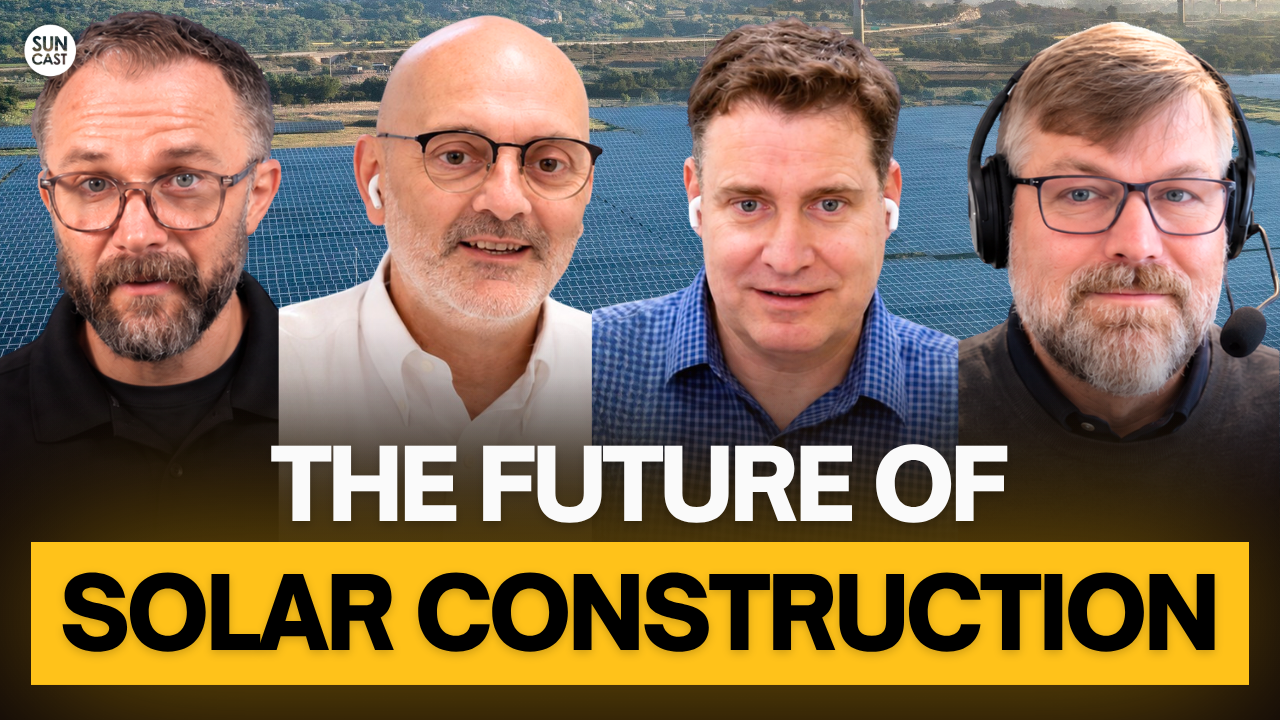
We'd love if you'd leave us a 5 ⭐ rating & review and it's never been easier: www.ratethispodcast.com/suncast
If robotic automation is becoming inevitable in utility-scale solar, where does that thesis run into the realities of actually building a power plant?
That's the question behind today’s episode.
We start with Nick de Vries, CTO of Silicon Ranch, to ask what an owner actually wants from automation. Nick's answer sets the standard: the technology matters only if it improves safety, quality, repeatability, and the performance of an asset Silicon Ranch expects to own for decades.
Then Matt Campbell, CEO of Terabase, takes us into the field, where his team is applying manufacturing principles to solar construction. That's where an important constraint emerges. Robots can move and place modules remarkably well, but some of the work that experienced crews make look simple becomes much harder when every action has to be repeatable.
One deceptively small interface keeps surfacing: the point where the module actually attaches to the structure.
That leads Nico to Frédéric Laure, VP of Diversification at ARaymond North America, to understand why fastening, tolerances, torque, and component design become different problems once machines enter the workflow.
The bigger lesson isn't simply about robots or fasteners. It's about constructability.
If what we are seeking is manufacturing-level throughput in the field, more of the variability may need to be engineered out long before construction begins.
Listen in to hear where solar automation is working, where the real-world constraints still live, and what the industry may need to redesign next.
Paid partnership: This Tactical Tuesday was produced with support from ARaymond.
RESOURCES:
Connect with Nick de Vries:
Connect with Matt Campbell:
Connect with Frédéric Laure:
Check out Silicon Ranch:
Check out TerraBase:
Check out ARaymond:
(00:00) Rethinking Utility-Scale Solar Construction and Robotics
(02:37) An Owner's Perspective on Jobsite Automation
(05:21) Lessons from 20 Years of Module Automation
(07:20) Targeting True Limiting Factors in Solar Design
(09:41) Installation Speed vs Long-Term Fastener Reliability
(13:39) Eliminating Field Variability Through Upstream Engineering
(15:39) Overcoming Construction Labor Shortages with Field Factories
(18:40) Standardizing Mega-Projects Through Digitalization
(20:33) Solving the Module Attachment Automation Bottleneck
(23:45) Integrating the Supply Chain for Robotic Assembly
(28:46) Redesigning Fasteners for Automated Construction
(32:54) Clip-Based Attachment Systems vs Threaded Bolts
(36:37) Designing for Assembly Across the Clean Energy Ecosystem
(40:22) Key Takeaways: Repeatability, Interfaces, and Upstream Fixes
This Podcast is Free For You
Thanks to Our Sponsors
The following are Corporate Partners who have helped make SunCast possible:
Platinum Sponsor
The following are Corporate Partners who have helped make SunCast possible:

Noteworthy Quotes:
Matt Campbell 00:00
Half the project value is sitting in the panel, and it's attached by whatever it's attached with. It's almost like in an airplane, the attachment between the engine and the wing. Like that's not a thing that can fail. But then, as you go to a world of robotics, which is certainly the future, attaching those those nuts and bolts are actually quite hard with robots.
Nico Johnson 00:21
Hey, welcome back, Solar Warriors. This is Tactical Tuesday. Practical insights from experts on the front lines of the energy transition. Today, we're going after something that sits underneath almost every single conversation about building solar faster and better, and it's a single piece of hardware that I think most people don't think about that often. For 20 years, we've built utility-scale solar essentially the same way: ship in the material, bring in hundreds of people, assemble the kit and the field, and it works. That's exactly why it hasn't really changed. But we're being asked to build more, faster, and in a construction market that's already short on skilled EPCs in labor, so everybody is talking about automation and robots naturally. That's where my thoughts have been lately as well. I'm sure you've seen some of the videos we've produced on that topic. You see, I've spent the last six months trying to work out whether this is the right conversation to be having, and one thing I've found is that the future of solar construction and accelerating how we build these projects is not really about adding robots to job sites? It's about the design of the job site, such that it can behave more like a factory, and the place where the idea either works or falls apart is actually at a smaller junction of material than I had previously understood, where the module, the solar module guy that is, gets attached to the rail. So today you'll hear from Nick de Vries, CTO of Silicon Ranch, to find out what owner actually needs from all of this-the very concept of automation. Do they care? I ask Matt Campbell, CEO of TerraBase, what happens when you genuinely try to run a production line as though it is a factory out in the field? And then I get to Frederic Laure at ARaymond, because if we're gonna hand this job to a machine, namely robots, then the hardware itself is gonna have to change and adapt. The machines have to know how to systematically install this stuff. At the end of the day, this is Tactical Tuesday. My name is Nico Johnson, your host. Welcome to SunCast.
Nick de Vries 02:37
You need to know your product cold before you automate it, and if you're still iterating on things, no, don't automate.
Nico Johnson 02:47
Nick de Vries is the chief technology officer for Silicon Ranch, where not only has he been leading the company in construction and technology innovation for the last nine years, but has been actively building projects on behalf of Silicon Ranch for the better part of 15 years, so there is this growing assumption, as I mentioned, that the robotics and automation are going to become a bigger part. And in fact, I feel like we're seeing the early trials of that now for utility scale to really roll out in a way that we've been anticipating for two decades. But as an owner, do you actually care whether robots build your project?
Nick de Vries 03:19
Well, I'd say we would be agnostic as to exactly how the modules are installed or how the the plant is built. We first care about on time construction, quality construction, and then construction that that meets specifications is and is going to withstand the the rigors of of of of you know 40 years in the field, so that's paramount. How it gets there, we certainly care about job creation on our power plants, and and making sure that this is part of our company's mission is to create economic development opportunities using solar as a vehicle. So we definitely care about creating jobs. I, I'm proud of the fact that we've. There's a whole new set of people who are specialists, you know, skilled, skilled train employees who know how solar is built. This this shouldn't ever go away. But are you setting those workers up for success? We care about safety. We care about quality. We care that people have jobs that they care about, are good at, and are not menial. And so, then you can shift your thinking a little bit and say, how is the best way for a solid group of people to build a solar power plant? And there's times when you have to have flex and have all sorts of workers to do, say, module installers or some of the highly repeatable tasks. But we we know, right? Even though at an owner's level, this isn't what we do. This is a part of our contractors and suppliers' world, right? But we know. That if you can be helping them with lifting aids, setting them up for success, they're going to do a better job. We as an owner are going to get a better product, and the 40 years that this power plant has to operate, it's going to operate consistently and deliver energy for our customers on a daily basis, so it
Nico Johnson 05:21
was around this point in the conversation that Nick reminded me that none of this is actually new. See, 20 years ago, he was automating the manufacturing of solar modules at Applied Materials, modules twice the size of anything we're installing in the field today, mind you. Everything old is new again. Here's how he tells it:
Nick de Vries 05:37
20 years ago, when I started in the industry, we were automating manufacturing of solar modules from glass in to module out. At that time, they were twice the size of what you see Series Seven or a G12 module today. And the only way to move these kinds of sizes of modules were through lift aids automation. And so, sure, I've I've automated modules twice as big as what we're installing today.
Nico Johnson 06:06
I appreciate that perspective too, and I worked with one of your old colleagues, Jonathan Pickering, early in my career, and he was showing me pictures of how you guys were using the factory like suction cup things that we now see in a small scale being applied by you know Cosmic and Grit and Libra and all these companies, Aussies. They've all got the same devices that you guys were using 20 years ago, but deploying them in a in a novel way on skid steers and such. Deploying
Nick de Vries 06:28
them in the field, right? We started in the in in the factory setting, although we did extend that into the installation.
Nico Johnson 06:34
Yeah,
Nick de Vries 06:35
because the modules were big, and what we saw then was a module was you know maybe two feet by three feet, three feet by five feet at the largest. Sure, people could handle that, and they were going on roofs. But you could see where utility scale solar would go. Is the module form factor mattered? It was going to get big. There was value in increasing the size of the module, but can a human lift it, or can two people lift it? Has been sort of these gates as we've gone through module sizes, and clearly, larger modules add value. How do you do that repeatedly? How do you do it safely so people aren't injuring themselves? How do you do it with quality?
Nico Johnson 07:17
Yeah,
Nick de Vries 07:17
that's what we're all looking at again.
Nico Johnson 07:20
You know, a lot of times it feels like technology is out there looking for a problem to solve, and and and it can feel that way right now with sort of this latest wave of robotics. And I'm curious, where does automation really become interesting for you as an owner versus again just sort of like one of your vendors trying to sell you on sort of bigger, faster, better.
Nick de Vries 07:45
Yeah, look, yeah, you've got a solution looking for a problem, and I've come up with solutions and invent things, and I'm looking for ways. I love them, and I'm looking for ways to deploy them. For us, the litmus test is how does this add value for us at the company? And core to those things are, in my mind, as the as the CTO is, has this problem that they're trying to solve been a limiting factor? Is it just something that well we have a way of doing it, and maybe it could get better, or is this a limiting factor that is preventing us from taking our designs to another level, taking our quality to another level? We think about scale. I mean, the first solar project I built was a megawatt. Now we build in the 500 megawatt ranges. Can I repeat what we used to do in the past? And sometimes, is yes, you can, and other times no. The quantity of what we're dealing with is is is the the the sheer numbers, the statistics of it are too large, and so you have to find a new way. That's then what gets interesting. That's what I zero in on.
Nico Johnson 08:59
Yeah, and is
Nick de Vries 09:00
it can can it take what we build in our business to another level?
Nico Johnson 09:03
It's clear to me that right now more than ever speed matters. But what I hear from you is the speed is only valuable to you as an owner if the finished asset is at least as reliable as what we're already building today.
Nick de Vries 09:15
Speed and I'd say cadence and pace.
Nico Johnson 09:18
Yeah,
Nick de Vries 09:18
right. Blazing out sprint from the start line. Speed is not what builds a great project, right? But the right things, landing at the right time, keeping your schedule, working methodically. Sometimes slow is fast, right? And and and that that's what wins races.
Nico Johnson 09:41
I'm really eager to hear your perspective on where do you see these limiting factors, and are there any sort of myths around that exist that folks are trying to use to make a case for automation that maybe aren't as strong for you as an owner,
Nick de Vries 09:56
whether it's automation or just fastening, and we'll we'll. Start with modules because I mentioned before just the volume of what we deal with. Yeah, nothing has scaled more with just the sheer quantity of modules that that that we have, and we we own every every module that we ever bought and anyone ever installed. Right, we're in the the 10s of millions of these things now. One sort of myth is sort of speed to install a module. Just that sheer, you know, off the starting block speed to install a module is what's that matters. That will compress a schedule and bring down the the cost of construction because so
Nico Johnson 10:36
many man hours can be attributed to it, and it makes
Nick de Vries 10:39
a whole lot of sense. Totally, it it definitely matters. Yeah. Okay, but it's not the only thing that that gates right. And so this myoptic view, like we just have to install fast, has led to many fastening methods that are slick, fast, innovative, and believe me, I like love seeing people innovate. But time has shown these are not the most robust connections. Right, connecting to the frame, back through the frame, not clamping on the frame. That is hands down the the most reliable in the way that these modules have been intended to be installed. The real test is is did we fasten all these you know, hundreds of 1000s of millions of modules correctly is what happens when the first wind blows, right? What happens when the first storm comes through? And again, this is where, well, okay, some are going to fall off because you know we installed 100,000 of these things, so you know some small percentage means these are going to fly. This is unacceptable. So where, where you know you oh it's okay if point some percent of these modules fly off. No, no, no. Now we have a 10 million of these. This is hundreds of 1000s of modules flying off. Completely unacceptable. Yeah. So for us, like we have focused on the type of fasteners and not just the speed of the fastening, but really, is this the right sound method? Is there an opportunity to remove installation or operator error through robotics? And if so, like where where do you see those opportunities? It's focusing on on the the task and setting people up for success to complete the task. If you've ever stamped a bunch of envelopes or put your return address on a whole bunch of envelopes, you can handwrite each one of them. And my handwriting gets sloppy. We have a stamp that just stamps out our address that on the back of an envelope. When so that's an aid. That's a tool to get repeatability, whether it's robotics or a human doing. Focus on how do we set the person up for success. You know, and this is that what drives good outcomes. So sometimes that's a robot. Sometimes you know that's a aid, a tool that that allows you to a jig that gets things lined up for the human. Sometimes that's certain types of fasteners that are one pre pre set up, or others that are just on their purpose built for the task. They they connect, and there's no you know did I chitin this quite right? Did I get it right? It's a one and done on digital right or not right connection. This is honestly what we have a lot of in our fleet. We could see the success early on, and and something I focus on when evaluating new designs, robots or not.
Nico Johnson 13:39
What stands out for you? What should we engineer out upfront in the process right now?
Nick de Vries 13:43
Variability, right? So anything that you're going to get a a wide outcomes of of of events or a vary of various outcomes. If we didn't quite know what size module we were getting, they're all going to be plus or minus an inch. You can see where that would just stack up and not not work, right? So we don't have various size modules on on on wood job, but anywhere that this this comes in, so the variety of of different materials, the variety of suppliers that you have can all add variability. So you want to know that someone can do the task. It's going to come out with a you know certain probability, a certain you know distribution of of of of outcomes. Again, to the fastener analogy, it's connected or it's not connected. It's not almost all the way connected or three out of four connected, all four all connected every time. No matter whether this getting built in the morning on a Saturday afternoon, consistency is key.
Nico Johnson 14:53
From your perspective as an owner, do you feel like there's a an advantage to or a need to move constructability more upstream?
Nick de Vries 15:00
It dictates the quality you're going to get in in in the field, and so constructability isn't something for the workers to think about or the companies, you know, the EPCs to think about. It permeates into the equipment that you buy and how you are and and design, right? And so that's different organizations, right? So you've got a design company, you have multiple equipment manufacturers, all feeding the builders, right? And so you need an ecosystem that is all focused on constructability for it to actually bear out in the field.
Nico Johnson 15:39
We're hitting the limits today of existing construction models. So, in my time in the industry, although there have been a lot of improvements, fundamentally the approach to construction is unchanged. Now, it's unchanged because it's working. Right? You can you know bring in hundreds of folks, ship in the material, assemble the kit, and get the project online. That's Matt Campbell, CEO of TerraBase. He's been in solar for 22 years, going back to the world's very first 10 megawatt project, and he spent the last decade trying to move the factory of solar out into a field because that's where Nick leaves us. He's agnostic, frankly, about the method and not remotely agnostic about the variability, connected or not connected, constructability of these systems needs to be designed upstream across the whole ecosystem, or it never actually shows up in the field. Which raises the obvious question: Has anybody built that? As the
Matt Campbell 16:33
industry continues to grow and as the pressure increases to go faster, there's just not enough EPCs. There aren't enough laborers. There's not, you know, there's not enough support to be able to build these projects on the time that customers are demanding. And as infrastructure build increases with data centers and natural gas infrastructure, that what was already a constrained construction market is getting worse.
Nico Johnson 16:59
Matt, you know, the industry lately talks a lot about automation, especially with the pressure that we've enunciated of needing to move faster and safer and better than ever. I wonder if you think that's the right conversation, or if there's a bigger shift happening.
Matt Campbell 17:12
Technology is is is a tool to solve problems, right? And and so I think we don't want to push technology like robotics or AI for the purposes of for technology's sake, you want to do it to help improve the industry, right? And so, as you think about applying these technologies to construction, you know, you think about all right, like what are some of the pain points? And I think one of them is lifting heavy solar panels, right? Like, you know, we're on a job site right now in the southeast U.S. where the humidity is super high, the heat index is over 110, and and the workers have to lift panels that are close to 100 pounds, you know. And it's just really not. It's not a great. It's not good for the workers. It's not good for quality. It's you know, and so that's an example where okay maybe the solution is to apply robotics. Maybe the solution is to apply, you know, you know AI to help solve problems that you know have been solved in other industries.
Nico Johnson 18:13
Yeah, you mentioned manufacturing, and a lot of folks think about the existing sort of deployment of infrastructure in the field as construction, I hear you know a lot more folks talking about manufacturing in the field or moving manufacturing to the field. Is something that you guys with TerraFab talk quite a bit about as well. How do we begin to rethink how the solar industry builds things in that fashion?
Matt Campbell 18:40
There's a lot of different elements to it. I mean, one area I think is standardization. You know, how do we go from a world where every project's a snowflake to a world where things look more standardized, right? You know, standardized systems have better quality, easier to manage supply chain, more repeatable units, and I think that's that's one area that can drive efficiencies. I think there is digitalization of the operation. How do we understand? You know, one of the biggest pain points for EPCs is just knowing where are all my material, where's my machines, where's the labor, right? So bringing modern digitalization to construction is an important piece of the puzzle, and then of course with robotics, like how do we bring robotics as a as a tool to assist workers to build things faster, to work through inclement weather, to make sure that schedules aren't missed? It's the synthesis of like the digital, the sort of robotics and and other tools to help make things more efficient.
Nico Johnson 19:44
It occurred to me that for all the automation you see inside a factory where where human hands aren't sort of present, we still are very early days right now. To the point of your discussion around robotics. With how reliably, consistently we can literally attach these modules to the rails, which is the mating point. Like that's the that's the physical place they have to live for the next 25 years in order to meet the benchmark of production that all these systems have been financed around. Why is it that placing the module versus attaching it to the rail is still complicated? It seems like that's where automation collides with reality right now.
Matt Campbell 20:33
Yeah, I mean, I think that the module attachment is a seldom thought of part of a solar power plant, but one of the most important parts. Like you can imagine, because you've got half the project value is sitting in the panel, and it's attached by whatever it's attached with. It's almost like in an airplane, the attachment between the engine and the wing. Like that's not a thing that can fail. No. So, and in instances where there have been problems on projects with that attachment, it can become an extremely expensive problem. So, so I think that what you see in the industry is people gravitate towards traditional attachment methods, nuts and bolts, and clamps, and other things because they're proven they're robust. People can install them easily, but then as you go to a world of robotics, which is certainly the future, attaching those those nuts and bolts are actually quite hard with robots. And so you need other ways to facilitate the attachment in a way that keeps the panels secure for 30 years under all sorts of environmental conditions, that's low cost. You need the automation friendliness, the low cost, and the and the 30 or 40 years all coming together. You know the human hands are remarkably good at fine dexterity tasks like fishing a nut through a couple of holes and securing them. And I don't think the humanoid robots are going to be there for a little bit because because of the it's just a really hard problem in robotics. So so I think that changing the design of the fastener is really important, and I think you know that's where modern fasteners come into play, taking a lot of expertise from the automotive industry and applying it to what we're doing in solar.
Nico Johnson 22:26
For those who are unfamiliar, the approach that TerraBase takes is what you refer to as TerraFab, is more of bringing a manufacturing assembly line of thinking to the field. What does that look like? Can you explain it for folks who are unfamiliar?
Matt Campbell 22:40
Think of it as a portable factory that can be moved in four hours. So every 20, 3040, megawatts, you move the facility. You bring in material like steel tubes and brackets and fasteners and modules. You assemble them into sections, and those sections are delivered out into the field. And what we're trying to balance is how do you push the robotics into the field, but preserve some of the benefits of a factory. It's like a balance between between these things, because the further you get in the field, you know, you're literally knee deep into the mud, and and so some of the things you want to do to facilitate automation are very difficult to do out in the fields. So, for example, on the module attachment in our TerraFab, we've got a system, a very complex system of material conveyance and insertion, where every 10 seconds we can install four fasteners.
Nico Johnson 23:36
Okay, it was at this point in the conversation that I really wanted to hear from Matt what all of that automation actually does to your relationship with the supply chain, and this was his answer.
Matt Campbell 23:45
It's a close collaboration between the OEMs, so the module OEM, the structure OEM, and the fastener OEM, and then working with the EPCs, and you know, and it's kind of funny. Like, the more you automate, the more you really need to be integrated with the supply chain. Because in the world of manual construction, if something's crooked, somebody can take a hammer and bang it into place. Yeah. Right. Well, there's not nobody's no robot is banging things into place. Yeah, maybe maybe someday, but so that you know, there's you need good management of your supply chain so that the material comes out per spec and all that kind of stuff.
Nico Johnson 24:34
I was having a conversation in prep for thinking about this this overarching conversation with a project owner, an IPP, who said, "I don't really care whether a human or a robot makes the final attachment. I care about reducing the variables in field or otherwise. Do you agree?
Matt Campbell 24:51
Yeah, yeah. I mean, I think if you imagine what's important to the owner, the system needs to perform as expected. Both when it's completed, as well as after two years and 20 years and 30 years, and sadly, a lot of systems underperform, and a lot of systems, if they're not built correctly, will require more maintenance. And I think there's not enough discussion about this in the industry, which is, you know, if you if you if you mess up the design or mess up the installation, you know. You can have things like fires. You can have underperformance, and the O and M budgets are thin. And so you're spending your O and M money like fixing problems, and your revenue is lower because your energy is lower and your mate your opex is higher because you're fixing things. Like that's really going to hit the project economics. So if I'm coming in as an owner, I want I want no drama. I want high quality, on budget, on schedule, making the energy it should. And and I would agree, whether that's from a human or a robot, doesn't matter as long as the results are what you want. Now it turns out as you apply automation, it becomes easier to control the quality because when you have hundreds of people across 1000s of acres, it's really hard to manage quality because it's just tough environment, tough weather, lots of people, hard to supervise. Versus, you know, the beautiful thing is, like we can tell you on every fastener, was it torqued within point 3% and geolocate that, and so you you have a level of modernization that doesn't exist today.
Nico Johnson 26:33
This is where I put it to Matt directly. Had anybody actually designed hardware for this, not just adapted something that already existed, but designed it from the beginning to be installed by a machine. Here's what he told me.
Matt Campbell 26:47
So one of the things in our TerraFab today, you know, we were fortunate to work with some partners that have designed things for automation, which makes it easier for us to automate the module attachment process. So are currently using the Series Seven module from First Solar, and if you're not familiar with the Series Seven, it has a unique architecture with two steel rails that nest onto brackets on the tracker torque tube. And First Solar had co-engineered with ARaymond a unique wedge which goes into the back rails, and it is really automation friendly in a way that other attachment methods haven't been to date, and so in our TerraFab facility, we use that Series Seven with the wedge, and that's turned out to be a very efficient and reliable process to enable the automation to happen.
Nico Johnson 27:35
At the end of the day, if you're going to use robotic methods automation, they all have to look the same, and I keep coming back to this experience I had in the field very recently, where, as beautiful as it was to watch like a robotic arm laying the module, the thing that never looked the same, and I watched it over and over and over again, was the 20 seconds between the module landing and the module being attached to the rail, or maybe it was like two minutes. It was probably much longer than 20 seconds, but it never looked the same. As uniform as the the process might be, it never looked the same. And that was where I was just like, "What is? How are we going to invent around this? It sounds like one of the ways, and certainly because of the nature of the Series Seven as a glass module, like a glass glass module for solar and ARaymond have thought deeply about this. I have to go dig a little deeper into that aspect. Well, Matt Campbell, thank you for helping illuminate a little bit more for us how the industry is evolving in constructing these mega projects in a more reliable, safer, and faster process.
Matt Campbell 28:43
You're welcome, Nico. We're always here to help.
Frederic Laure 28:46
Attachment is a is a very challenging activity in the industry because most of the time people consider is going to be easy to do, so they usually don't anticipate that. So they design the complete system, or what is very expensive, very complex to manufacture, and then very late in the process, they are like, "Oh, wait, how do we do that?
Nico Johnson 29:10
Their voice is , VP of Diversification at ARaymond North America. He's been with this century-old company for more than 27 years, and previously ran their North American energy business. ARaymond does not come from solar; they come from automotive fastening, and they are the company Matt just pointed to, which is worth sitting with for a second. When I started installing solar back in 2006, module manufacturers didn't even send us modules with pre-drilled holes. We turned the panel over on the ground and drilled our own wherever the rack happened to need them. It took this industry more than a decade just to standardize where an attachment point should go. That's how long this has been sitting in plain sight.
Frederic Laure 29:51
In their engineers' mind, it should be easy, right? Because connecting stuff together-how could it be more? Complex than designing complete solar farm or manufacturing a solar module, so there is a lack of participation and a lack of understanding of how things have to be very accurate, very precise, so you can mate properly two elements together.
Nico Johnson 30:18
You know, most projects throughout the last 20 plus years that we've been working on, use threaded fasteners. I'm curious why threaded fasteners, in particular, struggle to translate from human installation finger digits to automated or robotic installation.
Frederic Laure 30:32
So the threaded fasteners is pretty easy to use at your house when you do it do your do it yourself stuff, and you will see that when you use a screw or threaded faster in your house, there is something that you absolutely don't control is the torque, but the performance comes from the torque, and controlling the torque in an automated way is not that easy. Okay, so that's what makes it make it very difficult. And second point is how this torque will evolve over time. How do you make sure that the torque stays the same over time with the vibration of the system, with like climate event and so on? And so it requires lots of maintenance down the road in the field to make sure that the torque is still there because without the torque, you don't have the mechanical performance, and without the mechanical performance, what you have failures in the field, and then it's downtime for the operation of the of the solar farm.
Nico Johnson 31:34
What actually has to change then around a fastener's design to go from something a person can install well to something a machine can reliably install every single time.
Frederic Laure 31:47
So the translation that we need to do to go from a manual manual operation to an automated assembly of this same part. So you have to think the product in a different way, you cannot just imagine the final performance of the part once installed in the field. You have to design the part so it can be properly automated, properly fed in an automated way into a robot system or whatever other equipment. So you really have to consider the part in the complete system, and not thinking, "Oh, this one part has to make this mechanical performance, and that's it. So it's really seeing how this part will interact with the robot, with the feeding system, with everything, and taking in consideration also more variation and and and variability of the feeding system of the robot, so it makes the design of the part way more complex, and you have to be like way more accurate in what what you do, so the system will work in a in a in a seamless way.
Nico Johnson 32:54
You have been working on a clip based system that fastens in quite a quite a different approach-one that the industry has had has had to get accustomed to thinking around. No torque, no bolts, just a clip. What does a clip-based system do differently at the moment of attachment mechanically compared to a bolt and torque system?
Frederic Laure 33:14
What a clip makes differently than a bolt and and not system is the speed. It's instant. You push it in a hole, and that's it. And what makes it also very interesting is most of the time there is a sound when the clip is clipping. You can hear a pop or something like that, which tells you that it's it's connected. It's a clip. Okay. Yeah. So that's that's the the the main difference. So really, at this very very like small time when you push it, it is done. When when you use the bolt and the screw, it takes time to go through the thread and go to the torque and so on.
Nico Johnson 33:57
You know, there's this great promise, and that's why I'm trying to put this episode together is a great promise that robotic automation is going to accelerate as we all want the deployment of renewables and all kinds of construction. But let's stick with renewables because that's what we're focused on. And when I heard Matt Campbell, for example, describe that nobody's really quite figured out how to get the robots to do the bolts, and that we need a different, more repeatable process. That's when I started asking the question: Who's doing that, right? Like, and then that led me to ARaymond. How do you design a fastening system then to reduce the variability across different crews, sites, conditions? Not just in the lab, but actually once we get to the field.
Frederic Laure 34:37
So to reduce the the variability of a connecting system, it's not something we can do all on our side. We need to really partner with the compute ecosystem. All the companies around us who will be assembling things together. So in our case, it has to be the structure maker, the module maker, companies like. Terra base and all those people have to collaborate together, and then if we want to make the system more universal, it makes it more complex. Because then, if there is different tracker structure maker working for the same module, then we have to work with all those players to make sure that at the point of connection, the dimension of the holes or the slots, whatever, will be the same with the same tolerances. So, to have a very efficient automated system, we need repatriability and consistency into a size, dimension, and tolerances. So, it changes completely the way people are working, spending more time upfront at the engineering level. So later on, you can spend less time in the field. So it's because it becomes less and less a construction project, but more and more, if we want to make a comparison, more and more like a manufacturing project.
Nico Johnson 36:07
The thing I most wanted to put to Frederick was, how do you prove any of this? How do you know a fastener will still be doing his job in 40 years? And this is what he said:
Frederic Laure 36:16
That is absolutely key to deliver a consistent performance over time. And what's also important is not to do it just on the part itself, but on the system. So the part installed into the system and to test the complete system. So it requires like high level of collaboration between the players of the ecosystem.
Nico Johnson 36:37
You used a phrase that I'm not sure we've incorporated into this interview, but that I've heard you say of design for manufacturability. What would it look like to design for assembly? What would that change about how hardware gets designed from the beginning of a project? Maybe through the lens of your experience, often getting called in at the very end. How can we reimagine that process?
Frederic Laure 36:58
So that's a very good question, Nico. And you're right. Companies are looking at their own silo, and they want to do their job the best possible at the at the cheapest possible cost. They don't anticipate how to attach things together later on, which makes it harder for companies like like us. So to your point, if upstream they could add on design for manufacturability, design for assembly, so collaborating with the ecosystem, with the future partners, with companies like Carimon to have the proper ways to attach or to use a clip, it it would make it more efficient, and it would allow everyone to design cheaper and more robust solution for the industry. Because when a system is is is is fixed and designed, we always have to find like tricky ways to use what we get to make it happen, okay, so that's good, but it is not as optimized as could be if all of that was considered upstream. So that's a very good point, Nico.
Nico Johnson 38:11
Frederick, if we zoom out to you know five to 10 years from now, what do you think is the change in how we design or install fasteners that would most unlock faster solar deployment at scale without compromising the long-term reliability that we've come to appreciate from the way we've been doing it for 30 years.
Frederic Laure 38:35
So the next step in terms of innovation or design to speed up the assembly of a solar farm. I think could go two ways. One way is really the kinematics on how to assemble the module onto onto the the tracker system. Okay, and if we could just use like gravity, just weight of the panel and drop it, and it is connected. This would be like a big step forward. Wow! And then, if we could also have robots to do the handling of the modules or what is happening right now, okay, with companies like TerraBase and others, this will also speed up. So I think it's about the way to connect and how to handle this connection with automation.
Nico Johnson 39:26
I've not thought about it that way, but in a world where we have validated this sort of click it and it's done clamp system that, like what what ARaymond has introduced, it can be manufactured into the design of the product, and then the module just drops on. It just clicks on without the need for a separate physical step.
Frederic Laure 39:49
Yeah, this would be a dream,
Nico Johnson 39:51
Frederick. Thank you for helping sort of shed shed some light on all that is changing about the way we're building the. Critical juncture and attachment that actually allows us to ensure that these modules that are producing electricity can stay firmly secured in place to the infrastructure we're building to support them.
Frederic Laure 40:16
Thank you, Nico, for the opportunity. It was very nice to to see you again and to chat with you this afternoon, thanks so much.
Nico Johnson 40:22
This brings me back to where we started. The systems we're building today aren't optimized; they're customized. So the last question belongs with the person who has to live with the result for 40 years. Ask Nico what out of all of this conversation we cannot afford to get wrong. And here's what you had to say.
Nick de Vries 40:42
There's two things, and one I've already touched on, which is the quality. If you're going to be building fast, and you miss the quality, the power plants aren't delivering the electricity that you need. This is a big miss. But who are we delivering this electricity for? Who, right? And it's for the communities, the utilities, the businesses that need the energy, and particularly if we're building in ways that alienate people, building in ways that fail to deliver the promises of the project, we're going to lose them. Right. So that that that is from how you treat your neighbors to do you build on time, does what you build deliver the results that you've promised people in contract financiers, utilities, off-takers? The mission is to deliver electricity on time at an affordable rate, not just get things built.
Nico Johnson 41:36
Okay, a few things I'm taking away from this. First, nobody in the story is arguing for robots. They're all arguing for repeatability. Nick's version is, hey, connected or not connected. I want not three out of four connected. Matt's version is, hey, we could tell you on every single fastener and module whether it was torqued within three tenths of a percent, and we can geolocate it for you. And Frederick's version is designed for assembly. Same idea, three different ways to view it, depending on where you sit at the table. Okay, second, the bottleneck isn't the robot either; it's the interface. You see, as I've started to go out, actually, into the film, watch how this is being installed. I've noticed that placing a module is pretty well close to solved, even with robots, but attaching it is not. It still, in most cases, is a manual process. That's a hardware problem before the robotics ever get to the field. And then third, the thing I do keep coming back to is that the fix happens upstream, not in the field, many months before anybody ever gets on site, and it happens across companies that don't normally talk to each other, as you've heard. Module manufacturers, the tracker maker, the fastener maker, the EPC who orders all of this stuff, and the owner who has to live with it for 40 years. Frederick called it design for assembly. It's not a new concept. Nick called it an ecosystem. Matt called it being integrated within the supply chain, but nobody gets there alone. We've spent 20 years optimizing the panel and the tracker and the racking. The next 20 may come down to how we optimize, how we hold it all together. I want to give a huge thanks to Nick de Vries at Silicon Ranch, Matt Campbell at TerraBase, and Frederic Laure at ARaymond. This would not be possible without their generous time and insights. I hope it's been insightful to you. As I say always, I only ask you to pay the most expensive thing-the only non-renewable resource you've got: your attention, your time. I'm honored that you've given it to us here today. I'm Nico Johnson. This has been Tactical Tuesday. Remember, you are what you listen to. Thanks again for showing up, Solar Warrior. It's half the battle.

Nico Johnson
Entrepreneur & Podcaster
In my 20 year career, I've worked with dozens of entrepreneurs, intrapreneurs and professionals in transition to clarify their mission, set or stretch their goals, and work through the barriers to their growth.

Latest episodes
.png)
We’re Excited to Hear from You!
Don’t hesitate to reach out—whether you’re here to learn, share ideas, or work with us, we’re ready to connect.