
We'd love if you'd leave us a 5 ⭐ rating & review and it's never been easier: www.ratethispodcast.com/suncast
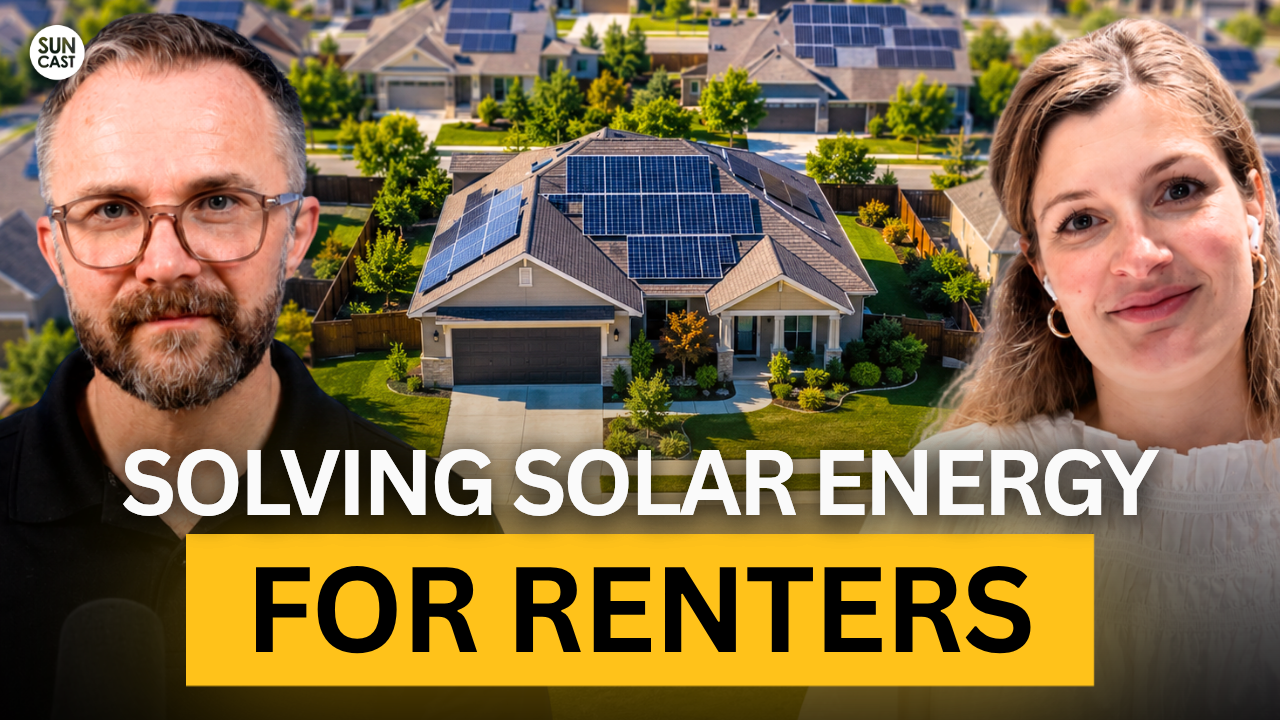
When Charlotte Meerstadt put solar on her Amsterdam home, the numbers made sense.
Then Charlotte moved to the U.S. and rented out the apartment. The solar panels kept doing exactly what they were supposed to do: producing cheap, clean power. But, while the tenant received the lower utility bill, Charlotte still owned the panels and had no clear way to capture the savings her asset was creating.
That mismatch revealed a bigger problem hiding across rental housing and distributed energy: the person who can invest in clean energy is often not the same person who gets the financial benefit.
Under 1% of rental rooftops have solar.
Now put that next to 49 million rental units in the U.S., including roughly 23 million apartments, and you start to see the size of the opportunity Charlotte Meerstadt stumbled into.
In this episode, Charlotte, Founder and CEO of Fram Energy, joins Nico to explain how she turned that insight into a company helping property owners, developers, and energy asset owners measure, bill, and collect the value their projects produce.
She also shares how early customer conversations shaped the product, why real-world complexity can become a moat, and what she had to unlearn as an engineer to become a founder.
Expect to learn:
🔹 Why solar savings get complicated when owners and tenants try to split the value
🔹 How meter data can become revenue asset owners can collect
🔹 Why billing, tariffs, permissions, and customer trust matter after the system is built
🔹 How customers pulled Fram from rental solar into larger energy transactions
🔹 Why Charlotte believes founders should keep removing themselves from the equation
This episode might help you see the business model problems that can hold back otherwise strong projects.
RESOURCES:
Connect with Charlotte Meerstadt:
Check out Fram Energy:
"The numbers just blew my mind that there's under 1% solar deployment across rental rooftops, but specifically for the U.S. there's like 49 million rental units." - Charlotte Meerstadt
(00:00) The Rental Rooftop Solar Gap
(02:14) The Landlord Split Incentive Problem
(05:05) Evaluating Workarounds for Rental Properties
(07:43) Identifying a Scalable Market Opportunity
(12:38) Leveraging Stanford Network for Early Traction
(15:14) Early Entrepreneurship and Formative Upbringing
(22:45) Raising Venture Capital as a Solo Founder
(28:46) Turning Hardware Dependencies into a Moat
(31:06) What Engineers Must Unlearn as Founders
(38:31) Converting Interval Data into Tenant Invoices
(44:22) Utility API Integrations and Compliance Hurdles
(51:52) Expanding Beyond Residential to Commercial Settlements
(55:42) Disciplined Market Focus and Saying No
(1:03:00) Achieving Zero Churn Through Customer Trust
(1:08:09) Founder Delegation and Stress-Testing Independence
This Podcast is Free For You
Thanks to Our Sponsors
The following are Corporate Partners who have helped make SunCast possible:
Platinum Sponsor
The following are Corporate Partners who have helped make SunCast possible:

Noteworthy Quotes:
Charlotte Meerstadt 00:00
The numbers just blew my mind that there's under 1% solar deployment across rental rooftops, but specifically for the U.S. there's like 49 million rental units. 23 million of those are apartments, and it just seemed like this wasn't just kind of a lose-lose for the owners of these rental units and their tenants, but also for the solar industry. The solar industry was just not able to sell into those segments.
Nico Johnson 00:29
Hey, welcome back, Solar Warriors. I'm Nico, of course, your host. And if you're new here, I just want to welcome you in to our community of clean energy champions, Solar Warriors, as we call them on the front lines of the energy transition. My job is to equip you with the tools you need to lead in this energy transition in your career, in your company, in your entrepreneurial endeavors. So, I bring smart people like our guest today on to give you a glimpse into what does it look like to make a decision to go and build something that can change the world, or that can change your corner of the world. Our guest today, Charlotte Meerstadt, put a solar array on her Amsterdam home, and it worked perfectly until she moved out and became the landlord of that property. Now, to be clear, the system kept producing the same electrons. It's just that the economics broke down when she became the landlord instead of the tenant occupant. The experience, as many have had, led Charlotte to found a company called Fram Energy, a company that converts electrons into cash flow by helping distributed energy asset owners like herself bill correctly and, more importantly, collect the revenue that those projects produce. Today, I want to understand how Charlotte recognized that this personal impediment pointed to a much larger opportunity. How she updated the thinking around how this market could grow, and what did it teach her? What she has learned about entrepreneurship as she's jumped headlong into building this company. What she learned about leadership and even creating the conditions for the best work of her team. Hey, Charlotte, it's so good to see you again.
Charlotte Meerstadt 02:14
Yeah, great to see you.
Nico Johnson 02:15
I wanted to start at the part of the story where you know the solar panels that you put on as a as a good green champion were a good investment, but what you ultimately called in a conversation we had prior a silly an extremely silly investment when you transitioned that apartment to being tenant occupied. What did that situation teach you about where the economic value of an energy asset lives.
Charlotte Meerstadt 02:43
So, as you were saying, the investment made so much sense when I lived there, and the apartment was owner occupied. It was great net metering rules, great incentives for putting the solar on the roof. So, they were set to make themselves back in about like four and a half years. After one and a half year, when I moved to the U.S. and we brought the renters in, the entire investment just stopped yielding a single dollar for us. And the simple reason is that the tenant was now paying the energy bill. So this big investment we had made was now sponsoring their bill. So my background is as a civil engineer, and I've always worked on some kind of renewable energy project corner, and it just was so interesting to me that, as you were saying, the electrons were the same, panels were on the roof, just cranking out value, but just because of these cash flows, it just made no sense at all for a rental property that we'd ever made that investment, and it just re sparked my curiosity of like, whoa, this thing that I'm seeing on my tiny rental is-is that a wider thing in the industry, or is it just this little anomaly that happened for my situation? And then the numbers just blew my mind that there's under 1% solar deployment across rental rooftops, but specifically for the U.S. there's like 49 million rental units. 23 million of those are apartments, and it just seemed like this wasn't just kind of a lose lose for the owners of these rental units and their tenants, but also for the solar industry, because the solar industry was just not able to sell into those segments. And because I came at this problem from my apartment situation, the initial focus was residential, but we soon found out that this was happening across offices, other types of commercial and industrial. There's like dynamics around data centers, and it just turned out to be this huge problem. And yeah, that's that's really. I think that the fact that the technology is so mature, and there was this problem that was just really well positioned for software. To solve is what got me super interested in pursuing this in a very serious way.
Nico Johnson 05:05
You know, the first thing that occurs to me, having owned rental properties, is well, why not just offer it as like electricity included, right? Bump it up 50 bucks or whatever the number. Like, surely there's a threshold, and you're very obviously a very smart person. So I'm curious the machinations that you went through of like how do we solve this, what what's known as the split incentive problem as a building or as a as a property owner, like what were the other options that you considered?
Charlotte Meerstadt 05:30
Yeah, so there were two issues with just raising the rent a bit and having rent included. So having power included. So first of all, when we raised the rent by, I think it was maybe like somewhere 5075 euros, the amount of viewings we got for our apartment listing just plummeted. Probably like 70% or something, because people just have these cutoff filters, and
Nico Johnson 05:58
yeah,
Charlotte Meerstadt 05:58
you we we just lost a lot of traffic on the apartment, the other dynamic that was tricky there is some logistics and rules about having the utility bill in our name when we would be living in the U.S. super far away, not using the power. There was both practical and kind of compliance reasons that that was not ideal either. So we did play around with that. Once we found tenants, we also pitched them like, "Hey, we can give you all of our data on what the system produced and how many euros it made for us when we were living there, and you can see that it's on average like 60 euros a month or something.
Nico Johnson 06:36
Right?
Charlotte Meerstadt 06:36
How about we charge you like 30, and you get to keep the rest, and the tenants were just super confused, sketched out, didn't know anything about solar, didn't know how to look at the data. What are you trying
Nico Johnson 06:48
to do? Are you trying to scam me? Greedy
Charlotte Meerstadt 06:50
landlord, back off! Like we we agreed to this rent, and you're trying to tack on this add-on thing. And so fascinating because definitely you're trying to help them. You're like, no, I'm going to save you money. Yeah, but they they did get a great deal by just saying nope, because then they just got all of the power free. And I do think it would have been really reasonable to say like, hey, FYI, for the power coming from the solar panels, you're going to be paying less than grid per kilowatt hour. That's essentially that would have been reasonable for them, but I was just like, where is a tool that would allow me to sell power to these people at a lower price than grid rate? And yeah, of course now it's it's very fun that it's led to an entire company being founded. But back then it was super super annoying and strange that our solar investment had just gone to zero.
Nico Johnson 07:43
Yeah, and you're not alone. This is a shared a shared frustration and a shared feeling. Many of us in in the solar industry broadly have put solar on that floor starter starter home or the first place where we live and move on and have really and have all encountered the same problem of like, well, now what do I do? I thought I was going to get this payback, but now it's going to somebody else who doesn't value it the same way. A lot of folks would experience that frustration, sort of throw their hands up because there is no real obvious solution, and then move on because you've only got so many hours in the day. How did you determine that this experience for you was evidence of a scalable market rather than a personal inconvenience?
Charlotte Meerstadt 08:27
I think there's a few factors that really helped it become a company instead of just a frustration. So first of all, the reason I moved out of that apartment is to go to business school in the U.S. at At Stanford, so just being in that environment where you, in all of your classes, are asked to kind of size markets and identify pain points and think through kind of product thinking, I think that was super helpful. And the reason that I went to business school in the first place is that I have this basically like 90% engineering focused background, but knew that I wanted to start a company at some point. So I started my very first company selling cakes to local cafes at 14, and have always been just really enthusiastic about the holistic, like connecting the dots thinking, you have to do where kind of team meets technology, meets operations, meets sales, and you have to be in all of those areas in order to do well. So I think that also really helped. And then starting to talk to potential customers is what was, and also customers, but also potential solar industry partners. Just hearing how huge it would be if someone solved the split incentive problem for just renewable energy deployment and the whole sector, as well as for individual like partners. And customers, all of that together really built the conviction that this particular problem was just a really good fit with my motivation and skill set as well.
Nico Johnson 10:11
I guess I'm trying to understand from an entrepreneurial perspective, like how you ultimately landed on like this is the one versus these other three I could possibly do, which also might have included following classmates, by the way, at a place like Stanford. That's not out of the question.
Charlotte Meerstadt 10:26
Yeah, I definitely went through that process, and the way I structured the two years of the MBA is, I'm going to spend the first year allowing myself to just diverge and follow all kinds of inclusive curiosities, say yes to lots of things. I took a pretty hefty computer science class and just spent an entire quarter, like most of my evenings, just coding. And that was I. Sometimes this was like right before AI could help you troubleshoot all those bugs. So there was like so many evenings that I would spend like three hours on a particular bug, and that was really fun about the first year that I kind of let myself really expand on that curiosity, and kind of came out of that with this problem space that just had a hold on me because of how both just how elegant it was that the hardware was all there, but we just needed to fix these cash flows as well as the human aspect. And I still really love that to this day that we serve these tenants and we work with property managers. And getting the human part right is just super important about this business. And I kind of loved that about it from day one. The other problem I was really excited by is essentially exploring as the planet heats up. Everyone's going to need more cooling, but almost all of the ways we have to cool people right now are super energy intensive and will like speed up the planet warming up. Also, a very human problem because there's a lot of expected just loss of life and of value from this upcoming heat, and the other idea I was just really excited about is what are passive ways and extremely low energy, like personal ways we can cool people instead of always chilling down spaces, so it was really between those two ideas. And then I think around December, January of the second year, I just saw all of the customer traction with this idea, as well as the compelling part that you don't really need to do that much hardware development, and went for it from that point in time. So
Nico Johnson 12:38
now I pull that other thread, which is you said you started talking to industry players and customers. When, how, intros from professors? You're in Palo Alto, Silicon Valley. I I lived there. I know exactly what it looks like to be like you're from in Palo Alto. You're just 15 minutes from. I could name 30 solar companies, but the main question as a student at Stanford is like, how did you start talking to industry players and customers.
Charlotte Meerstadt 13:02
Yeah, I tried to take a lot of the classes where the lecturers and the guest speakers would have relevant networks. So specifically around the time that I definitively committed to this idea, so like the quarter that runs kind of January to March or so, I took a particular real estate class, and after every class, I would just be at the front of the line of people wanting to speak to the guest speakers, being like, "Tell me, tell me, like, tell me about the building stock you own. What have you tried in terms of solar? Do you use that second? Oh, use that last two quarters, yeah, to like
Nico Johnson 13:39
structure the education around exactly what you needed. Oh, that's fascinating. And
Charlotte Meerstadt 13:43
it was it was such a great launchpad because of course my entire career and network had been in Europe up to then, and just being able to super efficiently raise like a pre-seed VC round as well as launch with first customers. All of that really, in some way, shape, or form, originated from that very strong, supportive entrepreneurial network around Stanford.
Nico Johnson 14:05
So, what evidence then did you need before you were willing to build a company around this idea?
Charlotte Meerstadt 14:10
I got a number of letters of intent from real estate owners for specific properties. I think that was important to me. Of course, before there was like any kind of entity, and before I had a product, I understood that that there wouldn't be full-fledged contracts. But them being like, this is an issue. These are the people in my company who will spend time working on this, and these are two properties that might be a great fit. That was a part of it, and actually talking to investors was really useful because, as I mentioned, my background is as an engineer and really deeply understanding the way that they size a market, and then doing that together with them for my market and being like, oh, this this thing is. Huge! Like this is other startups need to try to patch together like stretch markets to get a number that's like 1/5 of the size of just what my market feasibly is already. So I think both of both of those things. Yeah,
Nico Johnson 15:14
Charlotte, you mentioned you know selling cakes at 14. Did you grow up around entrepreneurs? Did you discover entrepreneurial agency for yourself, like how did that part of you flourish?
Charlotte Meerstadt 15:24
I think for me, it's always with these small scale things like the cakes. It's always come from some place of intrinsic enthusiasm and trying something out, just experimentation, and almost like other people being willing to pay for that, like the the cake thing started because I actually worked at one of the coffee shops, and I would sometimes like bake for the team, and then the the owners of the place were like, "Oh, this is much nicer than the stuff we sell. I was like, "Oh, would you like me to like bake in exchange for compensation, and I was very excited by that at 14. My family does joke that the unit economics on that particular company weren't great, and I did didn't do a good job valuing my own time, like biking around with ingredients and cakes. But it did it did teach me a lot about the commitments you make to customers, fulfilling orders, and slowly trying to get better at that unit economics part as well.
Nico Johnson 16:28
Okay, I'm gonna. You said it twice, so I'm gonna pull this thread for you. Part of my question was like, what about the environment you grew up in, and in a way influenced or informed your becoming an entrepreneur? No one in my inner, outer, or broadest possible circle said the words "Unit Economics" to me until my fifth job. I was 36 years old before someone uttered the words "Unit Economics" to me. So please help me understand how your family made jokes about something that took me 35 years to find.
Charlotte Meerstadt 17:04
Yeah, I think definitely growing up with two parents who, in various ways, got a lot of satisfaction from work. I think my father's career has more explicit entrepreneurial chapters, and my mother is a doctor, but very involved always with all kinds of new initiatives. And she did a lot when COVID came, which was kind of one big national startup anyway on the medical front. So I think both of them, I've always seen approach things with this "let's just try" curiosity angle. And then one thing that my parents did think was really important to impart on us was kind of if you choose to do something, just commit to doing it well, or at least doing your best. So I think we were whether it was school or hubbies. It wasn't especially compared to the after-school schedules of some U.S. kids. It wasn't particularly hardo, if it sounds hardo. It was more about if you are going to commit to doing this or that hubby this year. Just do your best, and you know, show up in a consistent, reliable way. And I think that that was a big part of their philosophy for us as well.
Nico Johnson 18:33
I'm curious if you can pull put your finger on something about your upbringing that that informed or kind of taught you about work, risk, money, responsibility, in a way that was formative.
Charlotte Meerstadt 18:46
So I'm the middle of three girls. I have an older sister and a younger sister who are both out there doing.
Nico Johnson 18:53
You're a middle
Charlotte Meerstadt 18:54
other cool stuff.
Nico Johnson 18:55
That is so instructive.
Charlotte Meerstadt 18:58
Are you psychoanalyzing me based on being the middle child. No, I have
Nico Johnson 19:03
a I have a middle child. Keep going.
Charlotte Meerstadt 19:06
Yeah. So one thing I'm thinking of, but it's not it's not really money. It's more organization. Is we would during the summer holidays really prepare, practice, make costumes, make scenery for these very elaborate plays, and we would take like an existing story, like Pride and Prejudice, or a series of unfortunate events, one of the books, and really take it into a full-scale production. So I think maybe an unexpected answer to your question is actually time and space to do that type of thing. I think if your schedule is stuffed full, you'd never have the boredom with your sisters to decide to you know stage an ambitious production that just takes two weeks to completely put together.
Nico Johnson 19:59
Yeah.
Charlotte Meerstadt 20:00
So, part of it is that time and space, and then I do think my my parents, you know, like opened a little bank account for us and everything like that. But it was honestly just trying the cake thing, for example, and then getting teased by everyone on how small my margins were. Was I think just just trying stuff and like to bring in a Silicon Valley cliche, like having that safe opportunity to just fill around and learn from that has so
Nico Johnson 20:34
it's so important really. I push my kids in not in like unhealthy ways, but I push them to try, just try. Like I drop ideas on them all the time. Like, oh, I wonder who pulls the trash cans in for those neighbors. Wonder how much of a pain in the butt that is for them. You know, I wonder who cuts the grass for them. I drop all these things on them all the time, like these little service ideas. And then I'm like, oh, I wonder how many of your neighbor friends would do that if you organized it in the neighborhood, right? Like, oh, you could be a manager of that stuff. So, my middle kid is the one who's more entrepreneurial because, yeah, generally speaking, middle kids are more independent and self-reliant. They're both the peacekeepers and negotiators in the family. They also are often more rebellious and creative. They're generally good leaders, but but will shun the sort of responsibility that that brings to them until until it's like I don't know. I'm going to say perfect timing, but anyway, yes, I'm psychoanalyzing you, and I'm unashamed to how many kids do you have? Have three boys.
Charlotte Meerstadt 21:44
Three boys. Okay.
Nico Johnson 21:45
Cool. Yeah. Yeah. And and I mean, so much of. I mean, I can only hope, Charlotte, that any of my boys have a modicum of the initiative and success that you have demonstrated. I mean, you're a guest on this show because you're doing something remarkable. So I'm always learning in that regard and and sort of internalizing as well. One of the reasons I ask these questions is because my kids very much come from a an entrepreneurial family in very very explicit ways, and I wonder. I'm always wondering like, what is it? Is it the is it the environment that makes the child or the child that makes the environment, like those kind of things, nurture and nature. You mentioned something. Another sort of thread that I want to pull here is you mentioned that you. I don't know if you said I look for things that other people are willing to pay for, and that prompted for me the reminder that you raised, which I wasn't aware of, a pre-seed round. Can you tell me about that?
Charlotte Meerstadt 22:45
I think specifically for Fram and for me as a solo founder, it was a fantastic decision to do that. We brought on board these incredibly knowledgeable investors who have a lot of experience building companies. Our lead investor Charles at Precursor Ventures has been at this for decade plus, and has great pattern recognition. And what I also love, I'm not someone who gets very kind of stressed in my demeanor or communication in like high tension times, and Charles is like that as well, which is great. I can just call him up and be like, "Hey, our lead software engineer like is leaving, and we're in the middle of my maternity leave. He's like, "Cool, how are we gonna fix it? I'm like, "Yeah, here's the plan, and I really enjoy working with him for that reason. So I think the partnerships are part of why it was a great decision for us. And for example, our first customer ever also came through. Actually, the very first investor to write a check, Tommy at Jetstream, he gave us the introduction for our first customer. So for me, as a solo founder in the U.S. I think going at this with outside capital was a really great decision, and being able to build a team, having the funds to build a team, the patience for our first projects to start generating cash, etc. I also think Europe has a lot of great bootstrap businesses. I don't think it's something that everyone has to do to build a great business.
Nico Johnson 24:30
Yeah,
Charlotte Meerstadt 24:30
specifically for where I was at the time of launching Fram, I think it worked out really great for
Nico Johnson 24:39
us. Yeah, what gave you the confidence to say, like, okay, not only should I go try to do this, but I believe that this is the right way to kick this company off.
Charlotte Meerstadt 24:48
Yeah, I think it's something you talk about a lot with your classmates and in your classes at Stanford
Nico Johnson 24:57
is normalized,
Charlotte Meerstadt 24:58
and yeah, I think there's there's. Just a lot of conversations of what what are the most value accretive outcomes for any particular company or business model, and with this particular huge market, and even though it's funny, I'm I'm a solo founder, but I am like a huge people person, and if anyone on a random day is like, "What do you like about working at Fram? the first thing I will always say is just going into the office in person and just hustling with our team. So I do think, for me, having these very strong skin in the game partnerships was a great fit to just launch the company,
Nico Johnson 25:44
yeah.
Charlotte Meerstadt 25:44
But immediately have this sense of community and partnership around the company as well, and then of course you you do the maths on does this market, does this opportunity, do the margins support like a VC backed outcome, and in the case of having the potential to essentially unlock that entire market segment, and then beyond that, there's above those 49 million rental units, there's the whole commercial opportunity that has a very similar technical, just back end and technology stack. So, for those reasons, both the partnerships as well as doing the maths, I think it was a great fit for Fram. I think being able to pay myself a salary was also great. There's usually some kind of limit when people bootstrap. Either you have to get some kind of non dilutive capital, which we also did get with Fram in the second year. So we got about $670,000 from the Department of Energy in our second year as a company because
Nico Johnson 26:52
you were in the
Charlotte Meerstadt 26:53
by the
Nico Johnson 26:54
solar prize
Charlotte Meerstadt 26:56
exactly. So if you if you have that type of public funding, maybe you can pay yourself out for a little bit. But of course, there's some sense of privilege or luxury to being able to bootstrap for maybe like a year or so. You'd need some kind of situation where you can actually take care of yourself in that context.
Nico Johnson 27:18
Is it public knowledge? Are you willing to share, like how much you've raised, or if you've proceeded beyond a pre-seed.
Charlotte Meerstadt 27:24
Yeah, we have in total, like VC cash about 2.3 million, and then the $670,000, which is kind of a funny number, really, across the three rounds of the solar prize, right? So I guess together that's about $3 million. Yeah,
Nico Johnson 27:44
and is all that in that pre-seed? Like, have you gone on and done a seed? Obviously, with those numbers, haven't done a.
Charlotte Meerstadt 27:53
No, we're we're planning to do kind of like a large seed next year. Yeah.
Nico Johnson 27:57
Okay.
Charlotte Meerstadt 27:58
Although, in in the age of AI, I actually don't think I should market it as a large seed because I think some of those AI companies are coming out of YC and doing like $30 million and calling it a seed. So I think I shouldn't say it's a large seed. No,
Nico Johnson 28:13
I mean honestly, like all of the terminologies out the window. It's bonkers right now. Yeah, there are companies coming out of YC raising 30 million seed rounds. I have a friend who's going into YC in this current cohort who's raising a 20 million, like a Series A.
Charlotte Meerstadt 28:29
Yeah,
Nico Johnson 28:30
and um, and I I feel like when he says 20 million Series A, I'm like, ooh, how are people going to feel about that? That's crazy. Series 20 million was a Series B when I started my company 10 years ago. Like it is bonkers. It's bananas. And then
Charlotte Meerstadt 28:46
what is what is fun and interesting? There's so many different dynamics playing out in that market right now. Yeah. And of course, these very like AI related hypey companies have their own kind of private massive rounds, massive valuations, pocket of the market. What is funny is, and this is great for most things in solar, is that any hardware or strong relation to hardware is perceived completely differently than when I started the company back in 2023. So we, even though we're a software company, have all this dependence on the actual physical solar systems. We integrate with on-site hardware. We essentially are dependent on the hardware to start making revenue, and that was really something to kind of push under the carpet when I was raising. Like it was not something to highlight back in 2023, and now investors love it. They're like, "How are you? How are you protected from someone vibe coding this in a week on Claude? I'm like, "Well, we spent
Nico Johnson 29:53
let me tell you about our hardware later. Six
Charlotte Meerstadt 29:55
months. We we we spent six months per trajectory integrating with all." Of the big utilities, like that is something that is super moaty and hard to replicate. We have dozens of integrations with all these different potential hardware providers that we run into on site that we need to pull data from. We have these ways of reading the utility PDFs and like knowing when they do their weird rate changes, and we actually keep that up to date in a very sophisticated way. So all these things that were, and then also on the human side with the tenants and the property management software, you need a bunch of integrations and operational know-how to do that. And all that was completely unattractive in the kind of everything must be as sassy and as like digital as possible, era, and now it's actually become a really valuable moat and something that we like to actively tell investors about. Like, hey, by the way, we're tied to the real world in all of these super impractical and annoying ways that make that like make us need to build very sophisticated software tools. And they're like great. We love this. More integrations, more complexity. So that's kind of funny.
Nico Johnson 31:06
Oh my god! All right, I'm going to pull on your engineering brain here for a second. What did you have to unlearn to become a founder?
Charlotte Meerstadt 31:13
I think in engineering, you're taught to always want to de-risk things, and I. I think what you need to do in a founder context is just give everything real world contact and like try stuff as soon as possible. So I think as an engineer, you're like, ooh, before I serve, like before I go model a building for a customer, let's spend like three weeks building the perfect model to calculate revenue for their roof, and we're gonna make it really fancy and add all of these extra features to it. And I think that that was like a real trap that you very much need to deactivate as a founder. You're just like, what can I build in one afternoon to show this person how much the solar would be worth on their roof, and then let's get it back to them for feedback because they're actually going to tell me which numbers they're missing, and I'll build much better fancy features than if I come up with the numbers they might want to see. For example, yes. So yeah,
Nico Johnson 32:17
I heard.
Charlotte Meerstadt 32:17
Go
Nico Johnson 32:17
ahead. I heard. I heard two things there, and the latter actually captivates me. It is you had to divorce yourself from the need to be so smart, like to have all the answers and all the knowledge, so that the customer you did you had to like decide not to find validation from the customer in having them say, "Oh, you've thought thought through this so thoroughly for me. That's one, and the other is engineers want to de-risk, and entrepreneurs have to move too fast to de-risk sufficiently.
Charlotte Meerstadt 32:46
And that was also a really big hiring lesson for me. That we have two founding engineers now; they just they just build all the time, and they they they never build anything that no one's asked for, they they just are like okay, we have that customer next week. Let's just go see if this thing solves their problem. And they build something in a day, try it out, see if the customer is getting value, and otherwise they scrap it. And yeah, that that just works super well. And it is for me being kind of not executing, but dialed dialed in enough into the technical stuff is a really fun part of my job, and a lot of it intersects with the stuff that is literally my job. Yeah, it's like the way the way I talk to customers about how we solve their problems, the way that we work on communicating our differentiation and value prop from like a marketing perspective. But it is actually very fun. Like yesterday, we ran into a new edge case, like something that had never happened before. That initially, like that, required some kind of new rule in our system, and I do really love just being part in a small way of the conversation of how are we going to fix that from a technical perspective.
Nico Johnson 34:09
I want to better understand the underlying problem. Why does solar, in particular, the rental market for solar, and where the split incentive problem exists? Why has that problem persisted for so long? Maybe for those who lost track of the thread, remind us what the problem is-the split incentive-and then I'm and I'm really curious. Like, why has nobody really fixed it for 20 plus years?
Charlotte Meerstadt 34:34
So, what it boils down to is that it is very difficult without the type of tool that we've built to make any kind of on-site energy generation, energy storage, solar, etc. even heat pumps and stuff like that work for rental because you have the landlord, property owner who has control. Over the building, its roof. Who could make the investment? Who like has the means to make the investment? But they're not the one paying the energy bill. The tenant pays the energy bill, and that's just the super simple cash flow issue that has made this space so hard for the solar industry and other renewable energy players to sell into, and it's an interesting question why it hasn't been fixed. I think there's the transient nature of the tenants, which some people have found hard. Like you can't really you could say ambitious things like the tenants invest a tiny bit and get equity in the asset or whatever, but the average tenant's tenancy is like less than two years, so that doesn't make sense. Like, don't don't ask the tenants to put in any money upfront or anything. So I think those types of solutions haven't worked out, and then I think anything there's been a lot of policy public sector work trying to create like small financial incentives to decarbonize rentals because fundamentally there's still no business case like if you need to invest 3 million and you're getting like 300k from the government that is nice but it doesn't make it profitable all of a sudden, and I think that is really where we fundamentally come in by just turning that apartment complex, the roof of it, into a power plant where the on-site tenants are buying the power. We fundamentally make that like a profitable high IRR opportunity, and I think that is the trick: is not trying to sell this in any kind of way. Like, be noble, help the tenants, help the environment. It's just like this is a great business case, and look, it has these very provable auxiliary benefits that are going to be fantastic for your property and your community.
Nico Johnson 37:00
Yeah, and and from a real estate investor owner's mindset, the well, let's think about like the CNI market where this also has applicability. Our industry has more or less solved that by saying, "Hey, look, you have an underutilized asset. It's called a roof. You spend an outsized amount of grief, anguish, and time thinking about how to protect the tenant underneath it by having a good roof. I understand that you don't want to put any risk on that roof, but what if I could pay you for that real estate and you can monetize a different additional square footage on that building? So our industry has done a good job over the last 15 years of going to the big the big box building owners and saying, "Let me just lease that rooftop for you. You get $1 per square foot, just like you do on the floor. Instead, now it's on the ceiling, and we'll take the burden of figuring out what happens to those electrons. We just need you to sign a few of these papers that say that we actually can access the roof and we can own an asset that's on your roof. And that alone was very complicated. And finding the off taker was the developer's problem. All of a sudden, you've come in and said you already have an off taker. The problem is that they don't know that they can pay you for that asset, and you don't have a way to charge them. We are going to essentially like give you like give you back control of monetizing this rooftop space.
Charlotte Meerstadt 38:16
Yeah, we're going to completely automate that. We're going to make it smooth for you and your property management team. We're going to make it super easy for the tenants, and they're going to see real value. While you're also going to be making a great return on this solar investment.
Nico Johnson 38:31
Let's talk about the great return. Take me from the meter data to the money. What has to happen between an asset producing energy and its owner receiving the correct payment.
Charlotte Meerstadt 38:41
So that's exactly what we take care of on a month-to-month basis. So whenever I tell people about what our product does, I actually always start with the interval data. So I love how you ask the question because I can just go through that. So we've built, depending on the geography and the type of project, all these various technical connections to ingest interval data from whatever source we're getting it from. So, what interval data means is like usage, usually every 15 minutes, as well as production of the system every 15 minutes. We take all of that data, which for a community of let's say 400 residents is, I think, across production and consumption a couple million data points. So our system kind of ingests that and starts to sort both the production and the consumption into the correct time of use buckets based on the individual tariff. Is this res on care or another discount program? Essentially, based on the characteristics of every meter and every tenant, a unique calculation and like a unique bucketing of the interval data kicks off for all of them. So all that is automated on our system, and we generate a bill that. Accurately reflects the value that the tenant received from the solar that month, and then gives them part of that, which we call like their discount percentage. Like part of that just gets given to the tenant. Like they always are better off on firm energy than they are if they would have been getting those electrons from the grid, and we essentially bill them for the portion that is the value they got minus their discount rate, and we take care of creating a very clear PDF invoice. We are super proud of our PDF invoice. It's actually much more simple than anything that our competitors have, and that's like it took us a long time to get the language, the line item, and the visuals as simple as possible in a way that tenants just minimally need to call our customer support to understand what's going on.
Nico Johnson 40:50
Right,
Charlotte Meerstadt 40:50
and I actually had a really big compliment. So, on our team, everyone does 111 hour customer service shift, which is like we we have a team actually dedicated to doing that, but it's an important way to make sure everyone talks to customers. So I was doing mine like three weeks ago, and a senior resident like called up and she had a question about something, and at some point she mentioned like, "I love your bill because I feel like I don't need a college degree to understand what's going on. Anyway, small digressions. So
Nico Johnson 41:21
that's fantastic.
Charlotte Meerstadt 41:22
Yeah, we we crunched that bill that we're very proud of because it's super simple. Make that PDF and then charge the resident for whatever they they owe. That can be usually for a multifamily community through the property management software. For a commercial off taker, it is generally through some kind of wire or bank transfer. We also have projects where we have built like a payment portal for residential tenants. So there's this variation in what we're able to offer on kind of the fintech payment collection side. And then another important piece is that we have really figured out how to scale handling customer support in a very high quality way because the moment that you're billing people for power, you should expect a bunch of traffic of people asking questions, and they totally should. It's super important that they're being billed accurately for their power. It's a big responsibility we have. So we also see the customer support piece, even though it is not the glamorous Silicon Valley part of what we do, as extremely key to the interactions that tenants have with our business and the overall value that we're providing. A
Nico Johnson 42:35
couple of things stand as like sort of big question marks for me. The first is what permissions are required for you to do what you do?
Charlotte Meerstadt 42:45
I wanted to say it's more stringent on the Resi side than for commercial projects, which which is true. So in terms of permissions, obviously you need to do this in a geography and a way that is customized to that geography to be compliant. So we have a lot of projects in California, and there is just a couple core principles in California that you need to like hit when you're serving resi consumers with a product like this. Like you can never, never, ever bill them more than they would have paid on if they were connected to the grid. There's things about account ownership, transparency of how you're calculating the bills. So you need to make sure, which is less of a permission, more of just a compliance thing. You need to make sure you're doing the solar billing in a way that makes sense for that particular geography, right? You always need a lease addendum. You can't just from one day to the next without them signing onto it. Be like, tenant, you pay for solar now. They they sign onto it through a lease addendum. So you need to tell them the story of how this is going to create value for them and how they can check every month that they're seeing that value, in order to get that signature, and then we also work with a direct technical connection to the big utilities we work with, and we have the tenants like share their data with us through that connection, which usually happens at the same time that they share their lease addendum. It takes like two minutes.
Nico Johnson 44:22
I know that you haven't been in the industry for 20 years, but like this stuff used to be very, very complicated. What needed to be true for all of this to work for you? Things like utility API, etc. have only been around for 10 years.
Charlotte Meerstadt 44:35
We built our tech stack in a way that we don't need intermediaries like utility APIs, so we just have these direct connections that we built to the utility, which is great for our unit economics. And it's also nice that if there's any technical issues, we're not beholden to someone else's team to figure them out. We can just solve them ourselves. So that is a great kind of competitive asset and dynamic. For our company, that we've built those in house, and in terms of what needed to be true, definitely the utilities even offering these digital connections is not a long term thing. And actually, the super easy two minute process for a tenant to authorize is, I think like two years old or something specifically for the big California IOUs. There used to be this terrible paper process. Oh
Nico Johnson 45:26
yes,
Charlotte Meerstadt 45:27
I think in that sense our timing was really good. Other things, I think the hardware providers. We also have some behind the meter projects where we get all the interval data from on site revenue grade sub meters. We need them to have very strong APIs. If we were launching Fram in 2005, probably I would have needed to hire some human to go read a bunch of on-site meters,
Nico Johnson 45:52
right?
Charlotte Meerstadt 45:52
Or I would have had to bribe the property manager to read 250 meters for me every single month. So I think, and that wouldn't have even captured the whole time of use on peak off peak dynamic. So, I think there being just really solid APIs around hardware has been really crucial as well. And then something that might not be a hard requirement, but has just helped us a lot is the speed of software development that you get with AI,
Nico Johnson 46:22
yeah.
Charlotte Meerstadt 46:23
Our software stack itself doesn't contain AI. It's one big box of rules. There's no agents making decisions that affect tenant bills, but it's super great that if you need to write a boring block of code, that we can have one of our super experienced engineers like fire that up with AI and then review it and be like, yeah, this is exactly what I needed to build. I just got it done in like 10 minutes instead of three hours, and then to push that to the stack.
Nico Johnson 46:52
Where do errors most commonly enter the process?
Charlotte Meerstadt 46:55
This is a really important part of what we do, and a big part of our moat, and however big you'll be as a billing company, like your quality assurance is always going to be super important. Because as I said, there's this massive responsibility that comes with billing people for power. There's so many things, so many edge cases that could trip up your billing system. There's move-ins, move-outs, the date that you're notified of both of those dynamics. There are rate changes that the utility implements. There are structural tariff changes that change the way the entire calculation needs to be done. There's specific holidays that the utilities have that impact for any given month the calculation. They might change the rates in the middle of your month, and you'll need to split up your calculations into two time periods. And it has been both fun and difficult to build a system that does all of that really well. So we very intensively have both automated checks, but also very rigorous human quality assurance. We, at Fram specifically, have taken the approach of maintaining essentially two systems for calculations. There's our software code stack that does all of this in a super fast. You just chuck in a community of 1000 tenants, and like within two minutes, you have all of their bills for a particular period. So that is kind of what we use to actually calculate the bills. We have spreadsheet models, and on purpose, they're spreadsheets and they're not code because we want anyone at the company to be able to work with them, that we actively maintain to also stay up to date. They both make sure that anyone can essentially understand the logic of calculating a bill if they look at the spreadsheet long enough. And we use them on every community. We still do spreadsheet checks for like three or four of the units, which we've become super fast at by now, and we do have little bits of code that throw stuff into the spreadsheet. But that is really because to us, being able to hit that accuracy every month and to stay ahead of all of those little edge cases and exceptions that can trip you up in billing is just a huge part of the value we're building, and keeping the reputation of reliability that we've built, and that has helped us not churn a single customer since launching.
Nico Johnson 49:33
Get out!
Charlotte Meerstadt 49:34
We've never, never had a customer terminate. That's amazing. That's fascinating. Yeah. I have a weird. I'm gonna pull.
Nico Johnson 49:41
I'm gonna have a weird sort of like very specific question that I can't get in my I can't get out of my head. So real estate it operates on a known amount of turnover and empty or unrented units. There's there's verbiage around that specifically, like but those units while they don't have a tenant, still have like. Fixed baseline costs, interconnection costs, etc. from the utility that somebody's got to pay. There's common area charges. How does that work for the facility owner specifically?
Charlotte Meerstadt 50:10
So there's a couple ways you can wire up a multifamily solar project. If you're in a geography that has some kind of virtual net metering setup, then you can actually flexibly reallocate. So, what virtual net metering means is you put all of the solar you produce through one producing meter, and then you administratively apply the value, like in credit form, the value from that solar to your 300 units. So if you're doing that type of interconnection and wiring, you can actually submit new percentages to the utility, and it'll take them a little while to implement it, like twoish months. But you can allocate solar power away from one of those vacant units, for a behind-the-meter project where you have specifically wired up electrons to go through all of your units, you're taking more of a loss if you have a long-term vacancy because you will be generating but not necessarily meaningfully monetizing those electrons that you produce, so we take that into account as an assumption in the modeling we do when we project revenue for our customers, and we definitely in the VNEM situation can help them reallocate and optimize for the behind the meter scenario, there's only so much you can do, and you'll you'll just end up not not monetizing the solar for that unit while there's no one in it.
Nico Johnson 51:52
So this started as a project for you in Stanford. Like, can I turn this idea, this pain point, into a business? You sort of pointed the ship, as it were, of Fram in the direction of solving this residential, predominantly residential tenant pain. I've heard sort of the conversation between you and I, as I've gotten to know you, you've described Fram and that it changes incrementally as you continue learning. I love that. Like what I sense from you is this this spirit of continuous learning as well. I'm curious what has caused the biggest change in your thinking so far about what Fram can do or what it exists to do. It
Charlotte Meerstadt 52:31
came from what our customers started asking us for. So, as I mentioned before, when I launched the company because of the way I discovered the problem, we were very anchored on solving the split incentive problem for Resi Rentals, and a bunch of the customers we work with actually also own commercial solar projects, and they really started asking us, like, "Hey, this automated billing and the way that you make all of the data so transparent and insightful, and there's this source of truth ledger that you create on like what happened with power. We kind of want that for our commercial projects, and That completely shifted my mindset on Fram being a tool to solve the split incentive to Fram actually having the potential to be this whole financial layer for all these decentralized energy transactions that we're both seeing right now and that we will see over the coming years. So, what I mean with decentralized transactions is we're moving from this centralized world of 50 years ago, where the utility just generated power, sent it to everyone, people consume it, pay the utility. That's a very central model where there's one generator of power. By now, everyone is generating power and selling it to who knows who. Like there's the classic Fram multifamily project where it's the landlord selling it to their tenant, but there's also solar developers selling to data centers, and there's like landlords selling half to the grid and half to some kind of virtual off Taker and what our customers asking us whether we could do this for projects that we had never envisioned our product working for, but that it works perfectly for, kind of opened our eyes of like, hey, everyone doing a clean energy project models out these beautiful 25 year cash flows, but they don't really think about operationally how they're going to capture those dollars every month. You can be great. We're going to sell at this custom tariff and with crazy peak pricing to this particular off taker, and then we're going to do like a virtual PPA for this part of the project, and actually creating the. Settlements and revenue collection layer that turns again those electrons into dollars in the bank is this new big vision that we have for the company because our customers started asking us to to do this for projects that we had never expected there to be this need for and I think that is an exciting recent learning that really came from people in this industry starting to ask for that super accurate, transparent settlements and revenue collection layer.
Nico Johnson 55:34
Yeah, I mean, what I heard you just describe is the the plaid for clean energy.
Charlotte Meerstadt 55:41
Yeah.
Nico Johnson 55:42
Okay.
Charlotte Meerstadt 55:42
Some plan Stripe.
Nico Johnson 55:44
Right. Yeah, but Fin Stripe
Charlotte Meerstadt 55:46
hybrid. Yeah.
Nico Johnson 55:47
Yeah, but Stripe moved into settlements, so I guess you did too. So, because you Stripe was a payment portal that allowed people to have like an elegant, fast backend solution to a front end problem, which is a checkout. Geez, okay, okay, that's really interesting. Okay, so the company starts in sort of the residential sector, and renters expands into large commercial opportunities. As a CEO, how do you determine whether an expansion strengthens the mission or distracts from it.
Charlotte Meerstadt 56:21
Super important question, and I do think early on in a company's life, all kinds of distraction does have the potential to kill your company as well. Yeah. So it's something
Nico Johnson 56:35
commercial takes long time. Commercial is not
Speaker 1 56:38
easy,
Nico Johnson 56:40
and developers are way over optimistic about how fast it's going to happen,
Charlotte Meerstadt 56:44
for sure. And that is generally like all of our channel partners, the solar installers and solar developers. It's so funny; they're always like, "We're going to do this deal. We're both going to make money exciting next month. Yeah, you're like three quarters further, and you're still telling your investors like, yeah, verbal commitment, like it's definitely happening, and it it does happen, but it just takes forever. So, what we're doing to kind of de-risk or as much as we can that distraction risk is not not allocating resources away from this core strength of the growing multifamily business.
Nico Johnson 57:25
Yeah.
Charlotte Meerstadt 57:25
So we, from both the engineering as well as account management, sales are very much doubling down on what we're good at and what we are proven at, which is just making our multifamily projects run much much better than on any other solution in the market.
Nico Johnson 57:42
Sure.
Charlotte Meerstadt 57:43
On top of that, we are trying to be kind of driven by the market and our CNI pipeline customers' needs. Okay. So we hold here for
Nico Johnson 57:55
a second.
Charlotte Meerstadt 57:56
We're essentially yeah.
Nico Johnson 57:57
What I hear you saying is, it's an 8020 Pareto. We're opportunistic. 80% of our time, effort, talent, resources is dedicated to the thing we built the company to do. Yeah, and then in addition to that, if I see an opportunity, I look at our cash flow and say, "Do I have excess that I can fund this experiment with?
Charlotte Meerstadt 58:17
Yeah, and we try to have that not driven by again similar to what we were discussing before, we try not to proactively build any kind of fancy, sophisticated things for commercial. The moment someone signs a contract, and for example, now we have a contract, and they're like, "We are paying Fram to bill this very interesting type of off taker, but we won't get into that. This very interesting type of off taker. We're gonna build them on like a custom variation of the ConEd tariff, and we're gonna do it through like this type of revenue collection. Now that we have that signature, we're like cool this project because, as we mentioned, commercial has really long timelines. This thing is launching in like January. We definitely have the time to build this, prove it, bug test it in a very robust way, and deliver this contract in a perfect way by January. So I think it's very much based on contracts signed and not like hypothetical building. Yeah, I
Nico Johnson 59:19
love that. Could take that example. Is that something that was like, even if private, but like an RFP? Like, let's just-I don't know who the customer is, but let's just say entity could be utility, whomever said to the general market, like we're looking for this thing, or is that something where your team came to a customer and said, "We think we could build this elegant solution for you, and they took a flyer on it.
Charlotte Meerstadt 59:38
So this particular customer was essentially in trouble because they, in order to make this this project work, they needed someone to build the super complex intricacies of the ConEd commercial tariff, but it couldn't become. Because it was like a behind-the-meter situation, yeah, and they just couldn't come up with who on earth could do that because there's there's a bunch of kind of
Nico Johnson 1:00:08
somebody. It sounds like somebody had other
Charlotte Meerstadt 1:00:09
complexity. It
Nico Johnson 1:00:10
sounds like somebody sold this idea, saying surely this is possible, and the other person said, yeah, and then they were like, holy shit, how do we do
Charlotte Meerstadt 1:00:18
it?
Nico Johnson 1:00:19
Okay,
Charlotte Meerstadt 1:00:19
exactly. So they, it was kind of funny. We organized an event for landlords for the multifamily value prep during like New York Tech Week or some New York week, and they actively came to our event to kind of beg us to be like, "Hey, it seems like you can do this. Can you please solve this problem? And that that was one of the examples where we were like, wow, there really isn't someone out there being like, you make a complex contract, you go generate your electrons. We're just gonna see what happens, and in a very automated way, apply your contract to it. No one's really doing that. Yeah. And so if you if you do anything that is not a flat PPA rate, which we also see some of our CNI customers get in trouble just billing 300 different flat PPA rates that will escalate and have their own like contract terms on their own schedules. That also can go wrong with volume. If you just have two PPAs and you bill both of them at 15 cents, you can do that in house. Like you don't need us. But luckily for us, energy transactions are getting much more complicated. They're starting to be like triangles or squares with like four directions that electrons and cash are flowing, and we're not really seeing anyone else trying to be the settlements layer that just looks what happens. We also we don't aim to like tell batteries when to discharge. We don't aim to install solar. Yeah, we just want to see what happened through the interval data. Apply whatever madness you came up with in your contract and make sure that everyone gets exactly the dollars that they're owed according to the contract.
Nico Johnson 1:01:55
Amazing. Okay, so as the CEO, part of your job is to filter the and separate the shaft from the wheat. So surely you've said no. What adjacent opportunities are you deliberately refusing to go after right now?
Charlotte Meerstadt 1:02:11
Community solar, completely uninterested in building community solar. It is basically the only truly competitive space we could enter because there are actually several credible options for like billing community solar, and it's honestly you can do it, but it's not always super easy to create community solar projects that have big margins. What does that mean? If you're a vendor in community solar, you're going to get squeezed to like the very very lowest point you can possibly go. Like the pricing pressure is super downward, so we just have a super clear hard no. Whenever anyone is like, "Oh, we love our other work with you. Can you do our community solar projects? That's like an easy no for us. We'll just we'll just keep it at that. Yeah, that's perfect,
Nico Johnson 1:03:00
Charlotte. I'm really fascinated by this idea of zero churn for me that points more to sort of organizational structure, even like corporate culture, than than anything else. Because it's yeah, it's an it's it for me is an indication that you've built the kind of thing that people can easily so so so easily adopt it that they forget about it because it just works, and that takes a certain type of focus as a team for a startup that has not even gotten to a Series A. Like I can't remember how many people you have on your team, but maybe I guess I want to better understand like the makeup of an organization that can build a product is that sticky.
Charlotte Meerstadt 1:03:44
We very much value and protect the trust we get from our customers. I think my biggest founder superpower is building trust with people that can be potential customers. It's our team, investors, especially super early on in the journey when you have nothing. All of those stakeholders, you're essentially asking to make the irrational decision to kind of follow you, invest their money, invest talented people's time. In the case of the team to go do this thing with you, so I think we never take the trust we receive lightly, and I think our customers really feel that in how we show up. So even though our system is very sophisticated and makes a small amount of mistakes, it's not that we never mess up, but the way that our team shows up when we do mess something up is we immediately tell the customer transparently exactly what happened, and on the same day fix it for them and like explain to them how we're going to make sure it never happens again. So I think. It doesn't even matter that much whether we mess up like once or four times in a year because it is dealt with in such a high reliability and mature way. I think it even almost sometimes builds trust with a particular customer when something glitches because they're like, wow, this was fixed before it was even on my radar, and I actually feel more bonding and trust with the Fram team right now. So there's that, and I think that is very ingrained in our culture, and we are not at all like a Silicon Valley 995 grind for the sake of it glorify no sleep like that is not really how we roll, but if we've promised something to a customer, people will cancel their dinner plan and make it happen like for that customer. So I think it's part of the culture we've built in how people show up. I also think there's an extra bit of relationship building. Like we, I think not just me, but all different roles on the team are encouraged to have these joyful and meaningful types of relationships with our customers as well. So I guess all of that is a little cultural. And you were asking about organizational. I guess culture is organization.
Nico Johnson 1:06:33
Yeah, it is.
Charlotte Meerstadt 1:06:34
And then there's there's also I guess this excitement. For example, earlier in the podcast, we briefly talked about this small bug that we caught yesterday evening and need to build a solution for. There's also this excitement that we experience whenever we do identify something that could be better about our tech stack. Another nice example of this in action, and when I say this, I mean this attitude of our team to really constantly have our ear to what the tenant and what the property owner and the solar industry like wants from us as a partner. We had a couple tenants, which I thought was just somehow really heartwarming. Like ask us to make them a profile picture in their Fram dashboard. They just really wanted to be able to set a profile picture. How
Nico Johnson 1:07:26
cool!
Charlotte Meerstadt 1:07:27
Yeah, it's kind of cute, isn't it? They're like, "Oh, I took this nice picture by the ocean. I just really want it on my Fram energy profile. And if it's low lift and we get that signal, that's kind of the attitude of our team is like, well, there's no better signal to spend time on something than people asking for it. So even though we would have never imagined to introduce profile pictures, you know, if the people want it, let's give them profile pictures. So I think that that constant listening to specifically what the customer wants is also part of slowly building something that people just really love and refer to each other as well.
Nico Johnson 1:08:09
I know that over the course of building the company, you've deliberately stepped away at moments that felt nearly impossible to step away from the company. In some ways, probably intentionally to sort of stress test, like is the business building in a way that it doesn't rely on me entirely? I'm curious as you now prepare to go into sort of maternity leave and thinking about you know what responsibilities need to be borne where. What did your absence previously reveal about the business and about where the gaps were, and so how are you thinking about that now? Going into sort of the phase of life you're in,
Charlotte Meerstadt 1:08:47
this is something I actually feel quite strongly about. I think we should, as founders, constantly be asking ourselves how to take ourselves out of the equation more. Sometimes I see these founders talk about they're like I could never take vacation for longer than three days because everything would collapse. I'm like, ooh, that's not a good sign.
Nico Johnson 1:09:13
Yeah,
Charlotte Meerstadt 1:09:13
that's like a huge risk for your business, and it sounds like you're also taking away a lot of opportunity for other people to carry like meaningful responsibility and ownership. So the first leave I think taught me that a bunch of stuff that to me has become routine and low growth is very filled with like honor and high growth for other team members. And how great is it that I can offload something that's become repetitive to me to someone capable who's going to get this career boost and growth out of it. So for this second leave, I have successfully, completely about two, three months ago, been able to remove myself from the. Operational piece of serving our existing contracts, and that's really because I needed to do that for leave. You know, if if us delivering on our contracts was dependent on me, like that wasn't going to work. So I gave a lot of stuff that I used to do to other people, and they they loved it, and have been crushing it, and have improved a bunch of stuff, and are doing it better than I was, and it's been amazing because it's just completely freed up my time for business development, sales, these these questions of how to prioritize time, etc. And I did a test leave in June for a week, and the team came out like really fired up about how well everything went. I think that's like a huge win and success, and maybe a small advantage of being a solo founder is that you have to do this even in normal life when you're not out to some extent because you just can't, as one person, hold the whole business on your shoulders.
Nico Johnson 1:10:57
Right.
Charlotte Meerstadt 1:10:57
So I think it is great for the company that we are through these this second leave like pushed to do stuff like just completely remove me from the day to day ups and yeah I think what our lead investor Charles said to me at some point is he's seen companies get delayed by the founder being on parental leave, but he's never seen a company die because of the founder being on parental leave. At some point, it's also like you do the best you can. It's definitely going to be a cool career opportunity for almost everyone to take on added responsibility. Totally, and then you make sensible decisions before and during your leave with the information you have, and just yeah, course correct if needed as well.
Nico Johnson 1:11:49
Charlotte, thanks for the great example and explanation that you're giving of how to be a founder who is willing to continually let go of responsibility and let the team surround you and surprise you. I'm sure that there are many listeners here who have enjoyed this conversation. They're still listening. If folks are very motivated and interested in connecting with the the stripe and plaid of the energy sector, how do you like to be found? How can folks connect with you?
Charlotte Meerstadt 1:12:19
I would say our website is just a great place to check out like our offering. Get in touch if there's anything that could be interesting to collaborate on. To follow the company, we definitely use LinkedIn as our most active platform to share open roles, updates. I would say follow Fram Energy on LinkedIn. Definitely feel free to connect with our team members and myself on LinkedIn as well. And yeah, I I would be very excited. I would welcome anyone's thoughts and feedback after this episode. I would say those those two channels are perfect. And then my own email address is charlotte at framenergy without any funny dashes or anything. The same way our website is spelt.com. So feel free to reach out to me personally as well.
Nico Johnson 1:13:12
I love it. Charlotte Meerstadt is the founder and CEO of Fram Energy. It's been a joy to have you on the show. I look forward to the feedback that I'm certain we will get from what has been a fun, wide-ranging but also very practical episode. Thank you.
Charlotte Meerstadt 1:13:27
Thanks, Nico. Thank you so much for having me. And I thought it was a very fun and original conversation.
Nico Johnson 1:13:34
My pleasure. All right, that's a wrap on my conversation with Charlotte. I really loved her story. It's a great reminder that some of the best business opportunities begin with a problem that everyone else has simply learned to work around and ignore. Solar project on her home worked. The economics didn't, and she was curious enough to figure out why. What problem in your own work deserves the same level of attention? What did you take from the very practical guidance and advice Charlotte provided on how to build a company culture that has zero churn and attrition? What a testament as a young entrepreneur to the vision that she's been able to pull together, you know, Fram's not the only company trying to solve this problem, but they're clearly doing something differently from others. I was laughing and encouraged by her saying that the community solar market, which we all would agree is a hot market and sort of one of those market chasing opportunities, is one that she very clearly says no to. What market are you saying no to? Really, have you thought through that? I hope that these interviews, these conversations, illuminate for you more than just how the energy industry is being built, but how you are building your toolkit, how you are building the. Vehicle that you drive towards innovation and evolution of our energy infrastructure and ecosystem. I'm honored to be along that journey with you. I know our sponsors as well are so thrilled that you stick around and listen to these conversations. They help us pay the bills, and all we ask you to pay is attention. You've done that all the way through this long interview, and I honor you for it. Thank you. Remember, you are what you listen to. Thanks again for showing up, Solo Warrior. It's half the battle.

Nico Johnson
Entrepreneur & Podcaster
In my 20 year career, I've worked with dozens of entrepreneurs, intrapreneurs and professionals in transition to clarify their mission, set or stretch their goals, and work through the barriers to their growth.

Latest episodes


We’re Excited to Hear from You!
Don’t hesitate to reach out—whether you’re here to learn, share ideas, or work with us, we’re ready to connect.