
We'd love if you'd leave us a 5 ⭐ rating & review and it's never been easier: www.ratethispodcast.com/suncast
Solar projects are increasingly being financed and operated as long-life infrastructure assets. That means the industry can no longer rely on assumptions about risk—we need evidence.
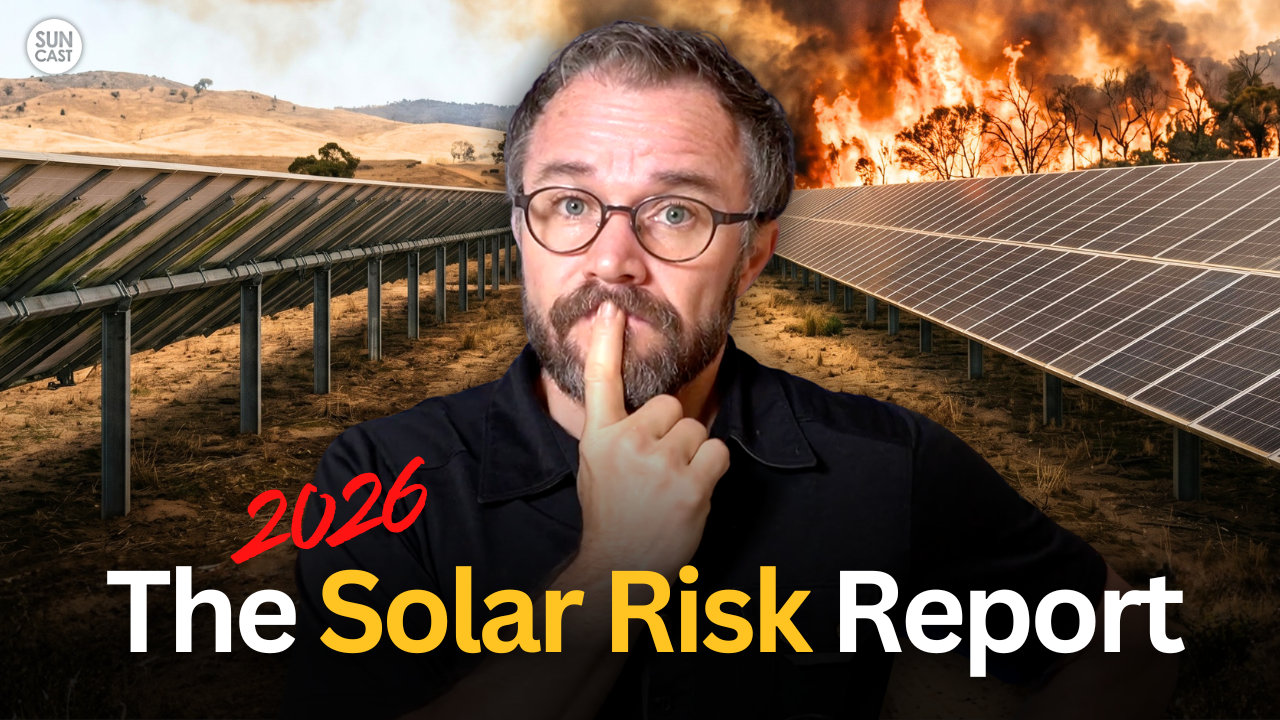
In this episode, Jason Kaminsky, CEO of kWh Analytics, walks us through what the latest Solar Risk Assessment reveals, and answers a deceptively simple question: Which solar risks actually matter?
Drawing on dozens of partners’ fleet-scale operational and underwriting data, Jason explains how the industry is moving beyond anecdotes to identify the risks that have a measurable impact on long-term performance, resilience, and project finance.
Expect to learn:
🔹 Why the solar industry finally has enough data to challenge long-held assumptions
🔹 What recent findings say about fire risk, bio-soiling, tracker performance, and equipment failures
🔹 How seemingly minor operational issues can become major financial variables at portfolio scale
🔹 Why insurers, lenders, and asset owners are paying closer attention to resilience
🔹 How the best operators are turning better data into stronger long-term outcomes
If you've seen the latest Solar Risk Assessment was released, but haven't had time to dig into it, this conversation is your guided tour through the findings that matter most.
Listen now to learn how the industry is turning better data into more resilient power.
RESOURCES:
Connect with Jason Kaminsky:
Check out kWh Analytics:
"I think the world is sort of evolving where you don't need to be an expert in everything, and know how to solve everything, but you need to be aware of the issues." – Jason Kaminsky
This Podcast is Free For You
Thanks to Our Sponsors
The following are Corporate Partners who have helped make SunCast possible:
Platinum Sponsor
The following are Corporate Partners who have helped make SunCast possible:

Noteworthy Quotes:
Nico Johnson 00:00
Solar and storage projects are increasingly being financed as long duration infrastructure assets modeled over 35 and even 40 year operating lives, but the industry is now reaching a point where we finally have enough operational data to discover where conventional wisdom starts to break down, things like wildfire maps that don't actually predict most PV fire losses, wind models that miss how trackers behave in real conditions, or operational issues that seemed minor at one small scale segment of our industry's growth, but have become major financial variables across gigawatt scale portfolios, and the timing of this year's solar risk assessment is notable, just weeks after kWh Analytics announced its acquisition by specialty insurer Beasley, it feels increasingly clear that renewable energy insurance is no longer a side conversation in project finance. It's become a core infrastructure for how projects get financed, how they operate, and how they're underwritten. Today, Jason Kaminsky of kWh Analytics joins us to break down the biggest signals from the 2026 solar risk assessment, which assumptions are failing, which risks are being misunderstood, and why resilience has become one of the defining competitive advantages of the next decade in energy infrastructure. Jason, welcome back to Suncast. Hello, Nico. Thank you for having me. Before we get into the actual guts of the SRA, I'm curious, what feels to you materially different about this year's report compared to maybe even two or three years ago? What's changed in the industry understanding of risk?
Jason Kaminsky 01:35
You know, I actually was looking back - this is year eight, so I was looking back at our first one in 2019 and many of the themes I'd say are consistent, right? If you're looking at what affects energy production, like all the way back to 2019 that was sort of a core theme of that report. I was actually surprised back then we actually had one article on hurricane risk and what, how that affects solar projects, pretty light. The things that were notably absent from those early reports were things on battery storage on wind facility, that's a more broad-based renewable energy this year, as well. If I compare it to recent history, we took an emphasis more on what we call emerging risks, so things like tax credit exposure, regulatory compliance, things that operators are certainly dealing with day to day, and have large potential financial implications that have to date, I guess, starting this year, I'd say otherwise have been, I'd say, less discussed, but we're beginning to shine a light on this.
Nico Johnson 02:28
It feels like the shift we're finally seeing as well, and you get this from the volume of data coming in from the partners mentioned in the report, is we finally have enough fleet scale operational data to distinguish anecdote from statistically meaningful patterns. Would you agree to that?
Jason Kaminsky 02:46
Yeah, well, I appreciate you noting partners, because this is very much not a KWH study. It is, we contribute to it, but we do pull in. I think this year we have maybe 16 contributors from all throughout the industry, so I learn a lot reading
Nico Johnson 03:00
it,
Jason Kaminsky 03:00
frankly, when I, when we're putting it together, and yeah, the requirement is it's a data-driven conclusion packaged up in a way that has a business conclusion and is accessible to the everyday reader, and you're right, I think if we look back in the early days it was maybe a little bit more anecdotal, there are some statistics around it, and now everything I'd say is not quite actuarial, but there's a lot of evidence to support the articles that are being shared this year.
Nico Johnson 03:27
Yeah, I was speaking of the partners, it's it's a who's who of the especially the utility, the large scale sector of the industry, from DNV and Kiwa to Next Power, Game Change, Groundwork, Light Source BP, tremendous. breadth of deep industry expertise, each of them in their own way considered leaders in the data that they can bring to bear, even a few sort of younger companies, so to speak, Raptor Maps and Crux that are contributing from their unique data sets. It's really impressive. What's also impressive, and I mentioned in the lead up, in the timing of the report, is kWh Analytics has achieved what many of us in startup land, in entrepreneurial dreams, seek, which is to at some day, some point, have sort of an exit moment. I mentioned that Beasley, the global insurer, acquired KW Analytics. Now I'd like to, without getting into deal specifics, sure, better understand from you what this acquisition perhaps signals for where renewable energy risk management is headed.
Jason Kaminsky 04:35
Yeah, well, thank you, Nico, for that. Yeah, there's a lot of work involved in putting together a deal, as I'm sure you and many of the listeners know, or at least can imagine. Yeah, so insurance is sort of this funny industry. It's multi trillion dollars of turnover a year, if you include health insurance and life insurance, but you package it all together, giant industry. And most people are unfamiliar with the names of people or companies that are involved in that space, so Beasley. Most of the time, what I hear is I've never heard of them, and that's fair, but they are a very substantial player in London and throughout the world, and they are known as a specialty insurer and reinsurer, so they like to target on risks that are otherwise poorly understood but growing, and when they were looking across the world as far as where a growth opportunity is, they had identified energy transition, which is why you know our partnership made a lot of sense, but I think if I sort of rewind, we started doing insurance in 2017 and I think most people didn't understand why a startup would be focused on insurance or where innovation comes from that, and then we moved into property insurance in 2023 we launched property insurance, so underwriting physical loss for solar storage and wind facilities, and I think a lot of people thought, like, oh, that's, you know, kind of understood, and we look at it right, and there's still, I mean, I would say there's still a lot of learnings we were doing as an industry every year, this year we're talking about fire, but every year there's new statistics that come out, new insights that come out, and unfortunately massive losses that emerge as well, right. So, what can we learn from those? How do we take that and push it back out to the industry? And I don't want to pat ourselves on the back too much, that's not the point of this statement, but there's not a lot of forums for these kinds of learnings to be shared broadly, right, there's conferences, people talk, which is great, we do that too, it's important, but there's very few publications you can pick up and hand to a trainee or hand to someone in asset management and say read this next week and see what you can take away from it, and that's why we do this, right, is that we learn from it, we think it's a good platform to spread our name and spread our learnings, but frankly, there's also just like a void in the industry. I think of what we can pick up. There's podcasts, obviously, Nico. Right, thank you for all the work you do. I don't know, I think it's important to share some of these learnings, and yes, it's called the risk assessment, but a lot of the articles also include potential solutions, right, things you can do to address the risks, risks that are being assessed. So, I know that was all very long-winded. I think the question which you asked is, what role does insurance play in risk management? I think that's growing, right. I think a lot of insurers like to tell themselves that they can help their clients, and I think in our space that's probably been under penetrated, right, and I think we do know a lot more as an industry about natural catastrophes, about physical damage. Developers are incredible at many things, right, at land, at interconnect, at equipment supply, at building things. They're not incredible at nat cat management, for the most part, natural catastrophe management, because they haven't had to, right. So I think we have learnings as an industry we can share, and I don't know. I think the acquisition is a sign that insurance can play a bigger role there, and that insurance is a lever to bring more capital into the industry. Right, you can't finance an asset if it's uninsured. So, I'm excited for the potential of joining a global platform, and the ability to be hopefully a little bit more nimble, even though we're working within a big company, of, you know, launching new products and seeing how we can help the industry continue to grow.
Nico Johnson 08:09
Put into perspective for folks who aren't familiar with Beasley, and I think that was a really well-rounded answer. Thank you for that. As recently as January, February, Next Power had about an 11 to 12 billion market cap, they're doing fantastic right now for all of us who perhaps have equity in those, in those in our, in our friends in the industry at Nico, next power, happy to see it's at 18 billion, but Beasley is around 11 billion in market cap, so by no means a small company throwing off for three years in a row, more than a billion in profit, which, of course, they've been able to now share the love by acquiring KWH. I mean, that's how, that's how, that's how the cycle works. I was thrilled for you and our friend Richard Matsui and the team who built such a needed product in the industry and really took a long view bet on the insurance market's role in helping get financiers and asset owners comfortable with this asset class, but it suggests for everyone, and it should, that not just solar and storage, but the broader renewable sector is increasingly being treated more like mature infrastructure, a class that we can rely on as a 4050 year asset rather than an emerging technology. Something that stood out to me, though, reading the report is it feels like less like a collection of technical observations and more like the industry finally has enough operating data to challenge long-held assumptions, but there are themes that emerge beneath, and they are, you know, start with sort of this characterization of assumptions once held that are now failing us. So let's start with fire risk, which this one really surprised me. The report purports only 4% of fire loss events occurred in high wildfire risk areas, but 84% were equipment driven brush fires originated. Something inside the plant. Why does the industry still tend to think about fire primarily as a geographic wildfire problem? And what should owners and operators actually be paying more attention to?
Jason Kaminsky 10:09
Most insurers, and most people, when they think about insurers, think about natural catastrophes, right? And when you think about hurricane, okay, that's broad-based hail, broad-based wildfire leads to massive losses, right. Last year we had the Palisades fire, right, big loss for the industry.
Nico Johnson 10:25
Yeah,
Jason Kaminsky 10:25
huge event, terrible event, right. The good news, it's good news, bad news, I guess, right, is that solar projects are built generally in not wildfire zones, right. Wildfire zones tend to be a little bit more forested, a little bit more urbanized. Well, maybe the I want to say urbanized wildfire areas tend to be a little bit more forested, right? And the fires burn really hot. Solar projects, by design, we put sort of in the middle of nowhere for the most part, right?
Nico Johnson 10:52
Yeah,
Jason Kaminsky 10:53
so the good news is I suppose that they are more controllable than nature, right? They are brush fires, they're still bad, right? Last year we said hail was the number one driver of loss, still the case, right? Number two is fire. So, when we think, what are those sort of events that can lead to really, really significant losses for an owner? Those are the top two. So, we think about them a lot, but you can do a lot to manage your fire risk, right? You can build fire breaks, you can manage your load, your vegetation management, right? Manage how much brush is on site. You could coordinate with your fire department. You can.. there's all sorts of things that an owner can do to help sort of control that exposure, which I think is the good news, right?
Nico Johnson 11:34
Does the data give you a sense of a variation between equipment selection versus site management O and M strategy?
Jason Kaminsky 11:41
The insurance term would sort of be frequency versus severity, right? So the frequency events would be from equipment, right? Inverters cause a lot of these, so they spark, something happens. We've seen like mowers spark a hit a spark, like hit a rock and create a spark. So those are the things that cause the fire. The site management, to your point is, then what happens once the fire starts, right? The site management, how you coordinate with the fire department leads to very different loss profiles, right, different outcomes. So you sort of want both, right. It's good to know. Okay, what are those things that could start a fire? They are also controllable, right, by how you operate the site, but things happen right, so if the bad thing happens, how do you also manage the loss profile, right? That's that's sort of the second point that you brought up there.
Nico Johnson 12:29
We'll link to somewhere here some episodes that we've done on fire, specifically. We had a fantastic couple of episodes with Kathleen McCaffery, formerly Global Fire Liaison for Tesla, all about fire, especially with regards to batteries, but I want to continue to hit on a high level some of the assumptions that I feel like the report challenges. The report says hourly wind models, for example, can under predict tracker stow losses by up to 4% What's actually happening there?
Jason Kaminsky 12:56
Each of these tracker manufacturers has their own algorithms to say, okay, if there's wind, right, something we're gonna, we're gonna protect the tracker, right. We don't want to blow apart, and we've seen this in a few facets of the industry, right, that it started with hourly modeling, right, and we're getting better at doing that now. People are doing minute modeling, as far as irradiance, right, and sort of, how does that affect production? This is another more operational decision that is affecting what's happening on the ground and affecting the production output, right. So, arrays research says that single axis trackers stow based on three second gusts and or one minute moving averages, right. So, there's sort of these very narrow temporal events that affect what's happening operationally to a tracker, and if you're modeling it on a much sort of more crude basis, which is natural, because it takes a lot of processing and a lot of very refined data to do. You're going to basically underestimate those stove events, which take it out of the optimal tilt and end up in lower production. Sort of like I get asked more than you might guess to say, is there a single thing that the industry is doing that leads to these assets to underperform, like we put out research that assets on the whole underperform, I don't know, six or 7% and the short answer is no. It's all these little things that sort of add up that all have little contributions to say yes. In theory, the asset could produce x, but in reality it produces 93% of X
Nico Johnson 14:21
Jason. I also thought that the bio soiling section was quite fascinating. Not that rain doesn't help clean modules - we all have known and understood this - but the industry may have underestimated exactly how the biological buildup of compounds over time, especially in humid climates, impacts the overall performance of the system. What changed in the data or analysis that allowed the industry to finally identify this more clearly?
Jason Kaminsky 14:47
So, Nico, I love this article because I've been doing this a long time, and this one to me came out of left field. I was like, what? What do you mean, sort of my reaction when I read the article, and the theme is that you have glass. Panels right, and the rain comes, and it gets rid of the bird poop and the dirt, and everyone thinks that your panel is clean. And the guys that started this company, Solar and Soiled, I think it was a PhD research project, that said, "No, there's actually like invisible algae that's growing on the glass and is absorbing the sunlight and affects production, and the only way you can clean it is by scrubbing the glass, and I read that, and my mind was blown. I was like, that did not even cross my mind as a potential scenario that we have to deal with as an industry, and you know, the stats were that it could have up five and even upwards of 10% losses, depending on the circumstance, and sort of where it's located, and the nature of the equipment, so you know, a problem seems like, again, there's a solution to it. I don't know how cost-effective that solution is, but a solution to it, and just one of those things that I was like, yeah, of all of the articles that went to me as a standout article, just because it was so unexpected as a type of risk that we have to worry about, and I do think at points sort of underscores your point of the advanced level of our industry, right, that we're getting to understand tier two, tier three effects that in the past no one had ever even thought about looking at. Right now, someone wrote a PhD paper on this idea and started a company around
Nico Johnson 16:17
it. I mean, the reality is, how many of these risks were basically just invisible until the industry was able to accumulate enough fleet scale operational history, which brings up brings me to the next theme. Another finding that really jumped out at me, and I think this one came from Next Powers, new one of their recent acquisitions on site. 79% of high risk connector failures showed no thermal signature during inspection, and that seems to be like the antithesis of what every inspection company would have you believe. So, talk to me about why this is such an important finding.
Jason Kaminsky 16:52
Yeah, also, so Next Power bought the on-site little robots that go around and take pictures of all of the, all of the modules. I follow them on LinkedIn. I often love their videos, the photos that they show, and yeah, that was an incredible finding to me as well. Right, that you have these issues that are on site, right? And for a long time we were doing drone inspections, which I still think have a lot of value associated with them.
Nico Johnson 17:15
Sure,
Jason Kaminsky 17:15
but their research was suggesting that there are other signatures that you can identify before it turns into a hot spot or a thermal event, or maybe I'll call it a pre-thermal event, right? Like, you have a connector that's burning really hot, and then eventually will melt, and then eventually we'll start a fire, and then not a brush fire, right? As we talked about earlier, that is one of the ignition sources for a solar project. Exactly, you know, it's incredibly these little robots go around, they can show that, like, the connectors aren't mated, or that there's separation between the protective layer and the connector,
Nico Johnson 17:46
right?
Jason Kaminsky 17:47
And it sort of makes sense, right, that you'd see that before you would see it in the data, or you'd see it as, like, a actually a hot piece of equipment, and you know, now we have the algorithms, and maybe with AI, we have the ability to say, hey, go fix this now, because with the passage of time, it will be a hot spot, and we all know it's better to fix this as preventative maintenance than as, like, an emergency. So I like that idea to say, okay, we have a queue, here's all the issues you got to deal with, add it to the queue, right, and fix it before it turns into a major event.
Nico Johnson 18:19
Yeah, we had Derek on to talk about the on-site robot and the processes that they were training their AI around. What stood out to me is what you pointed out. There are variances measured in micrometers, right, that human eye might not pick up, but the robotic camera imaging software that is scanning millions of connectors is able to pick up these variances, and they have, they have a partnership with Stobly from the very beginning, specifically around analyzing connectors to see if they could start finding these kind of, like you said, pre risk indicators, and I think it's fascinating that I agree with you, the article is really fascinating, and it underscores how this document, this oil risk assessment, is put together. It's a series of articles that dig into, we talk about at sun cast, signal versus noise, and there's a lot of noise around how we've been able to start trusting these systems and the data, and this is one proof point of, like, well, a thermal inspection used to be the gold standard, and now we see that there are, with additional data points, there's other risk factors that can be detected that thermal signature alone won't find.
Jason Kaminsky 19:33
Sorry, just on that point, the last two articles, right, the algae article and the biosmoking article, and the next power one. I mean, also this has sort of turned a little bit into an episode, entrepreneurship, but start identified by entrepreneurs, so we can be either have some research or technology that we can deploy and have built into companies to say we've identified this risk or we've identified a way to track risk, and we want to start companies around. It right, and I think it points to just the amount of innovation that's happening in our space, and like, sort of the, the, the earnestness of our industry to try to build, to your point, and operate a long life duration infrastructure asset.
Nico Johnson 20:17
Well, in this episode, we're not going to talk about the number one risk factor, which continues to be hail. The very first article I'd point to is another great example, like the ones you mentioned, Groundwork by, is run by a fantastic entrepreneur, Anne Will, who has had her own success story of being able to carve out a niche where people really wouldn't have said, like, you can build and scale a business focused only on this meta data and building sort of operationalizing site data for clients when very few people were capturing site data. I'd like to move into sort of how these subtle operational details in models for the last 1015 years are now becoming real financial variables, and that theme is that things that once look kind of like isolated operational details really do become measurable risk factors at scale. The engineering didn't sort of suddenly start mattering financially, it always has, but now, because we finally have built enough actual fleet scale evidence, and we can quantify it. These operational realities become visible through projects like the solar risk assessment. What do you think are some of the best examples of that evolution?
Jason Kaminsky 21:32
You know, I think Nico, it underscores, you know, maybe the challenge of the asset manager and operator in today's market, right? You have a financing team and a development team who comes up with a model, and then they hand it off, and they say, you know, go, go meet it, go meet those targets.
Nico Johnson 21:47
Yeah,
Jason Kaminsky 21:47
and there's just a myriad things that could go wrong, right? So, there's other articles in here about twisting of the trackers, right? If you look at where it starts, I guess, and where it ends, there's a noticeable twist just from day to day movement and wind loading. There's an article from Light Source about fuse sizing, and how that, if they're undersized fuses, can lead to material power impacts on the battery side. There's an article about HVAC equipment and how that could be a source of failure and repeated failure, right, and lead to operational downtime and challenges associated with that, there's some on wind, obviously. There's whole financing side we haven't talked about here about tax credit insurance or just tax credit sales and managing fiat risk, and there's a whole new set of issues coming with that, but I think that the complexity of being an owner in many ways has grown over the years, right, as we identify new issues like bio soiling, you then have to go and sort of put work behind how do you solve it, and again, I guess if we're sort of sticking with the theme of the entrepreneurial journey, there are vendors for the most part that you can turn to that can also help you solve it, right? So I don't think it's.. I think the world is sort of evolving where you don't need to be an expert in everything, right, and know how to solve everything, but you need to be aware of the issues, and then think that I mean I'm speaking out of turn, because I'm not an asset manager, but it sort of feels like the job is prioritizing what all those issues are, right, figuring out the cost benefit, and then managing the best asset you can, right, for both, for like performance risk, I'll call it, yeah, please,
Nico Johnson 23:20
and I can bring it closer to home, so you don't have to speak out of turn. At what point do these subtle operational decisions become underwriting questions rather than simply operational modeling assumptions?
Jason Kaminsky 23:31
Hmm, good question. Oh, bring it to the insurance underwriting team. Huh, you're right. I mean, we do the same thing, right? So today most of our business is property insurance, right? So we're thinking about what are those major drivers of loss for the industry, right, but we, we look at the same way, right? What, what are those operational decisions that can reduce risk, right? So the Groundwork article was co-written with Nicole Thompson, who runs our data modeling team. How do we think about the interplay of glass and stove strategies and operational effectiveness around those strategies and hail alerts and sort of the whole set of business around that, or how do we think about fire load management? Right to your point earlier, and there's no, there's no single, I mean, I think that's sort of the theme of this industry, right? There's no silver bullet solution, you sort of have to look at all the cost benefits associated with it. Yeah, I think that's an opportunity for us as an industry, frankly, is is we're good at identifying the risks, but a lot of the cost benefit, right? I get asked all the time, also, if I do x, will I get a discount to help
Nico Johnson 24:30
pay for it? Exactly, exactly the question in everybody's mind right now, right? If I go with heart hail hardened modules, is the offset and insurance risk gonna pay for it, that's that's what folks are trying to figure out,
Jason Kaminsky 24:43
so they're trying to figure out, and we do price to it, right? It does show up in our pricing, because we adjust, we do risk-adjusted pricing, right? So it does show up in our pricing, so in short, yes, but also not to make this a whole insurance conversation, that is somewhat cyclical, right? So in today's market people. More risk on, they're willing to ask fewer questions, and just sort of roll the dice, and you might not get the price signal as strongly in today's market, but insurance changes on a dime, right? It'll, it'll show up in two years, and you don't want to be caught flat-footed, so sort of have to take a little bit of a longer-term view when it comes to insurance, because it reprices every 12 months, right, for the most part, and we're in a risk-on market, but it will be risk off again, because it always is. It's sort of a cycle, insurance market worse than cycles.
Nico Johnson 25:28
Yeah, and, and for anyone who, I mean, thankfully, we've got 900 episodes to go to dig into, but anyone who maybe didn't hear the episode we did with Kevin at Light Source BP about specifically all the work they did down in Texas to basically validate that insurance will give you better premiums if you take proactive measures against these environmental extreme environmental impacts like hail. Well, we can link to that episode as well, but you know, Jason, think up to now, folks might think, "Wow, it'd be easy to feel like doom and gloom. The report points out all the things the industry still needs to fix. I think the optimistic story seems to be that many of these risks, not only are measurable and manageable, but we are learning to improve on them if operators identify them early enough, and I've heard you talk about the idea of resilient power, the projects and systems that nobody hears, because they simply perform the way they're supposed to. What are the best operators doing differently today? What are some of those resilient power examples?
Jason Kaminsky 26:38
Yeah, maybe I'll answer your question a slightly different way, which is, what are we doing as an industry, or what? Where is some of that innovation happening? And I'll point to maybe a recent partnership we just announced with Next Power, right? Hopefully the first of many, which is you're right, there are things you can do to manage it, and in today's world of AI, and sort of I'll call it getting closer to data transparency. Everything has monitors on it, right? Everything is tracked all the time
Nico Johnson 27:06
very
Jason Kaminsky 27:06
granularly. So, next power knows, right? Is your tracker going into Hailsto? Is it getting a hail alert? Is it going into Hailstowe? What performance is it doing? And, in the absence of data, right, as an underwriter, we have to assume a client is average or below average, right. You can't assume everyone is best in class, because, well, because you can't. So, what we also find, though, is that getting very granular data is sometimes hard for a client to then share with a broker to then share with the markets and explain exactly what's going on. So, we said, let's connect the dots behind the scene, right? You sign a form, there's confidentiality protections in place. What do we get? We basically see did those trackers go in stow, and sort of what was the associated effectiveness of that, and we can underwrite to that, right? So you're right, there are risks associated with a lot of this stuff. It is the risk assessment, as we've talked about. There are solutions to many of those, and I'd say the next step then is, how is that communicated broadly with other stakeholders, right, with the financing community, with the insurance community, and we're beginning to also draw some of those connections to say, okay, if you have a drone flying over and it's lowering your transformer risk, if you have a tracker that's going into Hailstoe, right, if you have whatever, there's lots and lots of things that we could be looking at. How do we make it seamless to say, okay, we can go get that information from those various parties, and you as a client, right, you just do the work, and all of us behind the scenes will go make sure that we know how it's working, and then ultimately give you feedback on it, right, and say we think this is good, or we've seen this other issue with this other client, and level up the entire industry, that to me is maybe the most exciting opportunity. Is we are building a lot of infrastructure, and it's going to be out there for a long time, and if our, you know, little company, maybe now part of a big company, but can give people feedback about what they could be doing to improve, it's, I mean, it's, it's not in areas where I'd say they are the experts, right. There's going to be a lot of things that are out of our core competence, but there's some things that I'd say we know particularly well, right. Those are the sorts of insights that we want to be sharing with our customers. Yeah, tell, yeah, make these very durable, resilient 40 year life assets that we frankly don't read about in the news, because they're working and there's no issues. Yeah, hopefully the solar risk assessment is one page in the future. I doubt that will be the case, but that's maybe an aspirational goal.
Nico Johnson 29:31
Jason, I am sure someone out there like my friend David Pena Volta is going to say, How do I get my reports and data and articles into the solar risk assessment. I'm doing valuable field work to ensure that we understand the risks to developers. Who's the person on your team they should reach out to? Ooh,
Jason Kaminsky 29:53
great question. So, yeah, so some of these I'd say it's a mix, right? Some of these are inbounds, right? We get approached. By people saying, can we join the solar risk assessment? We have a unique insight. Some of the times we're doing outreach. Nicky on our team, who runs our marketing, she really should get a ton of credit for making this year's report, as well as previous year's reports, such an incredible publication. So, you could reach out to us through the website, or reach out to me, or Nicky, who I think you could find on our website, and word of caution, right, it's not going to be for another year, but it is about a six month effort. We start this in January every year, so there's a lot of work that goes into it behind the scenes to get, I'd say, articles that are really digestible and readable and make sense for taking a sink like a key statistic and trying to make it actionable,
Nico Johnson 30:44
Jason, as we close, you're talking directly to the best and biggest developers, asset owners, operators, even financiers in the industry. What do you hope is the biggest shift in thinking they take away from reading this year's solar risk assessment?
Jason Kaminsky 30:58
Yeah, I think if I, if I go back to the theme of data transparency and maybe data liquidity. Right, I've always been impressed that the asset management community is one that shares a lot of info with each other. Right, I think that community, more than any other community I'm a part of, has said we do not benefit if our neighbor, our competitor, has an issue with their plan. Right, like no one wins when there's a big fire, or no one wins when there's a big hail event, or when our neighbor system is just not producing well, right. So, there's a lot of data sharing. The next phase of that is, I think, setting up those systems behind the scenes, right? Like, we, I'll be honest with you, Nico, we put out our first research that said assets were underperforming seven or 8% and I've heard recently people thought it was a lie. People thought it was like those guys are self-interested, they're just putting that out to help sell their products. And then they were like, but we looked at all of our data and it almost exactly matched the statistics you're putting out, right? Like, it's all, it's all based in data written by our engineers, but but I think the next phase of that is saying some of those vendors, right, some of the underwriters, some of the financers, there's tools behind the scenes for some of that data to be shared in a way that is protected, right, it's not going to be public, but that can be used to help benefit both the client as well as the rest of the sort of financial stakeholder community, and that feels like the way that the industry is going, right, is how do we sort of build solutions and connectors, and you know, glean those needed insights, so that we can benefit ultimately the customer who we're all trying to serve, which is the asset owner.
Nico Johnson 32:39
Jason, as always, I appreciate the conversation. The report is dense in the best possible way, and I think that is what makes it valuable, and it is the fact that the industry contributes to it. It's not from one single entity that allows us to separate signal from noise here using the operational data that you and your colleagues have been able to sift, I love the terminology you used, and I'll try to continue integrating it, data liquidity. I hope for all of you who are listening that this overview of the solar risk assessment helps those of you, like me, who prefer to listen rather than read, but if, if you are a voracious reader, it is not an overly complicated or long document to get through. It is a concise 32 page document with individual articles you can read one at a time, like a magazine or trade journal. I would encourage you to treat it as such. Maybe print it out and put it on your desk if you are in, if you're looking for the tactile nature of it. But do read it. Don't forego. We did not dig into every story. This is meant to be a taste, a taste test for you of whether or not there's something more that you want to consume, I can promise that you will. Jason, thanks to you and your team for helping once again put together the annual solar risk assessment, and for giving us your valuable time.
Jason Kaminsky 34:13
Thank you, Nico. Thank you for listening,
Nico Johnson 34:15
and thank you also for listening. I hope that you'll tune in again. We've got almost 950 such episodes, including episodes with Jason, all about what kWh Analytics is, because he's been one of our many executive profiles that we cover here, entrepreneurs, founders, and operators on the front lines of the energy transition, helping you sift through and then separate the wheat from the chaff, the signal from the noise, as I like to say, I want to thank our sponsors, who helped make this all possible. They pay the bills. All we ask you to pay is attention. I hope the next thing you'll pay attention to is downloading the Solar Risk Assessment. You can also go learn more about all the fun conversations we've had over the last 10 years at SunCast dot Media. Remember, you are what you look. Into thanks again for showing up, Solo Warrior. It's half the battle.

Nico Johnson
Entrepreneur & Podcaster
In my 20 year career, I've worked with dozens of entrepreneurs, intrapreneurs and professionals in transition to clarify their mission, set or stretch their goals, and work through the barriers to their growth.

Latest episodes

We’re Excited to Hear from You!
Don’t hesitate to reach out—whether you’re here to learn, share ideas, or work with us, we’re ready to connect.