
We'd love if you'd leave us a 5 ⭐ rating & review and it's never been easier: www.ratethispodcast.com/suncast
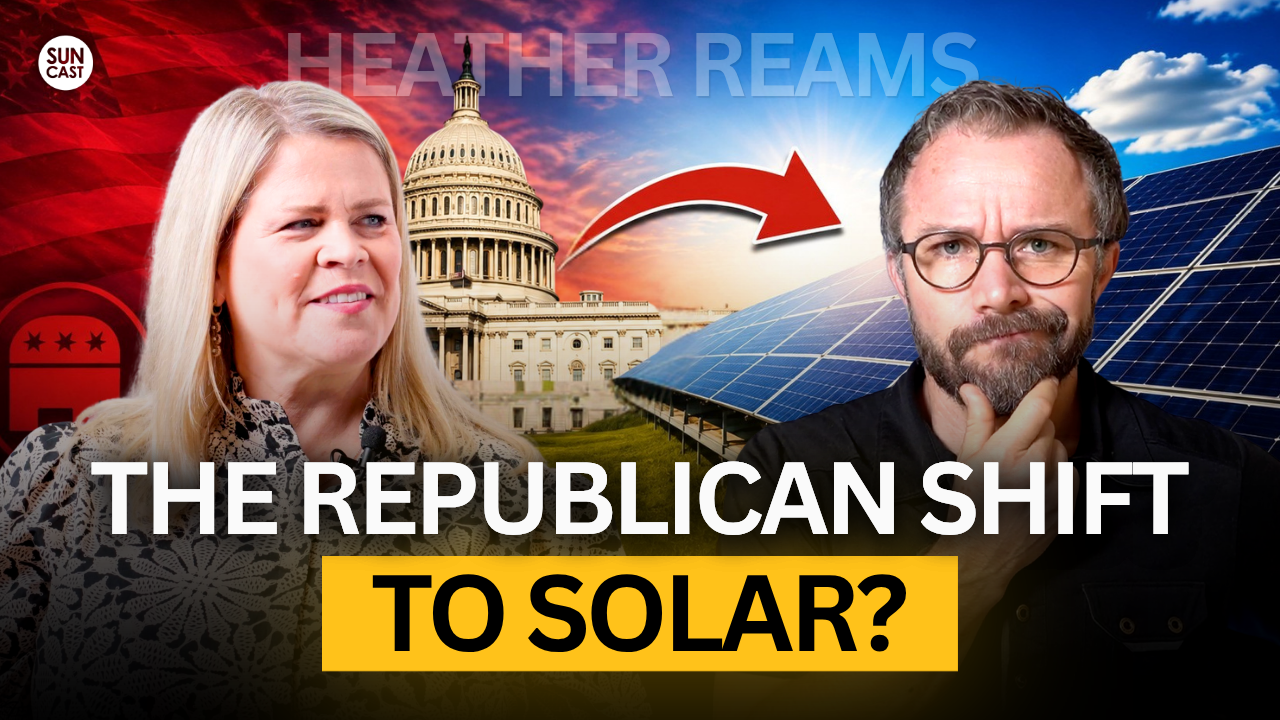
Heather Reams spends her days at the intersection of clean energy and public policy, helping shape conversations with lawmakers about how the U.S. meets rapidly growing electricity demand. As President and CEO of Citizens for Responsible Energy Solutions (CRES), she brings an insider's perspective on the political shifts redefining how Washington talks about solar—and why those shifts matter far beyond Capitol Hill.
In this conversation, Heather explains why affordability has become the dominant energy issue in Washington, why permitting reform remains one of the biggest barriers to building new infrastructure, and why solar's greatest political advantage today may be something much simpler than subsidies or ideology: it's ready to be built. Along the way, we explore how Republican engagement with solar is evolving, what changed after the debate over federal tax credits, and why the industry's long-term success still depends on educating policymakers and communities alike.
Expect to Learn:
🔹 Why solar's ability to deploy quickly is changing how policymakers evaluate its value (11:38)
🔹 How affordability and rising electricity demand have become Washington's defining energy priorities (00:58–02:02)
🔹 Why permitting reform is fundamentally about building infrastructure—not just renewable energy (04:28)
🔹 What the debate over federal tax credits changed inside the Republican conversation around solar (13:16)
🔹 Why transmission and permitting certainty matter just as much as favorable policy (05:24)
🔹 Why the clean energy industry cannot stop educating policymakers and the public simply because adoption is growing (16:40)
If you want to understand where clean energy fits in today's Republican Party, this conversation lays it out plainly. Hit play and hear it straight from inside the Beltway.
RESOURCES:
Connect with Heather Reams:
Check out Conservative Climate Foundation:
"Nuclear is exciting, and it's emissions free, but it's 15 years out to build, so there's no instant gratification." - Heather Reams
This Podcast is Free For You
Thanks to Our Sponsors
The following are Corporate Partners who have helped make SunCast possible:
Platinum Sponsor
The following are Corporate Partners who have helped make SunCast possible:

Noteworthy Quotes:
Heather Reams 00:00
Nuclear is exciting, and it's emissions free, but it's 15 years out to build, so there's no instant gratification. The solar industry has got its hands up going. We're ready to roll now.
Nico Johnson 00:14
Today, we're joined by one of the most influential voices inside the Beltway, Heather Reams, President and CEO of Citizens for Responsible Energy Solutions, otherwise known as Crez Heather. Great to have you.
Heather Reams 00:26
It's great to be here, although I'm not inside the Beltway right now. We're
Nico Johnson 00:29
not. We are inside the RTP, the Research Triangle.
Heather Reams 00:35
It's good to be out.
Nico Johnson 00:36
The Tri-State, you know, they call it the Tri-State, which is weird, like somehow it incorporates Greensboro, which is over an hour away. Heather, you spend your days, however, walking the halls of Capitol Hill, talking to policy makers. I'm curious, how you would distill or summarize the conversations that are dominating Washington at the moment with regards to energy.
Heather Reams 00:58
Well, I think it's affordability is kind of the big issue right now, keeping costs down, recognizing that demand is kind of going way up.
Nico Johnson 01:06
Yeah,
Heather Reams 01:07
but don't realize this, but like electricity demand has been pretty flat for a long time, it's allowed for some extraordinary growth in energy and renewable energy, for instance, but now we have this demand that we have to figure out how we're going to meet it, and they are policy issues, regulatory issues that you need to be solved, both in the state capitals like Raleigh, and then also in Washington, D.C.
Nico Johnson 01:32
Yeah, I think that folks who aren't necessarily in super into politics are missing the point that affordability is a political priority, and it's something that you know, talking to Jake about this, that over the last couple of days, that with over 30 gubernatorial races in, in the nearer view, energy policy is all of a sudden not a lower tier issue, but a top five issue.
Heather Reams 02:02
Not only that, it's the backbone of really what's the future going to look like in terms of how we run our lives, and you know what AI means. We could be here all day talking about what that means for us, but it could be some incredible breakthroughs in how we live the quality of our lives, both in the United States and around the world. So, there's a lot at stake here.
Nico Johnson 02:23
I'm curious around where generally clean energy fits into the conversation that you choose or do not choose to engage in, right? Like, you've walked the line of needing, needing the needing of forming this support role, sort of like the Republican whisperer for our industry, but also like Abby was saying about her job at SIA, being the one that comes back and is the voice of truth, is saying, hey guys, this is actually really what's being talked about,
Heather Reams 02:55
you know, it's been being a right of center organization and advocating for clean energy isn't what an easy job, I'll have to say, and, but it's getting easier because people are more familiar with renewable energy, they see, they drive past it, they understand it, they know that it's affordable, it's clean, they sometimes question reliability, but with batteries, we're starting to see solar plus batteries is nearly base load power, so technology is changing as well, and so keeping people informed about that is really important. And members of Congress, policy makers are listening to folks back home, they want to know what others think, so familiarity and understanding that education is critically important. But not every state is the same, not every locale is the same, so we have, that's why we recognize that more all the above is great, and a mix of energy is going to provide the greatest benefit for reliability, affordability, and cleanliness.
Nico Johnson 03:53
Yep, I feel like permitting reform is almost a universal talking point at this juncture.
Heather Reams 04:00
I didn't say permitting reform is like the not the top issue, I said affordability, I don't know, maybe, but
Nico Johnson 04:05
it has become, it feels like inside political circles a universal talking point about energy. One of the things that's surprising me, though, is that there are real obstacles to permit reform,
Heather Reams 04:18
definitely,
Nico Johnson 04:19
and it's not constrained to just solar, like a lot of solar folks are like, "Oh, permitting reforms like it's a renewable energy thing. No, it's actually like so much bigger than that. It's
Heather Reams 04:28
in everything. If you want to build the United States, you're talking about permitting reform, but specifically about energy, it's not just solar, it's transmission lines.
Nico Johnson 04:37
Yeah,
Heather Reams 04:38
need to move that energy. There's electrons from point A to point B. You got to build some lines to be able to move it, and usually those lines go across state lines boundaries, and that means you got to get, you know, policy makers in Washington, D.C. involved, so it gets, it gets pretty complicated. I think what we're seeing across the board in Washington, like different kinds of stakeholders all. All agreeing that we need some kind of modernization of our permitting, that it's from the 1970s and sometimes even earlier, and 50 plus years old, we need to do something to modernize the technology that we can do today. It's common sense, but the details are complicated.
Nico Johnson 05:18
What are the key provisions that are being debated that hold back her meeting reform, from
Heather Reams 05:24
one of them would be just timelines, right. So there are a number of laws that, if you're on a federal land, for instance, that you need to go through what, Clean Water Act, historic preservation, endangered species, these are all very important laws that need to be respected, but how long do we need to have open comment periods, for instance? And if we could have more predictability, instead of saying, you know, it's going to take, you know, five years for input, maybe it's 18 months. Right now that we have computers, we can do things more quickly, right, bringing technology and maybe bringing AI in, so we can create some more certainty for businesses, investors, developers, that will actually bring down costs, that gets back to that affordability. If we can streamline and smarten up our policies a little bit, it'll give us spades back in terms of costs and lowering costs that get passed on the consumer, ultimately. So, there's some certainty pieces I think that are pretty exciting, but there are also questions about who pays for what,
Nico Johnson 06:31
right?
Heather Reams 06:31
Right, and those are complicated state and federal issues, and there's no clear answer there. There's been some promises from hyperscalers, for instance, who want affordable clean energy that they're going to pay for their energy, that's that's great news, right? That's going to keep costs low, but but how do we move that energy from point a to point b? Who pays for that are still unanswered questions that they're debating in Congress. So, can we get something like totally, you know, comprehensive permitting? Maybe not. Maybe we should start with some smaller pieces, and then have kind of a more piecemeal approach. It sounds like, oh, why don't we just do it all at once and rip off the band aid? I don't know, politically, politically, if we can,
Nico Johnson 07:13
as a center-right organization, as I mentioned earlier, part of the role that you serve is as a voice of reason around how clean energy is benefiting all citizens. There's lots of data from Sia and others that that seem to help eliminate it, would would hope to eliminate the conversation a little more around what seems sometimes nonsensical of why, in particular, the GOP doesn't want to be fans of clean energy. I've seen what seems to be a slight narrative change, even what's her name, is it Katie Miller, and,
Heather Reams 07:55
oh, some of the influencers that are in Conway, even like they're
Nico Johnson 07:59
picking up sort of talking points around solar, how would you characterize the Republican conversation around clean energy right now?
Heather Reams 08:07
I think that members of Congress have generally embraced all the above energy, and that includes clean energy, right, and that's that, that looks a lot like a lot of different things, it could be hydropower, solar, wind, geothermal, advanced geothermal, natural gas, and many Republicans are also proud of the fact that by switching from coal to natural gas, we've reduced emissions in the country by 40% These are things to celebrate, but we shouldn't rest on our laurels. We can do more. Technology is going to allow us to do more, and being part of an innovation agenda is actually part of an all the above agenda that's allowing wind and solar to be as part of, you know, really like undergirding of our electricity demand in the United States. It's allowing us to scale faster because we can build it faster.
Nico Johnson 08:56
Yes,
Heather Reams 08:56
and that's answering a lot of challenging questions for policymakers. So, yeah, they wanted the other one,
Nico Johnson 09:02
sure, but if you back up six months, even just six months, eight months, when OBB was being debated, you couldn't find a Republican to say good things about, well, you probably could, but in the media you couldn't find a single Republican saying good things about clean energy, and if you read just the media, you would think, "Wow, this administration is going to kill all clean energy, especially wind, but solar as collateral damage.
Heather Reams 09:30
Yeah,
Nico Johnson 09:31
so what's changed?
Heather Reams 09:32
Well, I think the OB three package was much more.. well, the tax credits for that were passed in the IRA were part of the OB three that wasn't the whole part, yeah, and there were a lot of Republicans who were signing on to letters, going to the floor in the House of Representatives, for instance, talking about the benefits of clean energy, that this should be left aside, taking those tax credits away was a mistake, so we saw that, but the. Bill was also about no tax on tips, it was about border security, it was about nutrition benefits, it was packed with a lot of, a lot of national security issues. So we weren't just voting on one issue, they weren't just voting on one issue, I guess is the point, and so if you can, these mega bills actually dilute really unfortunately what people really care about, and you aren't able to talk about it.
Nico Johnson 10:23
Yeah,
Heather Reams 10:24
so what you're seeing now is Republicans may be saying, like, okay, some of these tax credits are no longer there, but how can we support energy coming online faster? One of those things is permitting. Yeah, you're seeing plenty of Republicans with their hands up in the air going, we need to treat all energy the same. Yeah, we need to permit it faster, yeah, and we need to do it with a speed that is much faster than what's happening right now, because the demand is crazy, and with demand means costs, yeah, we got to get our arms around affordability, and Republican
Nico Johnson 10:52
states are going to benefit more than anyone, Texas, Alabama, it's the, they're the fastest growing, strongest economies for clean energy deployment, which is the fastest farm of energy that we can build right now. Right
Speaker 1 11:05
now,
Nico Johnson 11:05
I think what's really fascinated me, just coming back to Katie Miller, Kellyanne Conway kind of conversation, is there seems to be something shifting inside the Republican Party, and the narrative, to our great surprise. I mean, we are all caught on our heels, like, what the hell is going on?
Heather Reams 11:22
Celebrate it, don't question it. Just celebrated, I'm all
Nico Johnson 11:26
for it, but I'm not gonna not question it. My question is, what's the political shift that's happening that's driving that? Like, where, where are we? How are we getting these uncanny wins?
Heather Reams 11:38
Let's say a couple things. One is, we were just talking about the speed in which you can deploy solar, is really fast. Yeah,
Heather Reams 11:45
right. So, nuclear is exciting, and it's emissions free, but it's 15 years out to build, so there's no instant gratification. Solar solar industry has got its hands up, going, we're ready to roll now, so use us. And if you're, if you're a policy maker coming up and trying to figure out how do you solve big problems, and you go, wait, they're ready to go, and they're not. Hmm,
Nico Johnson 12:06
yeah,
Heather Reams 12:06
you know, maybe it's creating some space for Republicans to say they were creating space for the president to say, hey, support solar. No, no, really, the reason why these influencers, Republican influencers, are engaging. I'm just glad they are, because it gives us a chance here to talk about how fast solar can deploy,
Nico Johnson 12:25
yes,
Heather Reams 12:25
and solve and solve a lot of the problems that we were facing, like affordability.
Nico Johnson 12:30
I'm hopeful that what we're seeing is so kind of two thoughts that I had. One is I'm hopeful that what we're seeing is actually the narrative that we've been proffering for the last eight months is working, because we've been saying speed to power crate, like let's just use existing technology to get us there
Heather Reams 12:45
back and roll,
Nico Johnson 12:46
and then be what I hear you saying is there are fundamental, we can all agree on this kind of things like permanent reform that when positioned correctly allow for a softening of other positions.
Heather Reams 13:03
Yes, I think that's right. And then wanting technology to be treated the same across different kinds, so what's good for one kind of technology and energy is good for another, and that there's not a picking of winners and losers, so to speak.
Nico Johnson 13:16
Do you think it surprises the right, the solar companies broadly, like the leadership were like great, good riddance to the taxes, the tax credits, because broadly, like the real thought leaders in the industry were like, yeah, you don't need your goddamn,
Heather Reams 13:30
that was like, I think one of the misnomers, because the industry did fight so hard to protect them, of course, but it was just anyone
Nico Johnson 13:36
would do, of course, right,
Heather Reams 13:37
it's competitive, and of course, that's what you do, yeah, but I think what's great is solar, so I'm like, all right, move on, moving on. It can take out some of the companies that maybe relied on, overly relied on those tax credits, and you should, and, and, and it should see that's exactly right. And so I think getting, getting the tax credits out of the way was actually a hindrance for Republicans to engage, because a lot of Republicans don't believe in tax credits generally, and now
Nico Johnson 14:02
when we don't have that, when they're not there, and we're still winning.
Heather Reams 14:05
Yeah, then so I always said solar wants to stand on its own. Let us let it. Well, like, okay, fine, we're doing it.
Nico Johnson 14:12
Cool.
Heather Reams 14:12
Now I want to see what the next argument is, if there even is one. The
Nico Johnson 14:16
other is the analogy of like when you are kind of with your child the first time you take the training wheels off,
Speaker 1 14:22
yeah, the
Nico Johnson 14:22
last thing they want is for you to take your hands off the seat or their back,
Speaker 1 14:25
right?
Nico Johnson 14:26
Right. And when you do, they're like, no, no, no,
Heather Reams 14:29
don't,
Nico Johnson 14:29
right. And I feel like we, as industry, always knew that we had to take the training wheels off. We always knew that, like, we're gonna go through the pain of the, of, of the beginning of the process, but that the end there's something we can enjoy and have proof that it works
Heather Reams 14:47
well, and then you can say, look at them go, right, just like when you let go of the bike and you watch, look at them go, and I think that's what we're going to start experiencing now, and what a great time to be able to look at them go, well. When energy demand is at an all-time high and continuing just to go up, costs are going up. The possibility of, you know, solving big problems, societal problems using AI is really exciting. You know, AI is not just for cat beans, you know, it's for, it's for solving big problems.
Nico Johnson 15:17
What signals coming out of Washington would you point clean energy leaders to, in particular, as not only what we should be thinking about, but how we should be considering our role, and how we interpret sort of what we can, where we can align where there is consensus, et cetera. Like, where should folks be paying attention?
Heather Reams 15:39
First of all, I do think in permitting reform, I think you've got both sides of the aisle that are recognized that something needs to be done. Yeah, they're not all going to agree 100% so that means you're going to have compromise, and that's what bipartisanship is all about. And not everyone's 100% happy from the administration, and now a lot of people are frustrated. The administration is changed its approach to renewable energy as compared to Trump won.
Nico Johnson 16:02
Yeah,
Heather Reams 16:03
but we are seeing that the administration is, for instance, keeping the loan program office, but repurposing and renaming it the Energy Dominance Energy Dominance Fund and EDF. It's called EDF, and so Jigger, when he ran Loan Program Office, is EDF, and they're recognizing that we need energy, right, that we, it isn't a time to back off on energy, it's a time to create more energy, and so that means that there's more investment happening from the Department of Energy, there's more room for innovation, and that's kind of exciting.
Nico Johnson 16:35
Where can, where are there areas where engagement can actually help move the needle?
Heather Reams 16:40
I can't. I cannot express enough the continuing to engage by education.
Nico Johnson 16:45
Yeah,
Heather Reams 16:46
whether that's site visit, site visits, you mean inviting,
Nico Johnson 16:50
inviting them to members of
Heather Reams 16:51
Congress.
Nico Johnson 16:52
Okay,
Heather Reams 16:52
it's also the community understanding, yeah, what you know, the benefits of solar, for instance, because when the communities understand and understand the benefits they translate that to community support, and that goes to policy makers at the state, local, and federal levels. That education we can't take for granted, because what we saw during OB three was actually a rollback of like maybe we need more education. When I think we all were pretty satisfied that we had educated a lot, we need more, and it needs to continue to keep going. We can't just say, "Oh, we educated last year, we're done.
Nico Johnson 17:26
Yeah, to
Heather Reams 17:26
keep doing
Nico Johnson 17:27
it. Okay, you guys are doing an excellent job educating inside of Capitol Hill. Is there something that, as a community of creators, influencers, content marketers, marketing generally, we should be doing differently or better to help make your job easier.
Heather Reams 17:42
Oh, wow. Well, I'd love to see more individuals talking about, you know, putting solar on their rooftops, for instance, and their
Nico Johnson 17:50
homeowners,
Heather Reams 17:50
like homeowners, like their experiences, just bringing it down to the average person. Yeah, I mean, I'm not going to build a solar array personally, right? Most people aren't going to do that. Developers are going to do that, but, like, what's my role as an individual, and hearing, like, what's the process you went through? Was it hard? Was it easy? Is it expensive? What did you do to, you know, to figure out the system to do that? It mean, I think people are kind of daunted by a knock at their door, like, "Hey, are you interested in solar? Yeah, I don't know. Am I.. should I be? I don't know, right. And so I think there's that type, because when one of the most exciting things I find is when people are either they're using solar power or they, they are in the industry, and how passionate they speak about it, because they have an experience about it. Think about if you go to a restaurant, you go, "Wow, that's a really great restaurant. You want to tell a friend, same idea.
Nico Johnson 18:36
Yeah, well, if you know anyone in your donor base that wants to collaborate on creating that kind of content. I think I know a guy,
Heather Reams 18:43
you know, a guy who might want to do that, right? Yeah,
Nico Johnson 18:45
Heather means it is always insightful. I'm so proud of the work that you guys are doing inside of, inside of Washington, carrying the banner into what many believe to be dark places, and like it's like the halls of justice, and you really are doing yeoman's work. Thank you.
Heather Reams 19:03
I appreciate the recognition, and I appreciate all that you do, and the education. We, it's a team effort, I think, for all of us working together to make sure we get the message out there. How important it is to have solar energy and renewable energy as part of what we do in our country to make it so great.
Nico Johnson 19:18
Responsible energy,
Heather Reams 19:19
responsible energy solutions. You bet.
Nico Johnson 19:21
Thank you.
Heather Reams 19:22
Thank you.
Nico Johnson 19:23
Hey, thank you for tuning in. And if you are going to one of our other upcoming events, please swing by our live stage and say hello. I do love meeting you in person. Twice weekly, we deliver conversations with founders and leaders on the front lines of the clean energy transition, and we're here bringing this content to you each and every week, free of charge. Of course, it's not free. Our sponsors help pay the bills and keep the lights on, so that we can help you build your legacy in the clean energy transition. And so, if you'd like to say thank you to them, or learn more about what it is that they bring into the world, or perhaps see how you could reach 1000s of listeners. Twice a week, just like they do. Check it out at SunCast dot media forward slash sponsor. Remember, you are what you listen to. Thanks again for showing up, Solar Warrior. It's half the battle.

Nico Johnson
Entrepreneur & Podcaster
In my 20 year career, I've worked with dozens of entrepreneurs, intrapreneurs and professionals in transition to clarify their mission, set or stretch their goals, and work through the barriers to their growth.

Latest episodes
We’re Excited to Hear from You!
Don’t hesitate to reach out—whether you’re here to learn, share ideas, or work with us, we’re ready to connect.