
We'd love if you'd leave us a 5 ⭐ rating & review and it's never been easier: www.ratethispodcast.com/suncast
After building and selling multiple companies, Marc Lopata has learned that the decisions that shape a business are rarely the ones people celebrate. They're the small decisions, made consistently over time, that ultimately determine whether a company lasts.
In this conversation, Marc shares the operating philosophy he's developed through decades of building companies, leading teams, and mentoring the next generation of entrepreneurs. From hiring the engineering intern who eventually bought his company to thinking about exit strategies before starting a business, resisting the lure of venture capital, and building teams that don't depend on the founder to succeed, Marc's stories come from solar—but the lessons apply to anyone responsible for leading people, managing risk, and building something meant to last.
Expect to learn:
⚡ What separates companies that endure from those that don't
⚡ Why Marc interviewed 45 candidates before hiring the intern who eventually bought his company
⚡ How to think about partners, succession, and exit planning long before you need them
⚡ Why Marc considers chasing venture capital one of his biggest business mistakes
⚡ How decades of building solar and storage projects shaped his approach to technology, risk, and leadership
Whether you're building your first company or leading an established team, Marc offers practical wisdom earned through experience, mistakes, and decades of disciplined execution.
RESOURCES:
Connect with Marc Lopata:
Check out Solar Island Energy:
"So whether you're in the states or whether in the Caribbean, you really need to understand the market." - Marc Lopata
This Podcast is Free For You
Thanks to Our Sponsors
The following are Corporate Partners who have helped make SunCast possible:
Platinum Sponsor
The following are Corporate Partners who have helped make SunCast possible:

Noteworthy Quotes:
Marc Lopata 00:00
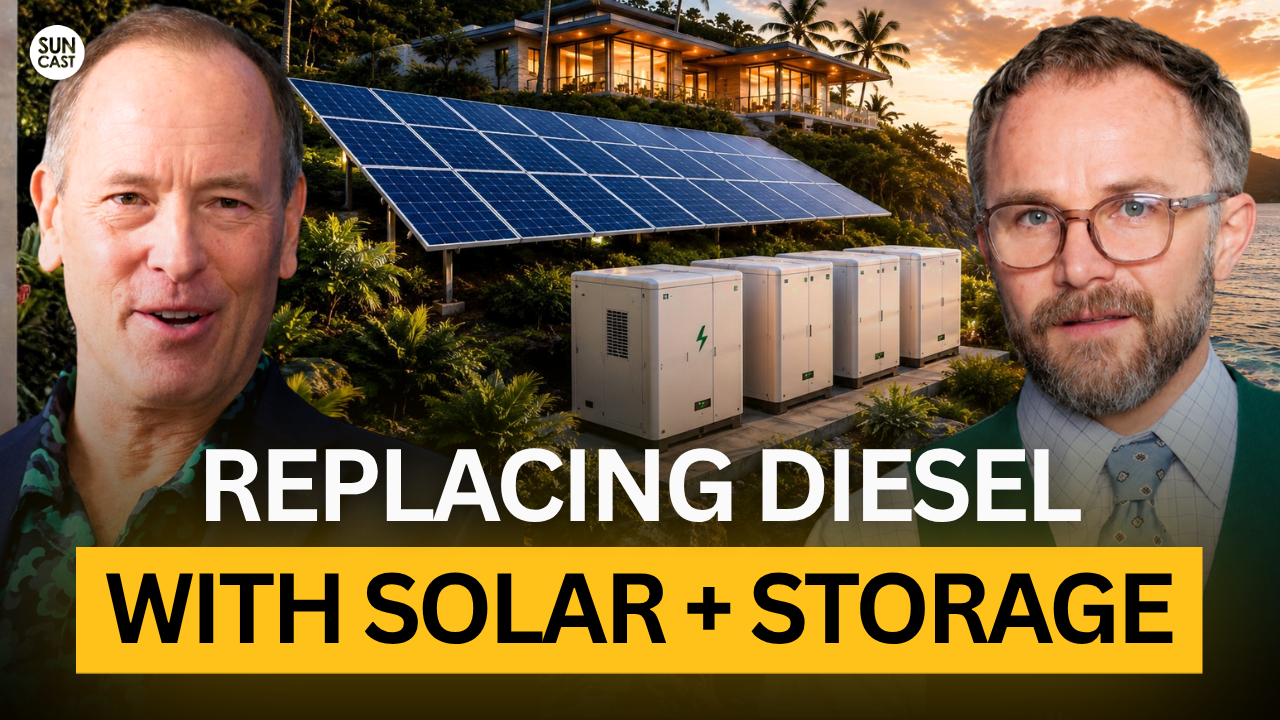
People don't realize until it's not there is that diesels are noisy. When we've turned off a diesel plant on an island, I had one guy that had been working there for 40 years, and he started crying. I said, "What are you crying about? And he says, "Man, I've never been on this island when the lights are on. There's not a diesel generator running. Wow! And the staff that works on the island-they're like, "Well, we can hear the birds chirping now.
Nico Johnson 00:22
Mark Lapata has built, scaled, and sold multiple companies in the solar industry over the last couple of decades, and he's now spent most of his time building solar and battery storage projects throughout the Caribbean. Along the way, he's mentored many founders, including myself, in the solar industry, and spent a lot of time really thinking about what it actually takes to build companies and careers that last. Mark Lapada, welcome to the show.
Marc Lopata 00:46
Thank you, Nico. It's a pleasure to be here.
Nico Johnson 00:47
It's a long time coming.
Marc Lopata 00:48
It has been a while.
Nico Johnson 00:49
Yeah, it has been for sure. I remember we first connected when you were working with microgrid. I think the original microgrid solar here in the United States, I was back at Trina.
Marc Lopata 01:02
You were living in North Miami.
Nico Johnson 01:04
I was. I had just moved there with my young family and started figuring out the Caribbean, where you had already been planting some roots. Well, you've built and sold a few companies now. I think I feel like at the beginning, it's always a good place to get a sense of how this originated for you. What made you decide that solar and clean energy and batteries was a place that you wanted to focus your time and energy? A
Marc Lopata 01:26
recruiter once told me that I would have gotten a job, but for my career has lacked focus.
Nico Johnson 01:33
Yeah.
Marc Lopata 01:34
So I've had a lot of a lot of different jobs in different industries, and I was in the ocean engineering business for a long time. We used to use solar energy to power instrumentation packages out in the ocean back in the '90s, and I built data centers at Verizon for a long time and got very interested in energy efficiency. So when I got a nice severance package from Verizon, I had been interested in energy efficiency and solar, and decided to give my shot at starting a business doing that.
Nico Johnson 02:04
Yeah,
Marc Lopata 02:05
our first motto was delivering solar energy with efficiency.
Nico Johnson 02:10
Oh wow, that was the first. That was microgrid, or was it a no? Yeah, that
Marc Lopata 02:14
was microgrid. How about
Nico Johnson 02:15
that?
Marc Lopata 02:15
Yeah, 20 years ago.
Nico Johnson 02:16
How do you pick a business partner? This is not something that I wanted to. This is sort of a little bit of a tangent off of that first question, but you've had the opportunity to work with a number of folks as business partners. How do you think about that?
Marc Lopata 02:31
I don't know that I'm the right person to ask that question.
Nico Johnson 02:34
Fair. That's fair. Well, we can we can move on.
Marc Lopata 02:37
It's tough. It's tough because you're basically marrying that person,
Nico Johnson 02:41
yeah,
Marc Lopata 02:42
and you really need to find someone who's who has expertise that's complementary to what yours is, and where you two can trust each other to not interfere and and you know to do things that the other person would do. Meaning,
Nico Johnson 02:58
like not interfere, like stay in their lane,
Marc Lopata 03:00
sort of, yeah, yeah,
Nico Johnson 03:01
yeah.
Marc Lopata 03:02
But it's that's that's the hardest thing
Nico Johnson 03:04
it really I've
Marc Lopata 03:04
ever found is is find the right business partner,
Nico Johnson 03:06
especially if you both are operators, if you both have good ideas, or at least believe you do.
Marc Lopata 03:11
Yeah, my business partner in the Bahamas now is is my best business partner I've ever had. Yeah,
Nico Johnson 03:15
what characterizes him thus?
Marc Lopata 03:17
He doesn't depend on me, and I don't depend on him.
Nico Johnson 03:20
Right on, yeah.
Marc Lopata 03:21
And we both know what we're good at, and we rely on each other for those for those things.
Nico Johnson 03:26
What's the communication model that you've honed over the last couple of decades to really ensure that you're aligned?
Marc Lopata 03:32
We just talk a lot.
Nico Johnson 03:33
Yeah,
Marc Lopata 03:33
we talk on the phone
Nico Johnson 03:34
daily,
Marc Lopata 03:34
not daily, but three or four times a week at least.
Nico Johnson 03:38
Yeah,
Marc Lopata 03:38
and and what I've always told my staff that I always do too is we communicate a lot by email.
Nico Johnson 03:45
Yeah,
Marc Lopata 03:45
but always follow up. I'm sorry, communicate a lot by telephone.
Nico Johnson 03:49
Yeah,
Marc Lopata 03:49
but always follow up with an email.
Nico Johnson 03:51
Right.
Marc Lopata 03:51
So that what you said, this is
Nico Johnson 03:52
what I heard,
Marc Lopata 03:53
is immoralized.
Nico Johnson 03:54
Ah, right. Yeah, yeah. We were recently having this discussion inside of our company. It's well, this is this is what I heard. Oh well, let's make sure we memorialize it. This is what I heard you say. Did I hear you say this correctly? This is what I'm going to do as a result of what I heard you say. Is that what you wanted me
Marc Lopata 04:10
to do? That's taking it to the nth degree.
Nico Johnson 04:12
Yeah.
Marc Lopata 04:12
No, but I mean, it's so much easier to to solve problems and answer questions and get on the same page on the phone.
Nico Johnson 04:19
Yeah, it's true. I think one of the things that we lack with the connectivity overload in modern society, especially with messaging and Slack, etc. is the skill to say, okay, actually, this is the boundary where we now need to pick up the phone and make a phone call. And I usually will say to somebody, "Hey, look, if if we've texted each other more than three rounds on something. Yeah, just call me. If you just press the phone button in WhatsApp, right? I will answer. I'm looking at your messages.
Marc Lopata 04:49
Right, and if they're messaging you back like five seconds later, exactly, exactly. Like
Nico Johnson 04:54
we should probably talk about this. Well, I wonder. I wonder of the companies that you've worked with and been able. To observe over the time that you've been in this industry and many others, in fact, what separates companies that survive from the ones that don't?
Marc Lopata 05:06
I think it is really important to have a plan and know where you're going. I mean, the stuff that we do here is not rocket science.
Nico Johnson 05:14
Yeah,
Marc Lopata 05:14
right. But I think the things that make the biggest differences are the companies that achieve financial sustainability.
Nico Johnson 05:20
Yeah,
Marc Lopata 05:20
you don't have to grow, but you don't want to shrink, and you want to make sure that everything you're doing is is sustainable financially.
Nico Johnson 05:28
Yeah,
Marc Lopata 05:28
and then I think having the best team that you can have. I mean, your team is amazing, but people in my company would joke that more than once I interviewed 40 to 50 people before I filled a position. Right, and I do all the hiring myself. And when I was at another company, I took training in how to hire people.
Nico Johnson 05:52
Oh wow!
Marc Lopata 05:53
And they said to everybody at the beginning, "What do you want to get out of this training? And I said, "I want to learn how to hire people quickly.
Nico Johnson 05:59
Right.
Marc Lopata 06:00
And they said that is not what you're going to get from this training.
Nico Johnson 06:02
You will learn how to hire people well.
Marc Lopata 06:05
Yeah, yeah, and and hire people that that you think want your job and can do your job.
Nico Johnson 06:12
Wow! And the guy,
Marc Lopata 06:13
the guy that I sold azimuth to.
Nico Johnson 06:16
Yeah,
Marc Lopata 06:16
I had interviewed 45 people before I hired him,
Nico Johnson 06:20
and he came in in what role?
Marc Lopata 06:21
And in engineering intern.
Nico Johnson 06:23
Engineering intern. Yeah. Oh my God. With me
Marc Lopata 06:24
for eight years, and now he owns the company.
Nico Johnson 06:27
Jeez.
Marc Lopata 06:27
And he's much smarter and much more ambitious than I ever was.
Nico Johnson 06:32
More ambitious, even.
Marc Lopata 06:33
Oh, much more.
Nico Johnson 06:33
Yeah. And he's got the hunger and the and the youth to go with it.
Marc Lopata 06:36
Yeah. And and the guy who was his boss, who he was interning with at the university, I was lamenting to him about my hiring problems, and he said, "Well, I hate to tell you this, but you should talk to my intern. I hire him the next day.
Nico Johnson 06:49
That's awesome.
Marc Lopata 06:50
Yeah, that's that's the most important thing because if you hire the right people, they'll figure out where the company needs to go. They're going to know how to do what they do best, whether they're doing finance or HR,
Nico Johnson 07:01
right,
Marc Lopata 07:02
or whatever it is,
Nico Johnson 07:04
yeah. So hire people who know how to do it, and preferably better than you do, and get out of their way,
Marc Lopata 07:10
right? Exactly.
Nico Johnson 07:10
Yeah, empower them. Yeah,
Marc Lopata 07:12
you look at companies that are like B Corps. I don't think that guarantees that you're going to be sustainable.
Nico Johnson 07:18
No,
Marc Lopata 07:19
you've just checked a bunch of boxes. I mean, it's important, and it's you know, it's gets the right message to people.
Nico Johnson 07:25
Sure,
Marc Lopata 07:25
but you really have to find those key people, search them out, and then then you get the reputation, and then the smartest people in the industry come to you looking for a job.
Nico Johnson 07:35
Yeah, one of the reputations you've built is someone who understands the Caribbean, can get stuff done there. It's a very different working model, sort of different working environment than mainland, the United States.
Marc Lopata 07:45
For sure,
Nico Johnson 07:45
what what did working in the Caribbean for the last decade plus teach you about building, in particular, solar projects that perhaps people in the mainland underestimate? It is
Marc Lopata 07:56
a tough place to build to work in general. I've watched a couple of really big companies try to dominate the Caribbean.
Nico Johnson 08:03
Yeah,
Marc Lopata 08:04
and they failed because they didn't understand the market.
Nico Johnson 08:09
Yeah.
Marc Lopata 08:09
So whether you're in the states or whether in the Caribbean, you really need to understand the market. How many potential clients are there out there? I started working in the BVI.
Nico Johnson 08:18
Yeah.
Marc Lopata 08:19
I thought, oh, there's a lot of business here in the BVI. I love the BVI.
Nico Johnson 08:23
Yeah,
Marc Lopata 08:23
and there must be tax benefits to being here. No, there's no work and there's no tax benefits. Yeah, but the Bahamas we specialize in privately owned islands, and there's at least 200 of those
Nico Johnson 08:37
powering wealthy wealthy island owners. Yeah,
Marc Lopata 08:40
all powered by diesel diesel generators.
Nico Johnson 08:43
Presently, all powered by diesel. Are you doing hybrid systems then?
Marc Lopata 08:46
We do diesel hybrids. Yeah, solar battery and diesel.
Nico Johnson 08:49
Yeah,
Marc Lopata 08:50
and a lot of energy efficiency stuff. Some solar thermal water heating.
Nico Johnson 08:54
Okay,
Marc Lopata 08:54
but it's it's mostly solar, and we usually offset around 90% of their diesel consumption.
Nico Johnson 08:59
Yeah, one of the things that I've loved about being able to sort of tap into the wealth of knowledge you've developed through your engineering expertise and experience is you've found things that work and things that don't work. Feel free to name drop technology specifically if the moment if you're comfortable with it. But I'm curious what works and what doesn't in terms of what your customers are asking you to do? They're asking you to basically help them save. I mean, not unlike what we're asking most of the utilities in many of the Central American countries to do, like reduce your overall diesel consumption. It will dramatically improve the air quality for everyone around you. It will dramatically reduce your variable operating expenses. So, what's working from a systems perspective?
Marc Lopata 09:43
You're right, and and you know what else is is people don't realize until it's not there.
Nico Johnson 09:48
The noise
Marc Lopata 09:48
is that diesels are noisy.
Nico Johnson 09:50
Yes.
Marc Lopata 09:50
Yeah, and and when we've turned off a diesel plant on an island, I had one guy that had been working there for 40 years, and he started crying. I said, "What are you crying?" And he says, "Man, I've never been on this island when the lights are on. There's not a diesel generator running.
Nico Johnson 10:04
Wow!
Marc Lopata 10:05
And and the the the staff that works on the island, they're like, 'Well, we can hear the birds chirping now.
Nico Johnson 10:11
Wow! What a what a novel idea.
Marc Lopata 10:14
Yeah, yeah, but it's oh, another thing in the Caribbean is the pipeline is barely manageable.
Nico Johnson 10:22
The pipeline,
Marc Lopata 10:23
yeah. I mean, here you might go
Nico Johnson 10:24
a day
Marc Lopata 10:25
before you sell a residential project or a month for a commercial project. I'm talking to people now that I've been talking to for five or six years.
Nico Johnson 10:32
Wow. Yeah.
Marc Lopata 10:33
So it's
Nico Johnson 10:34
so it's like commercial industrial scale or utility scale timelines is what you mean for sure.
Marc Lopata 10:39
Yeah.
Nico Johnson 10:40
And are you willing to talk about some of the vendors? I mean, we're here at NABSEP, where a lot of folks sort of geek out about what works and what doesn't.
Marc Lopata 10:46
Yeah, on the the stuff that's here, we do. We've been using some Solark.
Nico Johnson 10:52
Yep, on our hybrid system.
Marc Lopata 10:54
Yeah, on our smaller islanded systems.
Nico Johnson 10:56
Yeah,
Marc Lopata 10:57
and a lot of installers there are using Solarc now. Yeah, so they they have a good reputation. It seems like they're you know they have the longevity and
Nico Johnson 11:05
yeah
Marc Lopata 11:05
the support to make them work.
Nico Johnson 11:07
Yeah, the
Marc Lopata 11:08
batteries. Our residential team installs a lot of Tesla Powerwalls.
Nico Johnson 11:12
I would imagine. Yeah,
Marc Lopata 11:13
we're using ELM batteries.
Nico Johnson 11:15
I know the guys in Texas. They go to Dallas. Yeah, yeah. I need to go visit them when I'm down in Texas.
Marc Lopata 11:20
They have a a really impressive operation.
Nico Johnson 11:23
Are they like First Solar just sold out for the next five years at this point?
Marc Lopata 11:26
No,
Nico Johnson 11:26
no,
Marc Lopata 11:27
not at all.
Nico Johnson 11:27
That's impressive. So they've invested in capacity.
Marc Lopata 11:29
They have. They just moved into a huge ELM. ELM. Yeah, they're in a place called the Colonies.
Nico Johnson 11:35
Yeah,
Marc Lopata 11:36
which is a little bit north of Dallas, northwest, somewhere down there.
Nico Johnson 11:39
I need to follow up with that guy. It's always encouraging to see companies like that. You know, they're homegrown American companies. They've flown under the radar
Marc Lopata 11:46
completely.
Nico Johnson 11:46
Yeah, they're fully Fioc compliant.
Marc Lopata 11:49
Yeah, yeah, yeah, yeah. Right. We're using CATL on a big project now. Okay, 24 megawatt hour project.
Nico Johnson 11:56
Wow, that's a lot.
Marc Lopata 11:57
Yeah, the controller.
Nico Johnson 11:59
It's 24 megawatt hour.
Marc Lopata 12:01
Yeah.
Nico Johnson 12:01
Wow.
Marc Lopata 12:02
Yeah, it's a um.
Nico Johnson 12:03
That's a that's effectively long duration.
Marc Lopata 12:05
It is. Yeah. Everything's long duration. You know, everybody says, "Well, we're selling these long duration batteries. That really is sort of just a sales pitch.
Nico Johnson 12:14
Okay.
Marc Lopata 12:14
All batteries are long duration. You just pay more for them.
Speaker 1 12:17
Yeah.
Marc Lopata 12:18
Because they could be short duration.
Nico Johnson 12:20
Hmm. Yeah, okay, and you're using, but you're still using lithium ion for these 24 megawatt. Yeah,
Marc Lopata 12:27
yes,
Nico Johnson 12:28
yeah. Have you explored any of the other chemistries?
Marc Lopata 12:30
We have. I don't think anything. You know, I love to see new technology implemented.
Nico Johnson 12:35
Yeah,
Marc Lopata 12:35
I just don't want to be the one responsible for it.
Nico Johnson 12:38
You and lots of other people.
Marc Lopata 12:40
Yeah, I've been experimenting with some saltwater electrolysis and hydrogen storage. Oh, yeah. Also, which I think has a great future.
Nico Johnson 12:51
What do you see or pitfalls that folks run into when they start putting storage projects in place? You were one of the early engineers to start using storage at scale and and figuring your way around it. What do you see sort of the newbies doing wrong or pitfalls they commonly trip over?
Marc Lopata 13:08
If you said that I could back up,
Nico Johnson 13:10
yeah,
Marc Lopata 13:10
I did want. I would also be interested in talking about modules.
Nico Johnson 13:14
Yeah,
Marc Lopata 13:14
because I remember when we were when we were at Cref in like 2010.
Nico Johnson 13:18
Oh yeah,
Marc Lopata 13:18
and I was talking to a guy from Canadian Solar,
Nico Johnson 13:21
yeah,
Marc Lopata 13:21
and he said we've got these great modules. We're selling them all over the Caribbean.
Nico Johnson 13:26
Oh yeah,
Marc Lopata 13:26
I looked at him. I said these won't even make it to 110, 120 mile an hour wind. He says, but we're selling them everywhere, and I said that's just because you haven't had an audit by a hurricane yet, right? But now manufacturers are making them. We're buying a lot of Jinko,
Nico Johnson 13:41
yeah,
Marc Lopata 13:42
double glass, N type, and what's different about them while we have focused on them is that they've gone through three now almost four rounds of modifying that product,
Nico Johnson 13:54
yeah, to
Marc Lopata 13:54
take care of defects in the technology, right? Whereas other manufacturers are still on round one.
Nico Johnson 14:00
Amazing. What do you think of the steel frames from Origami? Is it?
Marc Lopata 14:03
I don't know anything about them.
Nico Johnson 14:05
No. Yeah. Next Power just purchased them and actually just announced a deal with Jinko to do a gigawatt of Jinko panels with the steel frames.
Marc Lopata 14:12
I don't think I understand the value proposition.
Nico Johnson 14:15
Oh, I did an episode on it. I'll send it to you.
Marc Lopata 14:16
Okay. Yeah. All right.
Nico Johnson 14:17
It's a fantastic company. I'm. I understand. Yeah, I understand why, especially for the utility sale side. I understand why Next Power acquired them, but that's that's for a different podcast.
Marc Lopata 14:28
You had asked me another question.
Nico Johnson 14:30
Yeah, and asked you about battery storage. I'm just curious when you see because you see a lot of folks sort of rush into batteries. Yeah, where do you see folks trip up? What are the common pitfalls?
Marc Lopata 14:39
I think that what happens with batteries is people aren't that selective about the the products that they pick.
Nico Johnson 14:47
Yeah,
Marc Lopata 14:47
you need to. Well, like with ELM, we went through a lot of different companies before we settle with ELM.
Nico Johnson 14:53
Yeah,
Marc Lopata 14:54
that you need the manufacturer needs to be behind supporting their product, and you need. To be as an integrator, be behind the additional work that's required because PV you can put a PV system on the roof and you might not ever see it again for 20 years. Right, but batteries have required preventative maintenance and they have other things that have to be done to keep them healthy. So I think people don't account for that. They don't account for the the we like to monitor all of our systems every day. Yeah, and people that you're competing against, I have a little expression that I don't feel uncomfortable saying it here because everybody's NABCEP certified. Yeah, but we're selling to people that don't know what they're buying. Yeah, and we're competing against people that don't know what they're selling. Right now, here that's not the case on the selling side. Yeah, but still, we're selling to people that really don't know what they're buying. Yeah, and you have to you have to incorporate everything that's required and communicate that to them, manage their expectations, and make sure they know why the cost of the project is the way it is. Yeah,
Nico Johnson 15:59
in the times that we've had conversations just about business generally. You said you've talked about both funding strategies and exit strategies, and how to think about them when you're setting up your business. Why does it matter to think about the end of the story at the beginning of the story? A lot of folks are just thinking about how to get to that first million.
Marc Lopata 16:18
Yeah, so am I. This is sort of on my list of business mistakes that I have made.
Nico Johnson 16:25
Okay, yeah,
Marc Lopata 16:27
some of them more than once. I guess the old expression is: if you don't have a road map and know what your destination is, any road will get you there.
Nico Johnson 16:36
Yeah.
Marc Lopata 16:36
So you really don't have a plan as to where you're going with the company, my plan was to have the biggest impact that I could on on the way energy is used, and wasn't really focused on money.
Nico Johnson 16:48
Yeah,
Marc Lopata 16:48
I didn't think about kids or family, but I think people need to think: What am I going to do? Am I just going to go and then at some point wind this company down?
Nico Johnson 16:58
Right,
Marc Lopata 16:58
because if you just wind it down, you're going to spend a lot of money winding it down.
Nico Johnson 17:03
That's right.
Marc Lopata 17:03
Do you have kids that might be interested in running the company, or are you going to sell the company to your employees?
Nico Johnson 17:09
Yeah.
Marc Lopata 17:09
So I think people really should think about that up front, and it'll sort of influence where you're going with the company.
Nico Johnson 17:15
We have a few conversations on on the record now. Most recently, Tyler Nelson of Revamp of companies founders that have taken the pathway of creating an ESOP and and basically selling the company and making it a an employee owned company, it's a really fascinating pathway. And now there's a lot of resources. I remember the first time I talked to someone, Gary Gerber, in fact, Sunlight Power about setting that up. It was totally foreign and new to him, and not many people in the solar industry had done it. It's obviously been done a lot of other places, but there's pitfalls to just about every structure. If you don't going back to hiring, get the right people in place. Gary famously kind of had to step back into Sunlight Power because as a person they hired in as the new CEO didn't cut it, and he still had a shareholder sort of equity interest in the business because they were buying him out. He needed very much needed to work, which makes me think about something that I've heard you say. Basically, you know, be careful chasing the the venture capital pennies. How do you think about the way to structure financing a company from the beginning, and when is it appropriate, if ever, to go raise investment, and from whom? How do you think about that?
Marc Lopata 18:18
I had a lot of a lot of offers for financing and a lot of venture capital offers.
Nico Johnson 18:23
Yeah,
Marc Lopata 18:23
they were the venture capital was at the top of my list of bad business decisions. Their venture capital in the solar energy industry is the same as any place else. I mean, when I do business with an outside company, if there if there are two companies, one's owned by venture capital. One is owner, practitioner owned, or ESOP. I'll always go to the non venture capital side because you know there's there's always a lot of promises. Again, getting things in writing is important, but you just see just like in airlines or any other business, you see service go down because the VCs are just trying to squeeze money out of it, no matter what they say. So someone can you can take a venture capital offer if your intention is just to take the money and run,
Nico Johnson 19:11
yeah,
Marc Lopata 19:11
and you don't care what happens to the company afterwards. Then take the venture capital deal,
Nico Johnson 19:16
yeah. If a young installer like or a young engineer like the one who ultimately ended up buying Azimuth comes to you today at the NavSeb conference where we're hanging out and asks, "What's the one operating discipline that I need to master or instill in my company if I want my company to survive over the next decade? What would be your answer?
Marc Lopata 19:36
I think there are a few things. One is again staffing, but diversity. I think it's good for companies not to be a one-trick pony, and we're seeing that happen in our industry now.
Nico Johnson 19:47
Yeah,
Marc Lopata 19:47
with people having to figure out how to change course midstream.
Nico Johnson 19:52
Yeah.
Marc Lopata 19:52
So besides not being a one-trick pony, I think it's super important. And and this was foreign to me. I'm an engineer. I'm not. I wasn't a finance guy, but it's really important to manage the financial health of your company. And I would get together with with my CPA every month,
Nico Johnson 20:11
yeah,
Marc Lopata 20:11
and go over the financial statements, and we would do something called the solvency test. Okay, that we invented. I'm sure it's common, but and it was looking our accounts payable and our receivables and our money in the bank and work that we hadn't been paid for, work we've been paid for, and see if we stop doing business today, would we have enough money to close out all these projects? And and people, I think, don't have a good grasp on that
Nico Johnson 20:37
right
Marc Lopata 20:38
up front. So the financial part is key.
Nico Johnson 20:41
Yeah, just to tag on to that, I think that in the decade that I've been, this is my second entrepreneurial journey, and I come from an entrepreneurial family. But nobody in my family knew how to mentor or teach me any of these things. But in the last decade with SunCast, if I could go back and do one thing differently, it would be exactly that. It would be from the very beginning setting up a cash flow model and really understanding what my runway is, and that's something that is not intuitive. Even though I've got an MBA, like I studied this in school. Until it's your thing, until it's your business, it's hard to really wrap your head around owning that cash flow, right?
Marc Lopata 21:19
Oh
Nico Johnson 21:19
yeah, yeah. When
Marc Lopata 21:20
right.
Nico Johnson 21:21
Yeah.
Marc Lopata 21:22
And and I mean, I'm sure 90% of the people, well, all the business owners here,
Nico Johnson 21:28
yeah,
Marc Lopata 21:28
are in that boat where their net worth is financing the operations of the company.
Nico Johnson 21:33
Oh, 100% Yeah. Yeah. I think I think that's largely true for most of the business owners I know.
Marc Lopata 21:38
Right.
Nico Johnson 21:39
Yeah. And honestly, it's one of the reasons why folks will eventually either capitulate to sell the company, or or they'll sell take some shares from private equity or venture capital. I remember, and with this, we'll we'll bring it to a close. I remember that when I interviewed our good friend Jeff Greenfield, I asked Jeff what would he do differently, right? And he's this is this is his final NABSEP. He's gonna retire,
Marc Lopata 22:01
retiring,
Nico Johnson 22:02
and he successfully sold his company after 20 something years. Do you know his answer? Was said he would have raised money sooner. He said he would have taken capital, outside capital, sooner, and it would have meant, in his words, happier, stress-free Christmases for his family.
Marc Lopata 22:18
Yeah, right.
Nico Johnson 22:19
Yeah, because it's like we don't pay ourselves what we should be paying ourselves, and sometimes taking that outside capital is the difference between having stress allocated in different ways, right?
Marc Lopata 22:29
Yeah, that's that's good advice. I wish I would have gotten that advice, but I think the people also they don't allocate enough time to their families,
Nico Johnson 22:38
yeah,
Marc Lopata 22:39
and to themselves,
Nico Johnson 22:40
yeah.
Marc Lopata 22:41
I mean, I'll tell people just because you're starting a company doesn't mean you need you stop going to the gym or running or walking or doing whatever. You need to maintain your own mental and physical health.
Nico Johnson 22:51
Yeah,
Marc Lopata 22:52
and go to your kids' games and figure out some way to make that work.
Nico Johnson 22:55
Yeah, Mark, I appreciate that that guidance, that voice in my head for more than a decade now. Thank you for all the time that you've given to helping me and others like me in our journey, following behind you as entrepreneurs in this industry.
Marc Lopata 23:08
Thanks, Nico. You know, it's it's a I look at it from the perspective of abundance rather than scarcity.
Nico Johnson 23:14
Yeah,
Marc Lopata 23:15
I don't mind mentoring my competitors even.
Nico Johnson 23:18
Yeah,
Marc Lopata 23:18
because I'd rather have my competitors doing a good job,
Nico Johnson 23:21
right?
Marc Lopata 23:22
Than doing a crappy job and lowballing everything, and it's like a zombie apocalypse.
Nico Johnson 23:27
Yeah,
Marc Lopata 23:27
you're not going to survive a zombie apocalypse by yourself. We're not going to we're not going to solarize the world with just one company. It's got to be as many as possible.
Nico Johnson 23:34
So true. Mark Lapata is CEO and co-founder of Solar Island Energy. Pleasure to have you on the show.
Marc Lopata 23:41
Thanks, Nico. We should do it again. My pleasure.
Nico Johnson 23:43
Hey, thank you for tuning in. And if you are going to one of our other upcoming events, please swing by our live stage and say hello. I do love meeting you in person. Twice weekly, we deliver conversations with founders and leaders on the front lines of the clean energy transition, and we're here bringing this content to you each and every week free of charge. Of course, it's not free. Our sponsors help pay the bills and keep the lights on, so that we can help you build your legacy in the clean energy transition. And so, if you'd like to say thank you to them, or learn more about what it is that they bring into the world, or perhaps see how you could reach 1000s of listeners twice a week, just like they do. Check it out at suncastmedia forward slash sponsor. Remember, you are what you listen to. Thanks again for showing up, Solar Warrior. It's half the battle.

Nico Johnson
Entrepreneur & Podcaster
In my 20 year career, I've worked with dozens of entrepreneurs, intrapreneurs and professionals in transition to clarify their mission, set or stretch their goals, and work through the barriers to their growth.

Latest episodes

We’re Excited to Hear from You!
Don’t hesitate to reach out—whether you’re here to learn, share ideas, or work with us, we’re ready to connect.