
We'd love if you'd leave us a 5 ⭐ rating & review and it's never been easier: www.ratethispodcast.com/suncast
America needs more electricity. But between recognizing that need and actually putting new power on the grid sits a complicated mix of policy, manufacturing, permitting, interconnection, capital, and community trust.
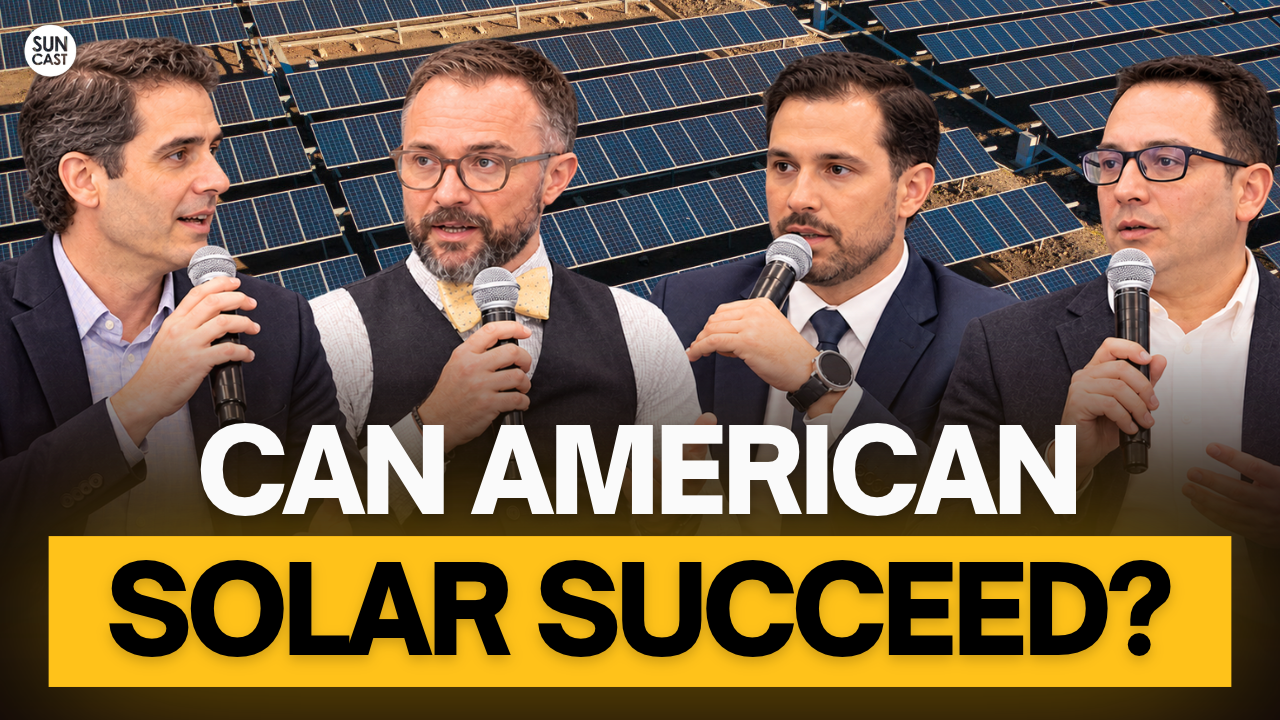
Recorded live at the CHESSA Energize Summit, this conversation looks at that challenge from three different points in the industry. Robin Dutta, Executive Director of the Chesapeake Solar & Storage Association, explains how policy and industry advocacy shape the market companies are trying to build in. Carlos Class, CEO of Goldi America, offers a firsthand look at the capital, certification, supply-chain work, and risk involved in bringing solar manufacturing back to Virginia. And Drew Price, co-founder of Hexagon Energy, shares what years of project development have taught him about interconnection uncertainty, resilient project portfolios, and why relationships with local communities can determine whether a good project ever gets built.
Together, the conversation gets beyond the simple call to “build more power” and into what doing that actually requires.
Expect to Learn:
🔹 Why interconnection and permitting delays are killing viable solar projects
🔹 How changing federal policies threaten domestic manufacturing investments
🔹 Why building American solar supply chains takes years, not months
🔹 How community trust can determine whether a project gets built
If you build, finance, manufacture, permit, or advocate for energy projects, this episode offers a practical look at the work between policy and power.
The technology is ready. The demand is here. What's stopping deployment?
RESOURCES:
Connect with Robin Dutta:
Connect with Carlos Class:
Connect with Drew Price:
Check out Chesapeake Solar & Storage Association:
Check out Solarix Group USA:
Check out Hexagon Energy:
This Podcast is Free For You
Thanks to Our Sponsors
The following are Corporate Partners who have helped make SunCast possible:
Platinum Sponsor
The following are Corporate Partners who have helped make SunCast possible:

Noteworthy Quotes:
Carlos Class 0:00
I'm not here to create jobs. I'm here to change lives forever. Okay, I'm here to do a multi-generational project that will set a established precedent for the Commonwealth. Whether you like it or not, it's happening.
Nico Johnson 0:14
Hey, welcome back to SunCast. Today's episode was a live recording shot on site at the Chesa Energize Summit in Charlottesville, Virginia, last month. If you're unfamiliar, Chesa is the Chesapeake Solar and Storage Association, the regional SIA entity for the region. Well, they had me host an opening keynote in front of a warm and welcoming room of humans, and the panel is about the gap between needing more power and actually getting it all built. We look at it from three different perspectives: policy fights that shape the market, what it really takes to actually build solar panels here in America again, and why good projects are still dying before they actually reach permission to operate. I'm joined by three experts: Robin Dutta, executive director of Chesa; Carlos Class, the CEO of Goldie America, who's actually building solar panels right in Forest, Virginia; and Drew Price of Hexagon Energy, a developer based right there in Charlottesville. Now, let's get into it. We've all heard about the incredible surge in demand. Low growth wasn't a thing that we talked about as an industry when Blair and I first met back in 2000 what 910, first trying to figure out how do we build these solar projects and how do we build an industry if all of our manufacturing is going abroad. Electricity demand is obviously rising. The federal policy environment has changed dramatically. Customers are worried about affordability, and we're asking this industry to build more generation and do it all faster. And by the way, at a time where supply chains are ever more constrained, so we're going to start with you, Robin. You spend every day hearing from the businesses in this room, the businesses you represent for Chesa, and translating their reality into policy. So, I'm curious if if I'm running a solar and storage company or broadly a clean energy company here in this region, what has materially changed about my reality and my business environment over the last year?
Robin Dutta 2:16
Well, first, thanks, Nico, for being here. It's it's it's exciting to be interviewed in front of a an audience as well. This is new for me. I think what's also new to me was the repeal of the investment tax credit. I think the what's changed in the last year begins there. I was working on federal affairs around the Inflation Reduction Act, so it's been really jarring for me personally to have worked on that piece, helped to get things like interconnection as an eligible cost in the tax credit over the finish line, be actually on the south lawn of the White House celebrating the the most ambitious climate law ever passed in the United States, and then see it pretty much repealed three years later, and then be in this position to work on you know the ripple effects and and you know basically it's red alert, and everyone's holding on for dear life. You know, while that's happened, what we've also seen is, or what we haven't seen, I should say, is we haven't seen states in in a same way as you know six seven years ago say, all right, we're jumping in to try to balance out, you know, bad federal policy. So now it's tariffs, it's FIOC compliance, it's no ITC, it's it's COD deadlines, and then what we're seeing in states, you know, somewhat in our region, some pivots around net metering, some that can certainly make sense, but some that doesn't. And I and I and I think there's a lot of frustration for folks saying, well, we have the affordability crisis. We're using more energy. Don't don't you need more solar and storage? How is it that suddenly we're dealing with these headwinds as well, or where we have opportunities? Can can we get to these opportunities even faster than we are? So I think it's a lot of questions. I think what everyone's facing.
Nico Johnson 4:02
I'm curious the policy fights. I mean, certainly my listeners may not know, but this you know this region, Virginia, Maryland, D.C., the and surrounding Delaware has a rich history of being pioneering in policy. It makes sense right here in Washington area, but I'm curious where you see the policy fights right now. Maybe the ones that even are not so in the headlines, but you have to focus on one
Robin Dutta 4:31
that I do think is in in the local headlines is siting, and it's one that if you're doing any kind of community solar or utility scale development in the region or really across the country, citing ordinances, moratoria of development, and it's we're starting to see a bit even with storage in certain places. You know that that's a that's a big one. Not so much in the headlines, the policy fights. I think it's storage. You know, storage. I like to say is. It's like a yogi bear, you know. I try to go for a yogi bearism. Nobody knows what it does because it does so much, and so you know. I think it's seen as as this big solution, and I think you know the the ways to unlock it are really in the regulatory space. So it's all in the weeds and it's all behind the scenes, and so we do you know we have that and that potential, but it's but it's it's very much out of sight, out of mind for the average person. And then I think just the last thing, and I think this is kind of because you know we we need to do a better job building out solar is not in the headlines, and so I think we need to be more present with ribbon cuttings and site visits and making sure that you know it's in the headlines locally and and in state papers, and and that our elected officials are are seeing it, and it's not this ephemeral thing, but it's a very tangible thing that's happening in their district and in their state.
Nico Johnson 5:51
Yeah, I have a question actually that is it's funny. I'm going to answer it with my own answer as well, tangentially what you just brought into the picture here, which is where do folks in the room actually need to be more engaged rather than on the sidelines? And before you answer that, it's funny. I live in North Carolina in Durham. I went to visit a project that, well, that a major national developer was doing a ribbon cutting for. 74 megawatts, $33 million in revenue over the life of the project back to that community, and that was just from the economic development side. There were three or four full-time jobs, a lot less than we'd like the news to report on. Right? Remarkably, guess how many people in the media were there covering it? If you consider me media, then it was exactly one, and I wasn't invited. I invited myself because I found out that it was an hour away, and somebody from the company was like, "Yeah, hey, I'm going to be in the area. You want to hang out?" I was like, "At the ribbon cutting, yes." Not one newspaper had been invited. Not one. The there. I asked the development team, "Why is Duke the only ones here?" And they're like, "Well, we just want more projects with Duke, and it's this myopic understanding of like what the ribbon cutting is for. And I completely agree with you. Like we, as an industry, do such a terrible job telling this story on Main Street that we are actually doing good in these neighborhoods and bringing economic development, and not actually replacing. I have a whole episode on how we're not replacing prime farmland. We're actually preventing the immense amount of land that would otherwise go into real estate or other sort of fixed assets from going into those assets, and we're preserving them for 1520, 3040 years. We've just talked about the market and how we're going to try to grow the market and how Chesa is supporting. But growing a domestic energy industry also means asking a much harder question. Frankly, I've been in this industry 20 years. I've watched domestic manufacturing peter away and go offshore, and I never thought it would come back. I've said publicly that I was wrong to be skeptical. I've watched one of my best friends build a factory. I've watched a lot of my industry friends build factories. I'm actually, frankly, in awe of the courage that folks like Carlos Class have and are taking to rebuild the domestic industry. Obviously, there are incentives and trade barriers that are making that job a lot easier than it would have been five or 10 years ago, but the question is, can we actually build the supply chain here that we need? And I want to get beyond the announcement of a new factory and into what actually it takes to build one. So thanks for the work that you are doing and your family is doing to build here domestically. Everybody sees the press release announcing a new solar factory. I'm curious, what's the hardest part of taking that empty building and turning it into a production facility with bankable solar modules, and that outsiders really can't appreciate. You
Carlos Class 8:48
know, to be honest with you, I thought it was going to be the investment side of the house. We're not affiliated to any single large entity that you can mention, right? Or Inc. 500 company as well. To be honest with you, the most difficult portion that myself and my core management team we faced was the continuous letdown and pushback from our community elected politicians. Speaking obviously in Central Virginia, all the way from the federal level representation to the local delegates, where we went to a place that had no jobs, no investments, more than half a million dollars in the last 10 years, and 800 families that lost their jobs. These include physicists, PhDs, you name it, right? And to be able to come back, and obviously the building itself was an overbuilt building. There were 25 megawatts of electricity going into that building, over 5 million gallons of potable water going to that building. So that building gave us the ability to become vertically integrated and slash down our initial. Investments by more than 50%, and to be able to paint a story of listen, we're a technology company founded by disabled veteran. We also have women owned in our management team and African American in our management team. We represent you know the best of America, which is a very diverse culture of people with experiences that put together something in the service of our community, which is generating domestic energy, my friends. And when I tried to say this, I was always asked, "Well, why don't you take all these investments and we can build a church right here? You can build Dollar General, a couple ABC stores. This is what our economy wants, and to be honest with you, you would think that I would tell you that the biggest you know hill that I had to climb was was investments with supply chain, but it really was. We are facing ourselves. We face right now the industry a big controversy, which is messaging. Also, we are the only industry that shoots itself, only energy industry that shoots its own foot. We prize ourselves out of business. We continue to lobby in DC to take away the import capacity of the other company, because I built mine now in the other country, I have another supplier, so I'm gonna screw him. Then you see the commodities market; they work together, right? It's one price per barrel of oil. Okay, it's one price per cubic inch or cubic foot of volume of natural gas. We don't have that in the industry, right? I have a phenomenal sales team that gets calls every single day, and it's how do you balance providing careers? Okay, because we don't create jobs, and that's one of the things I kept pushing back against the local politicians. I'm not here to create jobs.
Nico Johnson 11:56
Yeah,
Carlos Class 11:57
I'm here to change lives forever. Okay, I'm here to do a multi-generational project that will set a established precedent for the Commonwealth. Whether you like it or not, it's happening. We have almost 100 families right now, of which 42 families were evicted. I'm serious about this. We paid for the utility bills and gave them overtime so that they can get ahead. Where are the institutions? Where is the federal money coming? Where is the state money being used in these localities? Right? Where is the messaging? They asked me, right? Well, how is solar beneficial to the community? And I said, very easy. Lock in the electricity rate for the next 25 years, notwithstanding of what happens with whatever missile gets hit over there in the Strait of Hormuz or Bab el Mandeb, right? Also, health and environmental hazards. A solar panel breaks for whatever reason, we replace it. There's no leakage. There's no nothing, right? It's messaging, messaging, messaging is the ultimate weapon that we have at our disposal, and we need to start being serious about it with people like Robin, manufacturers like us, to really have a unified message.
Nico Johnson 13:17
I wonder, Carlos, the word domestic manufacturing gets bandied about, and I'm curious. There are a lot of terms kind of that we use: U.S. assembled, domestic content, compliant supply chains, American-made, FEOC. Can you help folks in this room understand the distinctions? What are you actually manufacturing right here in Virginia that still comes through? It it still comes through a global supply chain. We don't manufacture all the components here, but when you think about what it means for you to make domestic content, what should buyers be asking their suppliers, informed by sort of what's being really built here?
Carlos Class 13:55
Well, it would help if we have stable policy. Number one, because the word domestic content is defined by the IRS, not by us, right? I can say this is domestic content. The IRS might say no. There's 0.75% of that needs to come from this supply chain and from that supply chain. So it's a constant, ever-changing dynamic. The rock keeps getting swept under our feet, just as we get really comfortable with the planning of domestic supply chain, then the guy like guidelines are changed, right? But you ask, what do we produce? Well, just like BMW is a factory, they manufacture. Doesn't mean they produce the tires. Doesn't mean they produce the the radio or the the windshield, the glass. Ladies and gentlemen, domestic manufacturing is an ecosystem. Okay, it's an ecosystem of a lot of different companies and a lot of different teams of expertise of engineers, supply chain engineers, supply chain PhDs that have come together to produce one set, one widget, one good. We're not publicly traded, so we're not producing ingots and wafers. Although I am. Planning on doing that by 2030. However, we do produce domestically a solar panel. We use and we partner with 100% American steel. We partner with J Box injection molding manufacturers to produce a 100% domestic J box and cables in the back. We also partner now in Ohio, four hours from our facility, domestic front glass, highly tempered hurricane Cat Five, and hail resistant. Also, with increasing 97% light transmission, now we're hitting 98.5 light transmission rate. So initially, my team and I we were starting to sell out in the market pre-sell 580 5s and 580 s. Well, we're flashing 605, 600 watt modules this morning. These modules were produced at 605. That one 605. That's 1608. But that's efficiencies that we can achieve when we invest in local domestic manufacturing wherever it is produced. We're in California, Oregon, New York, Texas, Oklahoma. I don't really care. It's one ecosystem that is adding to the GDP of this country and our interdependence of you know foreign national security. So domestic manufacturing and energy manufacturing should always be considered as a national security asset for every senior leader in the in the United States.
Nico Johnson 16:19
Yeah, I agree with you. And yet, we still work in an international market where, I mean, even the name Goldie is not an American company. Goldie is an Indian company. What parts of the supply chain do you anticipate will will not be reshored? And in the, if we stick just to the module side of the business, are we going to see ingot pulling at at scale, or how how far up the value chain are we going? How how big are the campuses going to get here in the United States? Sort of equivalent to your Asian counterparts.
Carlos Class 16:51
I mean, it goes back to what's affecting the solar industry: permitting and siting, right? When we start getting into the vertical integration and sail manufacturing, you just saw what happened in Sail Fab in South Carolina, right? Some gas is leaked, and then obviously, but it was built very close to a school, things like that. So I think we got to be as we start looking into our now next roadmap of investments, domestic investments. We really got to start working with the cities and the state, right? And I would encourage those of you who represent a governmental agency, when you know domestic manufacturers like us are trying to reach out to you, don't send us AI-generated automated email saying thank you for your request. We'll get back to you when in the same order that this message came in. Right? We've been trying to schedule an inauguration of this facility for the last 90 days, and we've received no communication. So how do I? How do I? You asked about Goldie, right? Goldie India, yes, they are supporting us. They are our big brother. Why? Because we had to bootstrap ourselves. No American bank outside of Goldman Sachs really looked into us and say, "Wow!" Everybody says in the headlines in the news, "We're going to invest in American domestic manufacturing." Sure, if you have three letters and you're in the Inc. 500 and the S&P, that's going to happen. But if you are a disabled veteran-owned, African-American American-owned, women-owned American business that had a bootstrap together, put a team of engineers out of 30 years of experience in domestic renewable manufacturing from Spain, from Cartagena, from Austria, from Italy, from all these places around the world, to bring that to our communities. You know what they say? We are only a cash fill in the business. Show us your books. I'm saying, well, this is a startup. So where do we go, right? And it's international partners that see the value in domesticating supply chains. Hence, why majority of the solar manufacturing facilities that you see here are actually not American owned; they're foreign owned. We're so hesitant to invest in American manufacturing, but we move hell high water for a data center that even if you put 100% of the U.S. population under an AI subscription, you cannot pay back the capex, the initial investment of one data center. Okay, and second to this is, if you have the ability to produce energy and lock the rate of the people that are using that energy for the next 25 years, why are you jumping to bring things that are consuming our resources and we're giving away. Robin just talked and you just talked about the $33 million revenue that a 74 megawatt project brought to a county in North Carolina. All of you are here because you work in a business. I'm assuming, so you know that PNL is very important. Burnout rate and managing your cash flows is important. So is a county. So is a state. What is their surplus right now? We'll go to any county that's opposing solar. They're working out of a budget deficit. So if you go and the messaging is where we need to win the fight. If you go to a county and say, "I got 100 megawatt project," and by the way. Statewide, statewide. This is how many cents per watt or per megawatt you will earn, and that table is already broken down. All you do as a developer is go tell the county, "Hey, I got 100 megawatt that I want to build there," and the county puts in the sheet, "Oh, 100 megawatt that gives us $55 million a year. That's a lot of teachers' pay raise that we can do here. That's a lot of infrastructure investment. It's one project, but that doesn't exist. That model is not uniform. And I think honestly, that's where we need to work together as an industry from the policy standpoint.
Nico Johnson 20:33
What do we need folks in the industry to do differently besides improve our messaging? Is there anything else that you, as a manufacturer, Require is it longer term procurement commitments different model for procurement generally but is there is there an ask that you have of the community to help sustain this domestic this domestic I think this
Carlos Class 20:54
is the best question I've been asked in the last six months because nobody asks a manufacturer are are your panels certified? Right, they always ask that. Yes, of course. If not UL, if it's not UL certified, I can get in trouble. And people ask, well, I want this component, or I want you to use this. You do you know how long it takes to certify one panel for UL to go through the laboratory? If I make one slight change, because everybody says, "Well, buy American, man." They just open a factory. It's like, "Yeah, but I need to run quality testing on that in the laboratory to make sure that I can put a bankable 40-year performance warranty on that." And that component that I just opened a domestic factory is not going to crack on the pressure on the high temperatures, low temperatures, high humidity, snow humidities, desert area, right? Because United States is a little bit of everything from Tundra to Arctic, right? So I want everybody to understand and developers to understand that if I change one centimeter in the dimensions of that module, if I change one component because you want it 0.05% higher domestic content, it takes me no less than six months in a laboratory for UL to be able to give me an InterTech laboratories to give me a certification that I can market the module. So, as developers approach us or approach any other manufacturer, we're not here to sell any modules. We're here to improve messaging and information for the collective, but as modules approach people like us, companies like ours, right? Understand that when you ask for something to be changed, that's usually a 36 month time because it's not only going through the laboratory, but then the manufacturer of set component has to provide sampling. They also have to stand up their factory, right? And it's so trickle down effect of investments that then a developer says, "Nope, I'm just going to go for the single letter, you know, customer because they they're publicly traded and whatnot, right?" So then that entire ecosystem that had to go through the certification, through sampling, through calibration, right, engineering, third party calibrations, physics, engineering studies behind that. You know, you just backstab them pretty bad, and it's not easy. To be honest with you, I think we have to do a better understanding. And this is where policy is so important. As we pitch and pitch and pitch, American ingenuity, American dominance, American manufacturing. Yeah, yeah, yeah. I get it. Leave the rules as it is. Nobody starts playing Monopoly, and if you're losing and you end up in jail three times, you don't get to change the rules of the Monopoly game mid game, okay? Because there's already investments, there's already trickle down economics to it, and supply chain for any domestic manufacturing. You can ask BMW, you can ask Honda, Toyota. They said the factories here in the United States is no less than 36 to 48 months to secure entire lot supply chain, right? So we get announcements like Section 232, right? There were companies raising their stocks values, announcing that hey, we're Section 232 compliant even before Section 232 was even announced, right? I was compliant as well, but now we got what minimum import price, where sales for the first time in American history, and this is where we're failing. We're not talking about these things. We're so focused in a attorney general confirmation that we forget that Section 232 was roll out while the Attorney General confirmation was happening. And guess what? For the entire energy industry, now you have a minimum import price. If a sale would cost you eight or nine cents per watt to bring the sale here, guess what? The minimum enterprise right now is 25 cents, my friend. That's just a sale. You still have 60 more components of the solar panel. So, what is that solar panel going to be per what? 60 cents. Then, how do we stimulate the advance and the rapid deployment of gigawatts and gigawatts and gigawatts of generation if we're doing this to ourselves, politically speaking, right?
Nico Johnson 24:42
Couldn't agree more. When I was selling solar in 2013, we were selling panels at 54 cents a watt, which is coincidentally the exact same price that panels are rolling off the factory floor right now at at scale, at scale, at multi multi gigawatt contracted pricing. Thank you, Carlos. Very passionate defense of the domestic manufacturing industry, and I'm sure that folks will have a lot to a lot of questions for you. I wish you guys
Carlos Class 25:10
sleep in the factory, right? I know, man. See my fresh face, but I sleep there every day. Every day, I'm there till my team knows I'm there 234 in the morning. And just yesterday the new ADCBD was announced. Right, so I am coordinating with multiple countries at multiple fronts because, unfortunately, and I'm sorry, I don't mean to take your time, but this is something everybody can relay. And you see the YouTube comments, right? People criticize a tariff that was just dropped down, and the first comment that comes in a city town hall or something like that says, "Well, buy domestic, buy made in America." I get it. Your John Deere is not made here, by the way.
Nico Johnson 25:48
Yeah.
Carlos Class 25:48
Um. But the reality is, to buy a made in America, you have to invest in creating the domestic infrastructure of supply chain, right? And that's that's a multiple year process,
Nico Johnson 26:01
yeah, and supporting the reality that we have for the last 50 years built a global economy and offshored the majority of the components. Well, we've heard about the structure and dynamic of the market environment. We are hearing a lot of the a lot more nuance and detail around what it takes to actually manufacture the hardware here, but ultimately none of this matters unless we, as the developer economy, can turn policy and equipment and capital and land into something that generates electrons. Drew Brice and his team at Hexagon have spent more than a decade doing exactly that right here in Charlottesville, one of the many success stories that we have here in Seaville, probably the greatest incubator of clean energy companies in the United States. If I had to wager a guess, Drew, thank you for taking time as well to come join us. I know that everyone here is is super busy. You guys have developed projects for more than a decade now, and I'm curious as you've seen the market evolve. I said for a long time, solar was the was the the tail wagging the dog of the or sorry storage was the tail wagging the dog of the solar industry, and sure enough, you're either today developing storage as a business model or still developing solar and figuring out storage. There's really no other alternative that I see. What do you see right now that kills an otherwise good solar or storage project in the marketplace?
Drew Price 27:32
Thanks, Nico, longtime listener and first time caller. So very excited to be here today. Yeah, I. I I mean I think it's not going to be a surprise, and I hope I say some novel things today and don't just repeat everything the room knows already. But yeah, I mean I think the things that are killing otherwise good projects are interconnection and permitting. I mean they're the things that have that have been a barrier in this industry for a long time, and and I think on the interconnection side, it's it's only gotten sort of worse over time. It's not just the cost; it's unpredictability, it's the timeline, and so yeah. In some ways, time kills these projects.
Nico Johnson 28:10
Time kills all deals. So interconnection feels like it's the most uncertainty right now in the in the in the time stack.
Drew Price 28:17
Yeah, absolutely. I mean, I think we you know we've done small projects in Virginia for a very long time. We've done big projects in Virginia since the early, early days. And once upon a time, you know, there's always some element of uncertainty there. But I think it's just amplified as these queues have grown, and and that's been more and more present, even in like the Dominion queue as well. It's made it really, really challenging to bring those projects forward.
Nico Johnson 28:43
Well, Virginia is a data center alley and needs significantly more electricity supply than anyone can ask or imagine. Frankly, where do you see the biggest mismatch between how urgently we say we need electricity and how quickly the system allows you to provide it.
Drew Price 29:02
Yeah, I mean maybe it's good anecdotes, but ones that probably a lot of people know. So last year, and this wasn't in Virginia, but we closed the sale of a project that we outside of Chicago's 1.2 gigawatt solar project. We started working on that project probably eight years ago, and it will be another two or three years before it's fully complete. I mean, the the time that it takes to build things, and that's the whole process, not the actual physical construction, is like to me the biggest mismatch. And I don't know. I'm I'm sure Carlos would have less to say about this too on the like the construction side. But yeah, just these projects take a really long time. We've we've started to get into other types of energy. We started to look into geothermal projects. We've actually built a big portfolio. And one of the questions we've started getting is like geothermal. Like those projects take forever. And I'm like, have you been in solar? Like what? Those projects take forever too. Every project takes forever these days. So yeah, it's something's got to give there, and it feels like it. You know, you've seen that happening. You've seen that patience with some of the ISOs eroding. You've seen that at the state level. You've seen it at FERC commissioner level. Like the pressure is growing where it goes. I think no one really knows right now, but I think something's got to give there. A
Nico Johnson 30:24
lot of the variables that we hope will give are out of our control. What do you feel is still very much within the control of the developer right now?
Drew Price 30:33
Yeah, that's a that's a good one. I think it maybe gets to later things we'll talk about. I think you know how we engage, and it kind of picks up on things that Robin and Carlos both said. Like how we engage with communities, how we engage with the public is still very much in our control, and it matters, right? Like what how we interact and the the rapport we build, the trust we build, like that amplifies. And we've seen lessons when we don't do that about like how that takes time to overcome that. I think that's still very much in our control. And then how we approach these as developers, like building portfolios that are resilient, that are balanced, that enable you to absorb the uncertainties, is is to me a key part of being a developer these days. You probably never had the luxury, but you certainly don't have the luxury anymore of like having you know one or two or three projects you really love and like holding on to those things. Like there's too much uncertainty, and and so to a certain extent, we've found that you have to build bigger, more diverse portfolios that enable you to adapt to the things that you can't possibly predict.
Nico Johnson 31:41
It's it's like being a venture capitalist at this point. You know that a certain number of your projects are going to get killed, whether you like it or not.
Drew Price 31:47
Yeah, and you've always known that. Like that's always been part of the deal. But sure, now it just it's they get killed by more and more wild things that you never expected.
Nico Johnson 31:58
Yep. Yeah. There's more full self driving vehicles out there running amok. I wonder, you know, you mentioned communities, and as developers, we spend time across the table from not just landowners, but community stakeholders, local officials, you know, folks that care deeply about what sorts of assets and infrastructure coming to the community, whether they understand the long-term benefit or not. Some, you know, NIMBYism has been a huge obstacle, not just in our industry, but many industries, but certainly along the eastern seaboard in New York. Right now, it is a tremendous problem. What do you feel solar solar developers right now consistently misunderstand about the local resistance to these projects, and can you enunciate the variables that you're working to overcome in those markets?
Drew Price 32:50
We kind of have a running joke in the office that, like, whenever this topic comes up and it's like, "What can we do better?" That somebody inevitably chimes in, and they're like, "Have you tried talking to the people in the community? And we're like, oh my gosh, no! Like, that's an amazing idea. We should, we should do that. No, I think it's it's to me, it's like that. There's always a third or fourth or fifth variable. This is something I talk about with my kids in like any interaction, just in life as humans, like you know, it's easy to to interpret every interaction you have as like some sort of commentary on you or like your project or what's going on. And like a lot of times, that's not the case. You know, as developers, we are we are challenged and fortunate to go into a bunch of communities that are not ours and try to make things happen in real life, and you're walking into history. You're walking into a bunch of things that have predated you, that have influenced how that community feels about all kinds of things, like projects themselves, politicians, like energy, etc. And in some ways, like you know, the people who enjoy this job the most and who seem to do it best are those who are like really curious about people, about the communities that we're in, because it takes understanding that it takes building that trust to to be able to like permit a project. We always say trust permits projects or relationships permit projects because it's not it's not just the merits. Like you've obviously have to have a well-designed project. It obviously has to benefit the people there. Like those are table stakes, but like you've got to demonstrate that you're someone who cares about the community. And there is no one magic bullet. In a lot of ways, the questions you get are tests of you. They're not. They're not necessarily like, did you answer that right? It's did you answer that honestly? Did you give me the full truth? Did you tell me the thing that I know you told my neighbor about this? Like their their test of character.
Nico Johnson 34:50
Yeah, I find that a lot of the community engagement is looking for opportunity where there is otherwise imposition. I grew up in a very small farm. Town and there is always this sort of outsider mentality. It's like we protect ours and it's our family land. And you know how is I feel like a lot of the fear in rural America is about the things that come there to take the local resources and and send the money elsewhere, right? And I feel, what do what do you find the community leaders, the county supervisor, and others need to hear or see to turn that imposition into an opportunity?
Drew Price 35:35
I mean, it sounds really basic, but I it doesn't have to be unanimous support. But they, I think, they need to feel like this is something that the community has accepted at least at some level. You know, there is some critical mass, or there is some, or that they have a belief that they will accept that over time.
Nico Johnson 35:52
And there is no silver bullet, obviously. But what what do you see working? Maybe I am looking for a little more like tactical advice for folks that are struggling with communities that maybe are have their shield up, is it a certain amount of effort and investment and time before you even start developing the project of being in the community? I came across there's a community I don't remember the name of the company, but they're in Tennessee, and developers are hiring them to go six, 812 months ahead of a planned project development, and just like live in the community and start talking about the project and start talking about the company that's coming. And I mean, like, what have you guys experimented with?
Drew Price 36:32
Well, it's been been a while since I've been in the field myself, but I mean, it sounds trite, but I think it's again, it's relationships. It's like you said, it's you're showing up early and you're showing up often. You know, you think about this: how do you build trust in life? Like, well, it's usually a lot of interactions with people over time, right? It's like one of the reasons they say you make really good friends in college is that you see people frequently over long periods of time, and it's really hard to build trust quickly, right? The only way to do that is if Robin's like, "Hey, Nico's a nice guy. It's okay to be on this podcast. He's not going to ask you entrapping questions. Just show up." And I'm like, "Okay, I trust you, Robin. Don't put me in a bad position today." But otherwise, it it takes a lot of time to be comfortable with that. And so, yeah, I think you've got to be there often. You've got to be there and have times when you're interacting with people when you don't have things to ask. If every time you show up you've got an ask, then like that starts to get old for anybody.
Nico Johnson 37:31
If the Chesa team helped give you the ability to eliminate one bottleneck tomorrow, and your only objective was to get more good projects built, what is what? What would be your ask for Chesa as an organization?
Drew Price 37:44
Yeah, I mean in Virginia, and Robin may kick me under the table for this, but like I think the you know the rec value in the shared solar program, like it would be awesome for that. That's really changed economics there, and again in Virginia at a domestic level, like figuring out how to make interconnection costs, like they've they've risen to the point where they are a big deal killer, and it's it's kind of at this point it's like Dominion investing in their infrastructure more than anything, and and really the SEC feels like they've dabbled there, but has declined to kind of do too much there. But at a at a Virginia level, that's what I would say.
Nico Johnson 38:23
I really enjoyed this conversation. Virginia obviously needs substantially more electricity. I feel like we've covered a lot of topics around policy, manufacturing, development. There's there's no single policy or factory project that we could build that's going to solve the challenges that we have been talking about it requires all of these to come together. It's one of the things that we all understand about the value of trade associations, the value of these conferences. Most of the friendships I have in the industry, I met Blair at a conference 15 plus years ago. This is a place where we come together to build the trust within one another, and to help design the story that we tell the rest of the world. So my my encouragement to everyone here is: we need to lean in to the message that we share with the outside world. There's a lot of infighting. There's a lot of presumed competition in our industry, and that's real. Some developers win, some developers lose. Somebody buys Goldie, another person buys Canadian Solar. Right, like it is a rising tide lifts all boats. But we have much bigger things outside the industry to deal with. So my hope at this conference is that you all are asking each other the question: What what's working for how you're talking to the community? What's working in the messaging that you're putting into your social media? How are you constructing the amplification of this industry in a way that it gives Goldie a chance to survive? In a way that it gives Drew and his project. A chance to survive the onslaught of of negative PR happening at the local level, and then of course, what are you doing to support organizations like Chesa as members, as industry participants? Because Chesa relies on having members, not just members that pay their dues, but members that contribute. It can't just be them serving you. So, with that, I just want to say thank you for everyone. You've given us the only non-renewable resource you've got, and that's your time. Appreciate you all being here. Well, that was SunCast Live from Chesa Energized Summit. Big thanks to Robin and the entire Chesa team for the invitation and being such warm and welcoming hosts. I really think that the Chesa event is a must attend, especially if you're here on the East Coast. Thanks as well to Carlos and Drew for the generosity of your time and your perspectives. The conversation was a fantastic one. You can find all three on LinkedIn. Of course, we'll link to their bios and data in the show notes. Thank you to those who help make this show possible. They pay the bills, and all we ask you to pay is attention. You can learn more about them at suncast.media/sponsors. And if you're going to be live at an event and would like to meet us. Well, you can learn more about what events we are going to be attending or presenting at by going to SunCast Media. Next up on the roster is, of course, RE Plus in Las Vegas, where we will have a booth in Central Hall. It's booth 4459. Please come by and say hello. Check out some of our live podcasting on the show floor and meet our all-star wonderful team. Thanks again for showing up, Solar Warrior. It's half the battle.

Nico Johnson
Entrepreneur & Podcaster
In my 20 year career, I've worked with dozens of entrepreneurs, intrapreneurs and professionals in transition to clarify their mission, set or stretch their goals, and work through the barriers to their growth.

Latest episodes


We’re Excited to Hear from You!
Don’t hesitate to reach out—whether you’re here to learn, share ideas, or work with us, we’re ready to connect.