
We'd love if you'd leave us a 5 ⭐ rating & review and it's never been easier: www.ratethispodcast.com/suncast
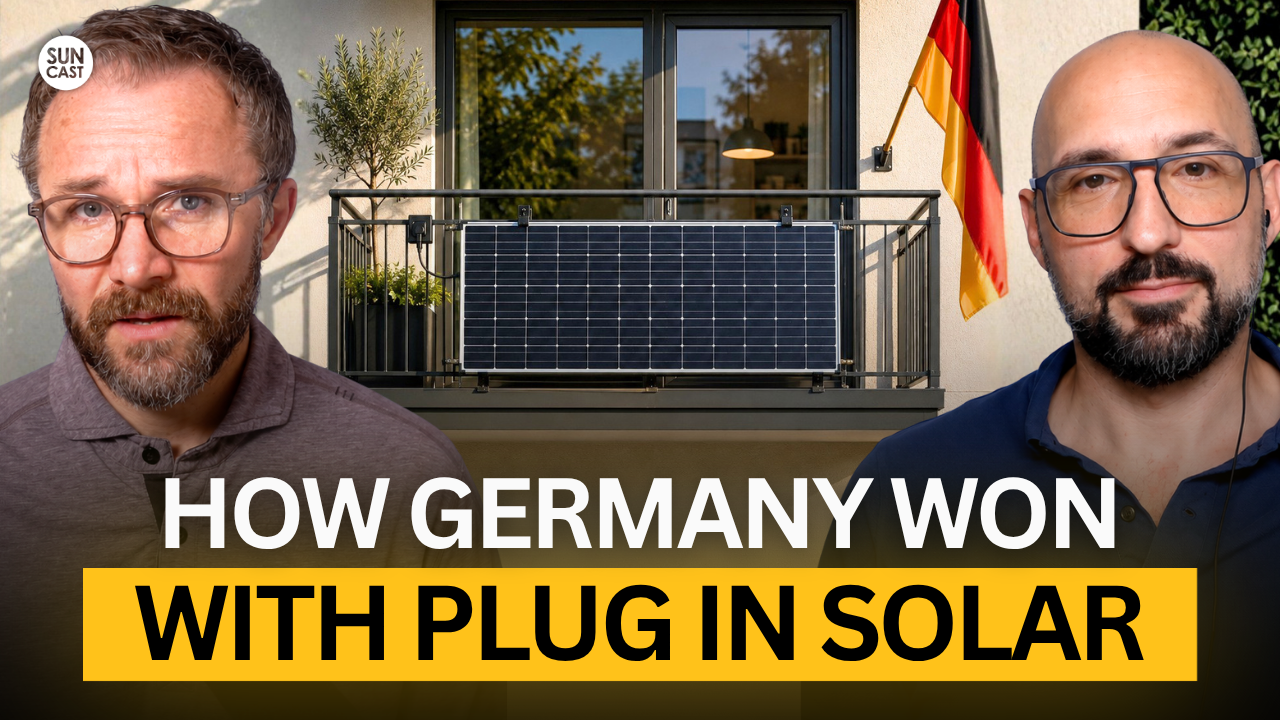
Germany has turned plug-in solar from a fringe idea into a mainstream energy product found in millions of homes. And the biggest lessons for the U.S. aren't really about solar panels.
They're about making solar easier.
In this Tactical Tuesday, CraftStrom Co-Founder and CEO Stephan Scherer shares what nearly a decade in the European plug-in solar market taught him about how a new energy category actually scales.
Simplicity matters as much as technology. Germany had to simplify registration and remove requirements that made a supposedly plug-and-play product harder to adopt.
Policy needs to separate different problems. Electrical safety inside the home and how much power a system exports to the grid aren't the same thing—and Stephan argues that conflating them could unnecessarily limit the U.S. market.
And perhaps most importantly, the category scales when it becomes easy to buy and easy to understand. In Germany, plug-in solar eventually moved beyond specialist channels and onto mainstream retail shelves.
This is a focused excerpt from my longer SunCast conversation with Stephan. If you want to understand who's actually buying plug-in solar in the U.S., why the ideal customer surprised even him, and whether solar could eventually become something we buy like an appliance, the full episode goes much deeper.
Episode 952: Plug-In Solar Is About to Change Everything | Stephan Scherer
(00:00) The Scale of German Plug-In Solar
(00:16) How Germany Scaled Balcony Solar
(01:50) The Direct-to-Consumer Plug-In Model
(02:15) Establishing European Plug-In Regulations
(02:53) The Rapid Market Adoption Curve
(04:22) Selling Solar in Everyday Supermarkets
(04:48) Simplifying Utility Registration Processes
(06:52) Eliminating Locking Plug Interconnection Barriers
(08:22) Accelerating Adoption with Zero Sales Tax
(09:11) Democratizing Solar Through Mainstream Retailers
RESOURCES:
Connect with Stephan Scherer:
Check out CraftStrom:
"You can't say it's a plug and play system and then require an electrician to come out and exchange one of the outlets." – Stephan Scherer
This Podcast is Free For You
Thanks to Our Sponsors
The following are Corporate Partners who have helped make SunCast possible:
Platinum Sponsor
The following are Corporate Partners who have helped make SunCast possible:

Noteworthy Quotes:
Stephan Scherer 00:00
Now we're probably close to 5 million systems. What one in nine households in Germany has one of these? That's not a growth curve that is easily replicable with traditional solar, because there's so much work that goes into this, from the planning stage to the interconnection phase. Right?
Nico Johnson 00:16
Hey there, solar warrior. Welcome back. This is Tactile Tuesday. Practical insights from experts on the front lines of the energy transition. Today, we're pulling a segment from a conversation I had a little while back with Stefan Scherer, co-founder and CEO of Kraft, who spent the better part of a decade building and selling plug-in solar, first in Europe and now here in the U.S. for today's Tactical Tuesday, I want to zero in on one thread from that conversation: how Germany went from a couple 1000 plug-in solar systems to something close to 5 million. That's one in nine households, and what, from Stefan's perspective, it actually took to get there. We dig into the specific things that Germany got right along the way: simplifying registration of the devices, dropping the locking plug requirement, zeroing out sales tax on these types of systems, and getting them onto the shelves of retailers like Aldi and Little, the Costco's of Europe, instead of leaving it to traditional solar installation channels. This is less a story about a technology breakthrough and more a story about an entire ecosystem: regulators, utilities, retailers, and consumers, all making solar simple enough that people would actually buy it, and perhaps what we might do here in America as well. All right, let's get into it.
Stephan Scherer 01:50
With plug-in solar, it's essentially click, deliver, install.
Nico Johnson 01:55
Amazing.
Stephan Scherer 01:56
You know, there's weeks potentially depending on you know if we're sold out or not in our case. Click being purchased
Nico Johnson 02:02
online, by the way. Like yeah, exactly. Yeah,
Stephan Scherer 02:05
yeah.
Nico Johnson 02:05
It's a it's a direct to consumer product that one can buy, have delivered the same way Amazon delivers products, and literally install themselves, self provision themselves.
Stephan Scherer 02:15
2016 is when, funnily enough, the Austrian government decided we're going to introduce a law based on this study. The study said, "Well, you know, you've got the same risk as as any appliance if you limit it to the 800 watts that's now known throughout Central Europe. So there was really no downside to this. So government created federal law saying this is legal up to this wattage, but you need to register it. Very simple.
Nico Johnson 02:42
Yeah,
Stephan Scherer 02:43
Germany followed suit the next year in 2017. Same federal laws, but it took a couple of years to get it right. Finally finished in 2024. I want to say
Nico Johnson 02:53
it was a slow process, but then it was like a. It's like they say it was slow. Then all at once, the German market. A lot of folks will comment that something like 4 million households have now balcony solar deployed. That seems like a rather large and quick upward upward trend.
Stephan Scherer 03:11
Oh yeah, oh yeah. If you look at the diffusion curve of any technology, you know we've got this beautiful S curves, right? And if you look at diffusion curves for like the iPhone, how quickly that dominated the market, right? And we saw very few technologies can emulate that, and we saw the same thing with this technology because essentially when we started, and this is late 2010 s, right? When we started selling, there were maybe a couple 1000 systems In Germany, within I want to yeah within three years. Once 2022 hit with the Ukraine war, it ballooned. I mean, it was crazy, and we went from a couple 1000 installed systems to over a million within you know two three years. It hasn't been that long. Now we're probably close to 5 million systems installed. So, what one in nine households in Germany has one of these, and also Europe at that time was already a fully established market with these systems being sold in supermarkets. Yeah, large chunk of our solar panels ended up in like Home Depot, the equivalent of Home Depot or supermarkets,
Nico Johnson 04:22
right?
Stephan Scherer 04:22
Essentially,
Nico Johnson 04:23
yeah. You mentioned Little was selling to Lidl is
Stephan Scherer 04:27
now selling very aggressively in the UK. Also, plug-in solar, plug-in batteries.
Nico Johnson 04:32
Yeah, you can walk in and get your groceries in a solar system all at once.
Stephan Scherer 04:36
You can literally carry it out, put in the trunk of your car, drive off, and you've got it installed in an hour at home. It's fantastic, and that's the idea. It's pure democratization of this technology of of renewable power.
Nico Johnson 04:48
If you think about the German market in particular, let's just focus on that. What do you think? Were the two to three decisions that Germany got right?
Stephan Scherer 04:55
They got absolutely right that they needed to simplify the. Registration process. Even though you didn't need a full-on interconnection agreement in the beginning, there were two governmental entities you needed to notify. So that alone was way too much work.
Nico Johnson 05:13
Yeah.
Stephan Scherer 05:14
So registration process. Yeah. Most people register.
Nico Johnson 05:16
Most people don't register products with the manufacturer, let alone with the utility, right? This is as I started researching this. I'm like, wait, how does this actually get done? And I remember in the in 2006 time frame, when the California Injury Commission needed a homeowner to go through this whole process to get these rebates that were coming back to them, the installer effectively did the work for the homeowner. But I'm fascinated by this registration process generally because, effectively, and what I've heard you say, and what I've read, and some other things that we'll bring into the conversation, this registration with the utility is one of the things that makes the utility confident that things are being done right, so that they can say, "Okay, green, you know, rubber stamp, green light, go for it.
Stephan Scherer 05:59
Exactly. Yeah. Not so. They they they kind of want to know this for two reasons. One is load management. So a utility rightfully says, "Well, I want to know if someone is exporting solar power and there's no interconnection contract. Like, how much is it going to be max so I can plan for this?
Nico Johnson 06:16
Yeah.
Stephan Scherer 06:17
On the other hand, what they're installing is that safe? Like, how do we know? And then, if you register the system, then you know by name. Okay, well, the system has certifications. It has. It passes all the regulatory tests. Yeah. So you do. We we and we embrace this. Like we say, yes, there should be a registration process. There shouldn't be an interconnection agreement required. That's unnecessary because honestly, most people don't want to export anyway. I think 99% of our people of our customers don't. They drop the the safety plug requirement.
Nico Johnson 06:52
Okay,
Stephan Scherer 06:53
that was another one that simply just wasn't accepted by the market. You can't say it's a plug and play system and then require an electrician to come out and exchange one of the outlets. That's then plugable, lockable. Sorry, pluggable, obviously, but lockable, so that it can't easily be unlocked by a child, which could then touch the prawns. The prawn question was was really never an issue in Germany because the the certifications already required that these inverters shut down in less than a second to be as critical as they unplugged again.
Stephan Scherer 07:28
So as soon as you unplug them, they're dead. Essentially, all of our inverters. So that was that was just a no go, and people weren't accepting it either. So they they could just buy a regular cable on Amazon or Team or whatever. So they dropped that eventually. Also, because there's no reason from a from a fireman's perspective, I was because I was talking to some fire marshals recently that wanted to know about about this technology. Yeah, and they were like, "But there's going to be more obstructions on balconies if if people install these systems,
Nico Johnson 08:02
yeah.
Stephan Scherer 08:02
And I I told them like yeah that's why we are very much against these lockable plugs because in a case of an emergency, whether it's a tripping hazard or whether you need to unplug it to make sure it's safe, don't make it lockable. Don't make it complicated. Like let it be a simple plug, just so it quickly unplugs,
Nico Johnson 08:22
yeah,
Stephan Scherer 08:22
and takes everything out of the data. So I also wanted to say the other thing that Germany got right is they they capped sales tax on to zero to 0%
Nico Johnson 08:35
Okay, 0% sales tax.
Stephan Scherer 08:37
0% sales tax on any of these products. I think
Nico Johnson 08:40
this is the first time I've heard that is that is a nuance that is more than just nuance. Introducing a new product category with zero sales tax is is an incentive.
Stephan Scherer 08:49
I mean, they they did apply it to all solar product, yeah. Okay, okay.
Nico Johnson 08:54
So there was zero sales. But the
Stephan Scherer 08:56
prevalence, but the prevalence of these systems, and suddenly millions of people are buying these. Right. It's it's it was fantastic to see, and this is a 19% sales tax, right? Yeah, this makes a difference.
Nico Johnson 09:11
One of the things I keep coming back to from your Germany experience is the role that retailers played. Most people, frankly, can't name a solar company. My parents can't. Your neighbors in Texas probably can't, but they know Aldi even here in the U.S. They know Costco, they know Home Depot. That's where they buy the things that break in their home that they need to replace. That's where they buy their appliances. So I'm curious how much of Germany's success and therefore how much of the United States' success is actually about putting solar in places that people already trust and buy.
Stephan Scherer 09:45
Oh, it's it's a huge factor in this. Our products were in those markets very early on. Honestly, as a startup, especially back then, like there's no way you have you can have that reach. But you want you want to disseminate the technology. Wanted to seminate the idea behind it, so it's it's a natural progression in the market that if it's an appliance, it'll be sold as an appliance. It'll be sold as an appliance, and on with online retailers, it'll be sold as an appliance physically in the shop, so you can pick it up and you know at Costco on the way out, pick up a solar system, install it, and have it run in a few hours.
Nico Johnson 10:22
Yeah,
Stephan Scherer 10:22
that's that's the idea, and that's how you that's how you really make it a benefit and for the for anyone really. That's how we democratize a technology is by putting it in front of everyone and making it easy to purchase and easy to install. And like I said, it's essentially an appliance. That's how we need to treat it. That's how we need to regulate it. Any appliance that uses a lot of electricity, whether it's a hairdryer, a toaster, a microwave oven, has risks associated. Doesn't mean that we shouldn't that we should stop using them. And we're pulling in customers from the traditional solar industry, definitely. Yeah, but we're also pulling customers that would have never been customers for traditional solar. That's why it grew so quickly in in Europe, and that's why it's going to grow very similarly in the United States.
Nico Johnson 11:10
And that's a wrap on this Tactical Tuesday. I am really grateful for you hanging out and listening to this one. And I'm curious if you got to thinking about exactly what plug-in solar could look like here in the U.S. I'd encourage you go back and listen to the full conversation I had with Stefan, episode 952, called "Plug-in Solar Is About to Change Everything. I'll link to it in the description. I've also got more episodes like this coming up, and you should also check out the episode we did on regulation and codes. There's so much more. Maybe we should do a plug-in solar page. I don't know. You let me know in the comments below. Thanks to our sponsors who help ensure every week that all you have to pay is attention. They pay the bills and keep the lights on. So grateful for them. You can check them out at suncast.media/sponsor. Remember, you are what you listen to. Thanks again for showing up, Solar Warrior. It's half the battle.

Nico Johnson
Entrepreneur & Podcaster
In my 20 year career, I've worked with dozens of entrepreneurs, intrapreneurs and professionals in transition to clarify their mission, set or stretch their goals, and work through the barriers to their growth.

Latest episodes


We’re Excited to Hear from You!
Don’t hesitate to reach out—whether you’re here to learn, share ideas, or work with us, we’re ready to connect.