
We'd love if you'd leave us a 5 ⭐ rating & review and it's never been easier: www.ratethispodcast.com/suncast
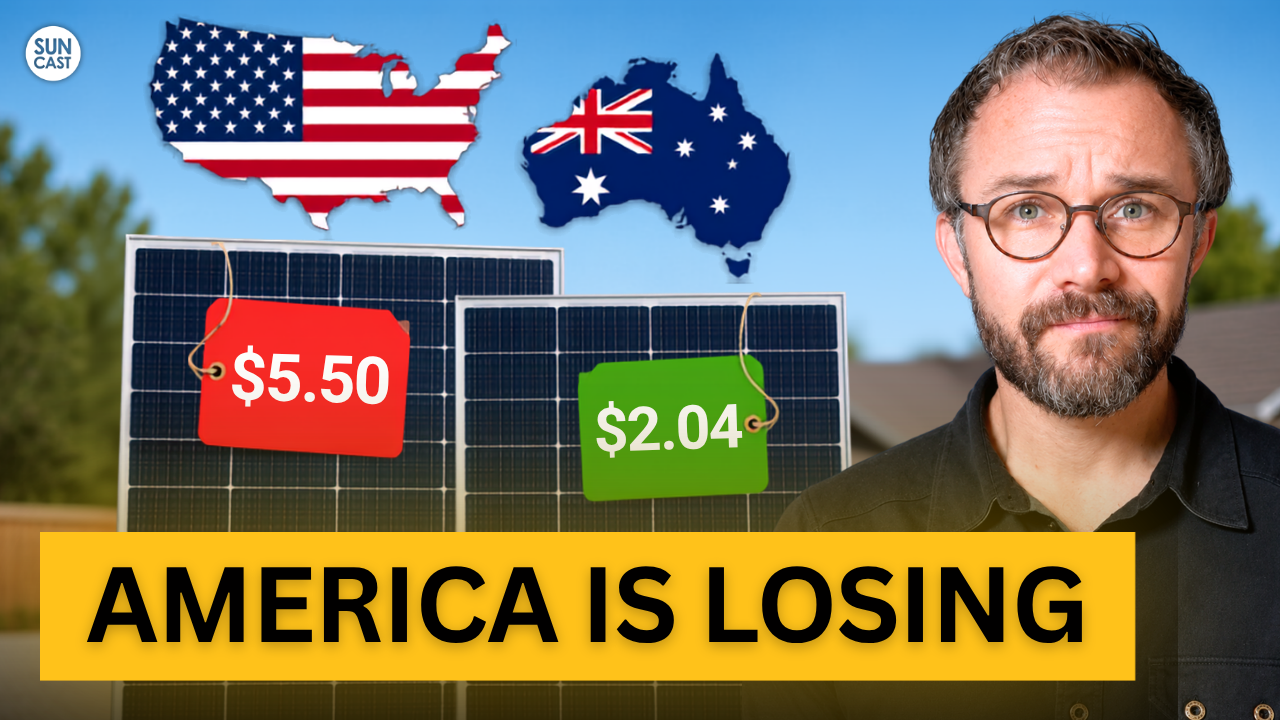
In Australia, residential solar and storage can be installed for about $2 a watt. In the U.S., a comparable system can cost more than twice that.
Why?
Barry Cinnamon was curious enough to go to Australia and investigate. What he found challenges the simple explanation that America's solar price gap comes down to permitting, labor, and other “soft costs.”
Australia offers a useful counterfactual: what can solar cost under a very different set of market and policy choices? And which of those choices would we actually want to make in America?
In this Tactical Tuesday, Barry and Nico unpack the cost stack and the tradeoffs behind it, from tariffs and domestic manufacturing to financing, interconnection, incentives, and policy stability.
Expect to learn:
🔹 Why Australian solar and storage can cost dramatically less than comparable U.S. systems
🔹 Why soft costs explain only part of the price difference
🔹 How tariffs, financing, manufacturing policy, and regulation affect what customers ultimately pay
🔹 The harder question underneath the comparison: are we optimizing for the cheapest energy, domestic manufacturing, American jobs, or some combination of all three?
Australia isn't necessarily a blueprint for the U.S. But it gives us a fascinating benchmark for asking what we're paying for, why we're paying for it, and which tradeoffs we're willing to make.
Listen to Part 1 of our conversation with Barry Cinnamon.
RESOURCES:
Connect with Barry Cinnamon:
Check out Check out Cinnamon Energy Systems:
"There's a lot we can do locally. There's a lot we can do statewide, but the biggest drivers of these high costs are U.S. federal policies." - Barry Cinnamon
(00:00) Comparing Australian and US Solar Installation Costs
(02:05) Investigating Australia's Low-Cost Solar Model
(03:17) The Australian versus US Solar Cost Breakdown
(04:21) Why US Federal Policies Drive Higher Costs
(05:44) Energy Cost Priorities versus Domestic Manufacturing Jobs
(07:33) Key Levers to Lower US Solar Prices
(08:55) Evaluating the Sustainability of Door-to-Door Sales
(09:44) Australian Battery Incentives and Homeowner Behavior
(11:16) Key Takeaways on Solar Tariffs and Incentives
This Podcast is Free For You
Thanks to Our Sponsors
The following are Corporate Partners who have helped make SunCast possible:
Platinum Sponsor
The following are Corporate Partners who have helped make SunCast possible:

Noteworthy Quotes:
Nico Johnson 00:00
Hey, Solar Warrior! Welcome back. A bit of a setup on today's episode. Not long ago, I sat down with Barry Cinnamon, founder and CEO of Cinnamon Energy Systems, and generally one of the icons of our industry. He's been at this since 2001. We were in front of a live audience for this conversation at Intersolar and Energy Storage North America 2026 down in San Diego. Barry had been chewing on something that bothers a lot of us. Australia is putting solar and batteries on homes for about $2 a watt. In some cases, actually much cheaper. Here, we're closer to five, sometimes 550 a watt. Same panels, same batteries, comparable safety rules. So Barry does what Barry does. He built his winter holiday around going to Sydney. Sat down with all the Australia insiders and installers that he could find, and he came back with a category by category teardown of exactly where that extra 350 a watt disappears to, I'll tell you now, the answer is not the one most of us give. It's not soft cost. Barry ran the math on his own company, and it doesn't get him anywhere near the $2 a watt. And he'll show you what does. Now this conversation ran long enough that we've split it up into two separate discussions. Today is the cost story: Australia versus the U.S. and what would actually move the needle if we wanted it to. We'll publish soon Barry's other half of the conversation with a completely different viewpoint, if you will, a concept for getting data centers to pay for your neighbor's rooftop solar. Now that one involves a jar of walnuts, and I'm not going to spoil it for you. Let's get into this one. You've been digging around into why the U.S. solar and battery costs are so much higher than places like Australia, Barry. So I wanted to have you come demonstrate and illustrate for us what you have uncovered?
Barry Cinnamon 02:05
I'm always puzzled by costs of solar around the world. Germany has historically been cheaper than the U.S. and then recently there's been a lot of people saying that the costs in Australia are 60 cents a kilowatt hour for solar, and you know the dollar 10 or so for batteries. And I'm just kind of running the numbers of even if I got the equipment direct from China and had no hassles in the U.S. it would still be a lot more. Right. But I'm just wondering why it was so cheap. It just so happens that I didn't go to kind of design my winter vacation around going to Australia, Sydney, and then hung out in New Zealand after that. But really, just to try and understand what we what we could possibly do here in the U.S. to bring those costs down, and typically we hear about the issue being soft costs.
Nico Johnson 02:50
Yeah,
Barry Cinnamon 02:50
you know, basically not the hardware, but it's all the labor, all those permitting, and things like that. And I I look at the numbers from my company and say, even if I were to wipe those out, I'm still not getting down to 60 cents a kilowatt hour. It just doesn't make. So I I dug into it, um, and what I found, and by meeting with solars in Australia and spend a lot of time there, diving into it, the real costs of solar in Australia before tariffs $2.04.
Nico Johnson 03:17
Okay,
Barry Cinnamon 03:18
that's with a battery,
Nico Johnson 03:20
with a battery, so four
Barry Cinnamon 03:21
with a battery. Okay,
Nico Johnson 03:22
so in Australia we're at two bucks a watt.
Barry Cinnamon 03:23
Right. All right. And in the U.S. typically it's about five and a half dollars a watt for a decent system with a battery. Huge difference. Why is that difference? So I'm starting to drill down and looking at those individual categories: the module, the batteries, the tariffs, the labor, the supply chain, the profits, all that. And and this chart over here kind of shows those specific differences category by category. Yeah, and then I say, right, well, you know, what can we fix? Yeah. So first of all, I looked at solar and a battery, and then since everybody's always talking about just solar, when I looked at the numbers in Australia, it's 82 cents a watt for just solar. That's pretty terrific.
Nico Johnson 04:00
Yeah, of course.
Barry Cinnamon 04:01
Now they have a 15 cent a watt incentive, which is which is nice. But still, we're at 330. We're at 330.
Nico Johnson 04:08
Yeah, that's incredible.
Barry Cinnamon 04:09
And so why? When I looked at it, I realized there's a lot we can do locally. There's a lot we can do statewide. But the biggest drivers of these high costs are U.S. federal policies.
Nico Johnson 04:21
No way.
Barry Cinnamon 04:21
It's it. Go figure. It's go federal policies. So it's the manufacturing policies. You aluminum extrusions for frames of solar panels. First, we have to pay U.S. rates for aluminum. We don't smelt a lot of aluminum here. The machining is expensive. The transportation is expensive. So that's that's a big one. Manufacturing.
Speaker 1 04:39
Right.
Barry Cinnamon 04:39
We don't really have any fully automated lines right now for silicon and cells and everything else? Although we have assembly plants, so that's one. The second is regulations. Yeah, yeah, we have safety regulations. Australia has them; they're they're comparable, but our labor costs are higher. The tax finance and business plan. The
Nico Johnson 04:56
regulations are comparable, but we're five times more expensive. The regulate they they have regulations three times over, but
Barry Cinnamon 05:03
but it's still when you look at the numbers and you know they're they're still higher, the business policies are higher, and this is kind of interesting when you look at how we have tax credits, yeah, and again 3x it's it's it's 3x, and then finally the direct tariffs and duties. So you look at Australia; they get good but very inexpensive racking directly from Shanghai. Yeah, the the modules come directly from Shanghai, and it's pretty good product. Battery systems are also very. Is there, as a
Nico Johnson 05:33
result, no domestic racking in Australia? No,
Barry Cinnamon 05:36
I don't think there's a domestic anything in Australia. Well,
Nico Johnson 05:39
is that the? I guess that's that's gonna be the corollary. Is that the is that the market that we want to incentivize? But carry on.
Barry Cinnamon 05:44
So so well, we have to we have to figure out what we're trying to solve, right? There's two problems we want to solve. So we want to solve. Australia is
Nico Johnson 05:49
arguably much closer to Shanghai. So
Barry Cinnamon 05:51
it's it's closer. Do we want cheap energy, or do we want to create jobs in in energy in solar and manufacturing? I thought it was
Nico Johnson 05:58
yes and.
Barry Cinnamon 05:59
Well, I you know my view is let's let's let's fill the installation queue. Let's get those construction people to work. That's going to automatically drive in demand,
Nico Johnson 06:07
and it increases the quality of jobs.
Barry Cinnamon 06:10
It's they're good jobs.
Nico Johnson 06:11
Yes,
Barry Cinnamon 06:11
the U. The when we look at these high manufacturing costs and our manufacturing policy, every four years we have a different president, and they change the policies. I mean, it's it's it's it's Bush one, Bush two, Obama, Trump. It's just a mess. Yep. So we just don't have steadiness. And if we were to put steadiness as far as putting those solar manufacturing policies in place, we would have factories making refined silicon, ingots, modules, the whole thing. But it just keeps changing, and it's even worse for batteries. We're going into the same cookie cycle.
Nico Johnson 06:42
Yeah, you know, I can't. What's what's the lady's name that worked with Liebrik that does all the studies? She's Jenny. So Jenny Chase did an excellent study on this. Like, what kind of jobs do we want to incentivize? Do we really think everybody wants to be the kind of factory worker that is employed in China in these factories, or do we want to incentivize folks to have more skilled labor?
Barry Cinnamon 07:04
She wrote an interesting. She did an interesting interview with Bloomberg New Energy Finance and Jenny Chase. She's you know gotten this. She basically said manufacturing solar panels is a really crappy business. That's
Nico Johnson 07:15
right.
Barry Cinnamon 07:16
And and you know the Chinese they kind of come and go. Same thing in the U.S. They go and they go. It's just so incentive driven. So many changes. You basically have to redo the factory every three or four years with new technology. Coming back to it, what are the things that we can do? What are the most effective things we can do? I'm going to skip down to the very bottom.
Nico Johnson 07:33
Yeah,
Barry Cinnamon 07:33
we we are making progress with state by state permitting, regulation, interconnection, the solar app. That that's terrific, but if we really want to get down to really cheap installed solar, it's eliminating the tariffs,
Nico Johnson 07:47
yeah,
Barry Cinnamon 07:47
eliminating interconnection requirements, engineering around the technical requirements, and creating a cheap and simple national solar financing, which is a little tricky. What does that look
Nico Johnson 07:59
like?
Barry Cinnamon 08:00
The Green Bank, it looks like the Green Bank, but what's
Nico Johnson 08:03
capitalism?
Barry Cinnamon 08:04
Yes, you have competition. You have you have other companies that specialize in their business of of providing solar financing, and that kind of they're they're not supporting those financing tools. So yeah, it's tough.
Nico Johnson 08:14
Yeah, we had had a good conversation with Ravi Nicholson from Atmos about this. You know, he points out a couple of things that he or his sort of the gong dealer fees and commissions. If we could if we could somehow adjust them, we would get closer to the goal line.
Barry Cinnamon 08:32
But it's it's still a very effective business model to drive very fast installations by just having door to door people knocking on doors and unfortunately lying, saying they were the utility, and they're trying to make a quarter million dollars to be at the top of the solar pro club.
Nico Johnson 08:45
Yeah, well, I don't know if you heard. I was totally aghast in the interview I did with TJ last week that he said door to door is still the number one way to sell solar.
Barry Cinnamon 08:55
I'm glad you mentioned that to me. I I spent it's a two and a half hour interview. It took me three workout sessions to go through the whole thing. I backed it up to the tub one minute 12, one hour 12 minutes when he started talking about the integrations he did with with the cobalt sunder and the ambient or something, and fascinating.
Nico Johnson 09:14
Yeah,
Barry Cinnamon 09:14
not my cup of tea. I don't. I'm not knocking door knocking everywhere, but I tell you, if you're trying to build a sustainable solar business, it's not by pounding on the door and persuading people to buy something. It's getting them to buy something reasonably that they'll repeat.
Nico Johnson 09:30
Barry, any parting thoughts on kind of wrapping up what you what what are your takeaways after your junket to Australia to uncover how we can be more cost competitive.
Barry Cinnamon 09:44
Well, let me tell you the reason. Let me give another example. So, so when I was in Australia, I met with a homeowner. They're getting the installation of solar and batteries put on their house. The solar was on the roof, fine. The guy pulled up in a truck, looked looked just like mine. They're putting in the batteries. Crews look just like mine, doing the same work. Very safe. Neighbor comes over and says to the to the installer manager. He said, "I'd like to get a quote for a two kilowatt system and 40 kilowatt hours of batteries. Wow, that's specific. I just my jaw dropped. Oh wow! Yeah, running the mat. Like that's that's a tiny amount of solar and a hell of a lot of batteries on a normal size house. And afterwards, I talked to the installer, and he said, "Well, in in Sydney, they're coming up with a plan where electricity you can draw as much electricity as you want in the middle of the day. It's free electricity. So you don't you're going to charge your batteries from the grid.
Nico Johnson 10:33
That's right.
Barry Cinnamon 10:34
But then it's like, why did he want 40 kilowatt hours of batteries? There's an incentive in Australia in in Sydney. The incentive is 300. incentive is $370 per kilowatt of batteries.
Nico Johnson 10:46
Wow!
Barry Cinnamon 10:46
And there are companies that are selling batteries for as low as $270 per million dollars per kilowatt hour. So the more batteries you buy up to 40, the more you make.
Nico Johnson 10:57
It's a money maker.
Barry Cinnamon 10:57
Yeah. And so, so what can we do? Well, first of all, that that's an irrational incentive program. But I think in in the U.S. what we can do, and we've had it, and and hopefully we'll have it again, is some kind of rational incentive program that helps. It's maybe a financing program. It's just you know another kind of tax credit which worked really well. But we'll see.
Nico Johnson 11:16
Okay, that's a wrap on this part one with Barry Sinan. Here's what stuck with me: We spend an enormous amount of energy in this industry arguing about permitting and soft costs, and I think those really matter, and they do. And we are making real progress on them. But Barry's numbers say that the biggest part of the gap still sits upstream of all that federal manufacturing policy, tariffs, the structure of our tax credits, and underneath all three of these, the fact that we tear up the rule book every four years and start all over. Australia didn't out-innovate us; they just stopped getting in their own way. The other thing I can't shake is that neighbor in Sydney walking over to the installer's truck and asking for a quote on two kilowatts of solar and 40 kilowatts of batteries. That's not somebody making an energy decision. That's somebody responding to an incentive, exactly as designed. Get the incentive wrong, and people will follow it straight off a cliff. They're right, you end up with the cheapest distributed capacity on the planet. We've done both in this country, so we know it cuts both ways. All right. Next time we have Barry back on, he will move from diagnosis to prescription. His concept for making data centers foot the bill for rooftop solar and storage. If you're anywhere near the data center conversation right now, and at this point who's not, you'll want to hear that one. So make sure you peruse the feed soon for Barry's next episode, and if you're not subscribed, make sure you subscribe and hit the bell. That way, you'll be notified whenever that episode is live. Remember, you are what you listen to. Thanks again for showing up, Solar Warrior. It's half the battle.

Nico Johnson
Entrepreneur & Podcaster
In my 20 year career, I've worked with dozens of entrepreneurs, intrapreneurs and professionals in transition to clarify their mission, set or stretch their goals, and work through the barriers to their growth.

Latest episodes

We’re Excited to Hear from You!
Don’t hesitate to reach out—whether you’re here to learn, share ideas, or work with us, we’re ready to connect.