
We'd love if you'd leave us a 5 ⭐ rating & review and it's never been easier: www.ratethispodcast.com/suncast
Buildings consume an enormous amount of energy. We have plenty of technologies that could make them perform better. So why is the real estate industry often so slow to adopt them?
Dermot Sweeny has spent decades confronting that problem from the architect’s side. When he couldn’t convince clients to try a radically different approach to office design, he bought an older building and proved it himself. More than 7 million square feet later, that willingness to test ideas in real buildings has become central to how Dermot and his son Aiden evaluate new technology.
In this episode, Nico explores how they turn promising ideas into technologies that developers are actually willing to use, including:
🔹 Why real estate’s resistance to change makes real-world proof so important
🔹 How a 2–4% increase in upfront cost can produce 30–50% reductions in energy costs
🔹 Using buildings as proving grounds for new technologies before asking clients to take the risk
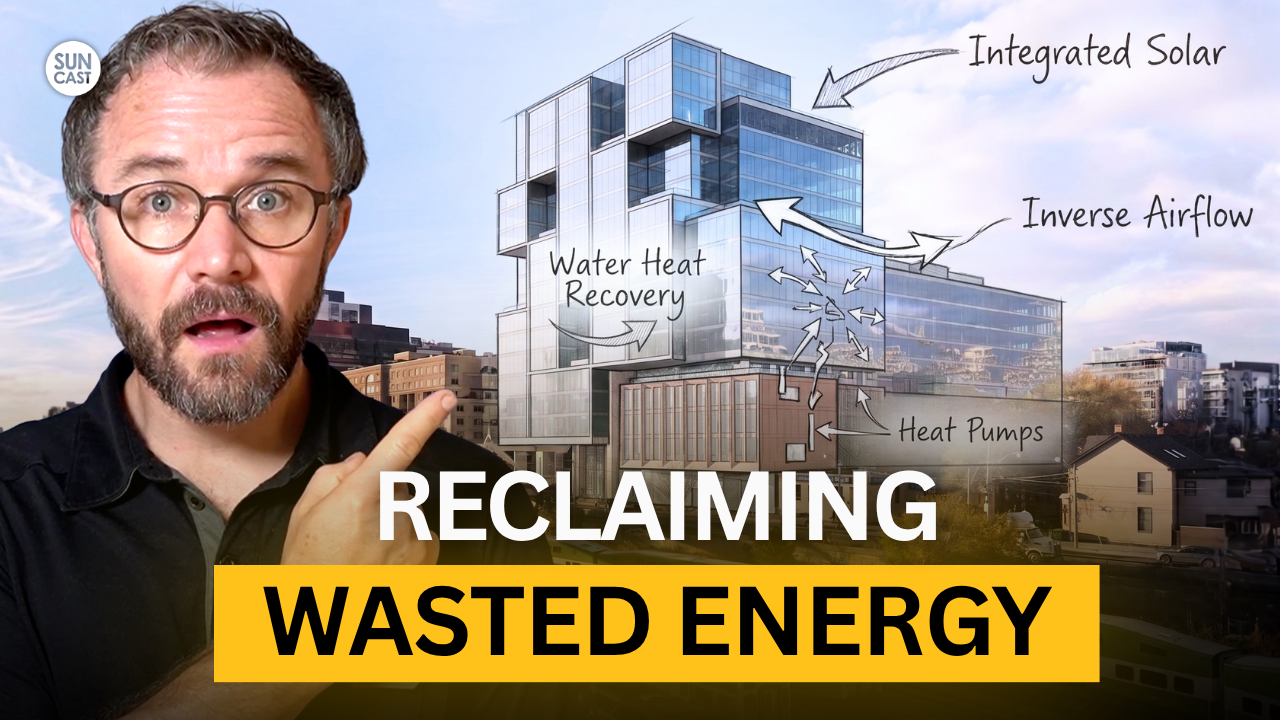
🔹 Where building-integrated solar, wastewater heat recovery, advanced windows, energy monitoring, and smarter HVAC fit into the equation
🔹 Why occupant comfort, fresh air, daylight, and flexibility can be economic advantages—not just sustainability features
🔹 How lower operating expenses can translate into higher real-estate value
For energy entrepreneurs trying to get new technology deployed, this conversation offers a useful look at what happens between having a better idea and convincing someone to actually put it in a building.
Hit play to learn why the building itself may be one of your biggest untapped energy assets.
RESOURCES:
Connect with Dermot Sweeny:
Connect with Aiden Sweeny:
Check out Sweeny & Co Architects Inc.:
(00:00) The 1,200 Space Heaters Under Desks Anomaly
(01:03) Welcome to SunCast: Commercial Buildings as Energy Systems
(03:08) Inventing Underfloor Air Distribution and Passive Cooling
(07:30) Integrating Daylighting, Perimeter HVAC, and Glare Control
(12:21) Bridging Economics, Venture Capital, and Real Estate Decarbonization
(17:31) How Lowering Operating Costs Boosts Real Estate Value
(20:11) Designing High-Performance Buildings from the Ground Up
(25:07) Overcoming Real Estate Risk Aversion with Proven Performance
(30:05) Cleantech Venture Investing and Wastewater Heat Recovery
(33:53) Submetering Analytics, Predictive Maintenance, and Advanced Dehumidification
(37:47) Deploying Building-Integrated Photovoltaics on Urban Facades
(46:01) Navigating Net-Zero Residential Real Estate and Heat Pumps
(53:10) Overcoming Landlord-Tenant Split Incentives to Drive ROI
(58:23) High-Performance Buildings in the Energy Transition
This Podcast is Free For You
Thanks to Our Sponsors
The following are Corporate Partners who have helped make SunCast possible:
Platinum Sponsor
The following are Corporate Partners who have helped make SunCast possible:

Noteworthy Quotes:
Dermot Sweeny 00:00
One of the guys that operated one of the buildings we developed bumped into me and said they've put me over on this other building, and it's an older office building, one of the most prominent in Canada. And they said we did a walk through on the hottest day of the year, which was August 11th, and it was 36 degrees outside and a high humidex. We did a walk through the building from top to bottom, and of course the cooling system was going crazy, trying to keep up. But we also found 1200 floor plugged-in unit heaters below people's desks. 1200 were on because someone sitting under one of those diffusers is freezing the arsenal. They had sweaters, a jacket on. Oh my God! They had a unit heater plugged into the power, running under the desk. I remember this system. That's at the very very early days when we had just completed Microsoft's headquarters. Hey,
Nico Johnson 01:03
welcome back to SunCast. Of course, I'm your host Nico, and if you are here for the first time, or as many as the 950 plus times, I want to say from the bottom of my heart, I'm grateful that you are giving us the only non-renewable resource you've got. Of course, that's your time. We're gonna take as little time as we can, as much time as necessary, to cover a topic that I think you're gonna find very interesting. That ROI compounds. So hopefully, you'll subscribe to the show and come back week over week as we bring you leaders on the front lines of the energy transition to teach you how to equip yourself and your team, your company, as operators who really build something worth having. When we think about the energy transition, we usually focus on generation, storage, even grid infrastructure broadly. But every commercial building is also an energy system. It's one whose performance is largely determined long before the tenant ever moves in to set building. Today's guests have spent decades thinking about that very challenge. Dermot Sweeney has designed some of Canada's leading high-performance commercial buildings, while Aidan Sweeney is helping bring that philosophy to a new generation of development and clean technology. One of the ideas that caught my attention is building integrated PV. I know a lot of you have talked about BIPV over the decades. It was one of the things that I first helped work on in my early career as well. I've rarely seen it done well until Aidan Sweeney called and said, "You got to talk to my dad. We've done it differently. We've done it successfully. You got to see it. I suspect it's just one example, though, of a much bigger conversation about designing buildings that don't simply consume energy, but rather manage it well and manage it on behalf of its occupants. And that is the reason that I said yes to Aidan and Dermot coming on the show. Without further ado, Dermot and Aidan Sweeney, welcome to SunCast.
Dermot Sweeny 03:04
Great to be here. Thank you.
Aiden Sweeny 03:06
Thanks for having us.
Nico Johnson 03:08
Yeah, I'm looking forward to this conversation. It's a little outside of the box of what we typically talk about, but I think that the those who have tuned in will quickly appreciate the depth of experience and what drew me to this conversation after I had a chance to really get to know you guys, Dermat? As I mentioned, you've spent decades designing high-performance commercial buildings. I'm curious when you first got started pushing for sustainable design. Maybe give me some context for kind of how that worked its way into your architectural purview, and what problem were you trying to solve that maybe others in your own practice or in your peer group weren't thinking about?
Dermot Sweeny 03:47
Where it started actually was I was very fortunate enough to do a term for architecture in Rome and went to the audience in a fantastic building designed in the 1950s by Narvi, and it was unbelievably comfortable. And I'm looking around. Of course, 5000 people are waiting for the Pope. And I looked around everywhere. There was no ducts. There's no diffusers. I'm thinking, how are we so comfortable? I reached down below the seat, and I saw that every chair in the place was on a single post. There was a hole in the floor bigger than the post, and the air was coming up beautifully from the floor up. We then started thinking about all of the problems in office buildings. We had started a commission to do an office many many years ago to retrofit, and I tried to get some of these ideas in. Didn't work, so my friend and I bought an old abandoned office building built in the. 60s, and we stripped all the outside skin off, and we stripped everything from the inside, and we built the first, certainly one of the first ever underfloor air projects. And what it does is, instead of pressurizing the space you live in or you occupy, which causes all kinds of issues. High pressure inside. People have sinus headaches, problems, whatever. Aiden's mother had this problem where she worked. We tried to solve that at the same time, so we neutralized the pressure in the space. That allowed us to do operable windows, bring fresh air in, and we pressurized the plenum and gave every one, every occupant their own diffuser. They could adjust their own temperature and fresh air. So we also determined that if we brought the air in at the bottom and took it away at the top, we used a lot less energy and people were far more comfortable. What typically happens from above is you use high velocity and much much colder air
Nico Johnson 06:08
to push it down.
Dermot Sweeny 06:10
Push it down. So if it came in at the floor, we could raise the temperature. That increased our ability to utilize the shoulder seasons in northern climates. So rather than an overhead having to condition the the air an overhead system long in or very early in March April at May we could get the shoulder season into early June we could also start at the end of September so that's free cooling that's a big deal. That reduces energy, and it just made everything more comfortable. No ceilings. You're in a space here. You can see.
Speaker 1 06:48
Yeah,
Dermot Sweeny 06:49
I tear it up. There is no ceiling.
Nico Johnson 06:51
Yeah,
Dermot Sweeny 06:52
love it so much. We moved in. So we we we've done about a little over 7 million feet of this. We started to discover that as the consumption of energy went down, let's look for every other way we could reduce energy.
Nico Johnson 07:06
Okay,
Dermot Sweeny 07:07
so that's how it started.
Nico Johnson 07:09
Massive
Dermot Sweeny 07:10
2019 99, so 27 years ago.
Nico Johnson 07:15
My goodness,
Dermot Sweeny 07:15
on a project that we did, we actually had to convert a system that was used for computer flooring into office flooring. We created new diffusers. We created all kinds of. So
Nico Johnson 07:27
you started inventing technology to address what you needed.
Dermot Sweeny 07:30
Absolutely, and one of the things that I learned years ago also from an interesting example of an art gallery that heated the space by way of a fin tube around the perimeter, and allowed air to pass down the glass and get cold. Come back up the other side, so we utilize that. I don't know if you can see it here, but you can see behind is a little drill at the glass, and that grill has a fin tube in it. We recoup heat on the air conditioning side to reduce the amount of gas used to heat the water for the perimeter, and it's all a sort of cyclical system that works really, really well. I guess the one, you know, when you get to really cold climates, when we did an office building in Calgary, we put two fin tubes in stacked, and we also have since then developed a way to boost the air conditioning as the planet heats up. Those loads are going up, so we actually use that same box in the summer with a boost fan on the perimeter that draws air out of the cool air plenum and puts it up outside the building. So these are all things. It having no ceiling allowed us to do indirect lighting.
Nico Johnson 08:50
Yeah,
Dermot Sweeny 08:50
indirect lighting bouncing off the concrete and coming down reduces glare tremendously, which is much healthier. And it also allowed us to reduce the energy required for the lighting by about 30%
Nico Johnson 09:05
Amazing! It's all. It turns out connected.
Dermot Sweeny 09:09
Yes, and you can see also on the perimeter. There's a light shelf in behind me. That light shelf reflects. It is aligned with a solid. Is that the
Nico Johnson 09:19
angled light?
Dermot Sweeny 09:21
Yeah.
Nico Johnson 09:21
Piece behind you, yeah,
Dermot Sweeny 09:22
yeah. That's the angled piece,
Nico Johnson 09:24
yeah.
Dermot Sweeny 09:24
And that rotates up to fully close in the morning because I'm facing east. In the afternoon, we're just at just past noon. It comes down level and stays level for the balance of the day
Nico Johnson 09:36
to diffuse light.
Dermot Sweeny 09:38
Well, what it does actually is interesting. It throws natural light deeper into the plan, into the into the
Nico Johnson 09:46
yeah into the rim. Yeah.
Dermot Sweeny 09:48
So it reflects off that. It also is aligned with the solar shade on the outside. Ah. So which is also designed with fins to take more light in. We have sensors. On the perimeter of the inside of the building, so when daylight reaches a certain level, we automatically shut off the artificial light. So this just kept snowballing. We were looking for different and better ways to do just about everything inside an office building. The beauty of all this, though, is the users now have a 10 foot eight ceiling height the underside of concrete because I can do in 18 inches what a ceiling would do in three and a half feet or say 4042 inches so that extra height we kept the floor to floor concrete the same and what we've done now in the building like I'm in, and many many other office buildings, we've allowed for greater height. That also gives for greater views. We don't need. We don't use perimeter beams, so you always can turn and look to the sky.
Nico Johnson 10:54
Yeah,
Dermot Sweeny 10:55
and you get a much more pleasant space. We think.
Nico Johnson 11:00
I had an episode with someone who does daylight daylighting for corporate buildings, and there's a bunch of statistics around reduction in in absenteeism, improvement in productivity of team members when natural light is introduced to To the facility, to the plan, to the work environment, if you will.
Dermot Sweeny 11:25
Absolutely, and one of the good things that happened, and this wasn't us doing it; it was just a change that started occurring throughout office buildings throughout North America, England, you know, all through Europe, where we started to say the corner office wasn't a reward, the perimeter office wasn't a reward. Let's all share the light. Let's work together. Well, suddenly, what we were doing made even more sense.
Nico Johnson 11:55
Right,
Dermot Sweeny 11:56
we were sharing that light as deep as 2530, feet into the plant, sometimes even more. You're okay with me speaking feet or inches, or you want metric? I do both. It's whichever
Nico Johnson 12:09
is most comfortable for you. I think our our audience is our global citizens. Folks understand metric, and I grew
Dermot Sweeny 12:15
up in feet and inches, and then totally fine changed to yeah centimeter.
Nico Johnson 12:21
It's totally fine. I think most folks are gonna understand both feet, if even if they're in Europe and prefer metrics. So, Aidan, I wanted to jump to you really quick, and there's a lot here to unpack. You grew up in this world where your dad was challenging what was normal in the architectural and sort of certainly commercial building space? You could have taken your career a number of different directions. What convinced you that what you saw happening within the world that your father occupied was where you wanted to point your career?
Aiden Sweeny 13:00
We've always had a passion for you know decarbonization, sustainability, encouraging a you know healthier future, and that's always just something I've been interested in personally. And with with real estate and designing new buildings, I think those that are interested in investing in real estate are inherently risk averse, right? To Dermot's earliest point, where he had difficulty convincing people to do things, so he actually had to buy a building and do it himself. I think there's a tremendous amount of power in in being able to do that and being able to become the developer and and actually being a first mover in the space, especially with you know the built environment, I think something like 40% of carbon emissions come from buildings.
Nico Johnson 13:53
Yeah,
Aiden Sweeny 13:53
so there's a huge opportunity to to reduce a substantial amount of carbon emissions through this kind of thing, you know, just just building upon what my father was able to build through his architecture practice and and development practice by buying and developing buildings to you know reach new heights and and new creative ideas where where they can be you know be first movers and encourage other people to to do the same. You know, on the same token, people are risk averse, but but at the same time, once once those investors realize that that is the best or the new best approach, it's very sticky. People don't want to deviate from that too, right? So to be able to to be a first mover and a leader in the space, and encourage certain practices or certain technologies to be involved in in buildings and and decarbonization, but also you know healthier, more productive. To your point, like people actually you know enjoying the space and being able to use it in a. Better way, yeah, is I think is tremendously powerful. And what's great about real estate too is it's it's a as a long lasting thing, and and you know we can leave a an amazing legacy for the for future generations by doing this.
Nico Johnson 15:15
Indeed, Aiden, you could have, like I said, you could have followed in your father's footsteps and become an architect. Perhaps tried to inherit sort of this the the work of being an architect. Did you did you study architecture or did you decide that there was a gap maybe in the way the business was approaching the the macro economics that you could fill by acquiring different skills? How did you think about that?
Aiden Sweeny 15:40
Yeah, you know, I did not study architecture. I have a an older sister who did. She followed in that footsteps, maybe that sort of that half of my father's brain. I, you know, coming out of high school and going into university, I didn't really know what I was wanting to do. So I ended up taking an economics degree, and it was a. I thought it was a tremendous foundation for any career.
Nico Johnson 16:03
Yeah,
Aiden Sweeny 16:03
but it was really once I graduated and sort of jumped into the professional world that I decided this was a really powerful thing that my father and and his his great team have built, and I wanted to help build it further and and take it to the next level if if possible.
Nico Johnson 16:22
Yeah, and as a result, so you've got the economics degree. Did you start identifying areas where there were economic dissonance, and and you thought you could make a an impact there? Like, I'm curious, just what does that conversation sound like? You're coming out of college or university and starting to think, you know, do I go work in the family business? Do I go work somewhere else? How how did you square that? The
Aiden Sweeny 16:48
foundation from an economics perspective, it really allows you to forecast, you know, different market trends, things along that nature, and pairing that with real estate and and the design aspects that Dermot mentioned, I think you know this this seemed more and more like an obvious fit and something that we really should be pursuing and pushing more. So, so yeah, I think it all sort of tied together in the end. But yeah, the like having that foundation and knowing, or or or having an idea as to what I think the future looks like, based on those forecasting abilities, I think it's it's a great way to translate into this for sure.
Dermot Sweeny 17:31
You know, it's interesting that fortunately energy costs money because it helps me do what we do, and Aiden is aligned so that we are constantly studying the net result of reducing cost.
Nico Johnson 17:46
Right,
Dermot Sweeny 17:47
and if Aidan and I both really clearly understand real estate, what a tenant wants in an office building is to understand the gross rent.
Nico Johnson 17:58
Yeah, what
Dermot Sweeny 17:59
is my gross cost of being here, so if the gross cost is say $40 per square foot, and and the operating is say seven eight of that, if I can reduce the seven eight to four or five, yeah, but hold the 40, well that increases the net rent, and as the net rent goes up, the value of the real estate drives up very quickly. Oh yeah! And in a down market, you can reduce your rent without affecting the debt rent. In other words, what you had in the beginning. So it has a tremendous long-term and short-term benefit to the value of real estate.
Nico Johnson 18:38
Yeah,
Dermot Sweeny 18:39
which is something together we study so that we, when we present to a client, and we we say to them, okay, your capital cost may increase slightly. You know, we're finding it's somewhere between two and 4% on the capital side.
Nico Johnson 18:56
Yeah,
Dermot Sweeny 18:57
but your op costs draw drop tremendously.
Nico Johnson 19:01
Yeah,
Dermot Sweeny 19:01
creating costs on the energy side may drop 3040, or 50% Yeah,
Nico Johnson 19:06
that's going to drive NOI. That's going to drive their net payback. Is
Dermot Sweeny 19:09
typically less than eight years.
Nico Johnson 19:13
Yeah,
Aiden Sweeny 19:13
and and and apply it on a cap rate valuation. Your the value of your asset can, you know, you can justify that amount of investment overnight. Sometimes,
Nico Johnson 19:24
oh yeah, yeah, yeah. It's very interesting, right? That there are different metrics for different
Dermot Sweeny 19:29
retrofitting,
Nico Johnson 19:30
even better retrofitting, even better. Maybe, yeah. Perhaps perhaps we'll get into that. Don't don't forget to remind me. Let's dig back into the economics of retrofitting. But and and there is a a lot of inventory that needs to be retrofitted. There's a huge market and opportunity for that. But if we think about designing the ideal building from the ground up, you know, let's start with the sort of a blank sheet of paper, if as it were, someone as a real estate owner comes to you, Derma, and says, "I want you to." Design for me the highest performing commercial building you know how to build today. Where do you start? You know, site orientation envelope. Like, how do you think about that?
Dermot Sweeny 20:11
Well, unfortunately, to a large degree, site orientation is very difficult when you're building towers on postage stamp sites.
Nico Johnson 20:19
Yeah,
Dermot Sweeny 20:20
there's not much you can do.
Nico Johnson 20:21
Yeah,
Dermot Sweeny 20:21
maybe in the suburbs, obviously, or you know, corporate parks or whatever. But typically, office buildings we work on are urban.
Nico Johnson 20:29
Yeah,
Dermot Sweeny 20:29
a lot of them. The case in point, though, when we did a very, very large headquarters, 550,000 feet, in a large corporate park, we oriented the building exactly on an east-west axis.
Nico Johnson 20:43
Yeah.
Dermot Sweeny 20:43
So it really helped in a lot of different ways.
Nico Johnson 20:47
Yeah.
Dermot Sweeny 20:48
But typically downtown we can't really achieve that.
Nico Johnson 20:51
Just so I'm clear, you would you would orient the longitude sort of like the length of the building east-west.
Dermot Sweeny 20:56
Yes. Okay. So we have two blocks of building. You look at my hand.
Nico Johnson 21:01
Yeah,
Dermot Sweeny 21:01
hear them a little bit. They're very, very long, and north is exactly this way.
Nico Johnson 21:06
Yeah, the long
Dermot Sweeny 21:07
axis is east-west.
Nico Johnson 21:08
Yeah,
Dermot Sweeny 21:09
that gave us really good exposure to solar and gave us great control of light because we're trying to keep some of the light out in the summer for heat gain, and we're trying to get as much light in in the winter for heat gain. So those things help absolutely, but typically downtown, what we're what we're faced with, I guess, here's how I I start. Number one, someone has to believe in all of what I said to you: the technology under poor air, higher volumes of space, more more light, operable windows-all those good things. Operable windows became pretty popular during COVID when people realized they didn't have them. So, fresh air is important. Productivity, people love where they work once they're in it, so that that is primary. Then we look at how do we reduce the consumption of gas because that's hydrocarbon,
Nico Johnson 22:12
right?
Dermot Sweeny 22:13
And that is consistently throughout North America much cheaper than electrical power,
Nico Johnson 22:19
right?
Dermot Sweeny 22:20
And the problem with that is, as you as you take away or reduce dramatically the amount of gas, you're using typically more power. Power is expensive, typically owned and operated by governments or agencies of government, and it's a little out of control. The costs are crazy. However, there are three four times more in Europe, which is why they they tend to be more energy conscious. Right. So we try to reduce the consumption of gas. We try to reclaim heat and create energy, and that energy we try to utilize to reduce energy. Period. As I was describing, we have heat wheels on the cooling side. People, very few people know that, you know, sort of. Well, throughout North America, you're cooling office buildings 365 days a year, essentially. So if you're doing that, then there's waste heat. How do I recoup the waste heat and turn that into either power, like electricity, or ways to reduce the requirement for heat around the perimeter, or heating hot water, or whatever. So we go through first, try to eliminate the the you know the gas, or home oil, or whatever it is, hydrocarbons. Then we look to recoup as much energy as humanly possible, and then we look to systems that use less energy, i.e. as I said, lighting, air conditioning. If I can increase the shoulder seasons through the year, I got free cooling. The more freeing I have, the better. So, and the whole world right now certainly after COVID, not the whole world, but a lot of people in the occupancy space, tenants, occupiers, want greater access to fresh air. So if I could bring in more fresh air longer and sooner, longer into the shoulder season, and sooner into the winter, without having to condition it. That's fantastic. Yeah, we can mix a lot with it. We also use traditionally office buildings have always used the return air to heat the incoming air in the winter, right? So that's always been something that was well considered. We just look for better and better equipment to do it,
Aiden Sweeny 24:49
and that also results in tremendous health benefits over over a long period of time as well, right? Just access to clean, fresh air fascinating
Dermot Sweeny 24:59
keeps people. Awake, yeah. Well, if you're if you're an employer, that's that's a good thing.
Nico Johnson 25:07
I'm fascinated with some of the how you're describing. I mean, there are technological upgrades, but there's also like a mindset shift.
Dermot Sweeny 25:18
Yes,
Nico Johnson 25:18
from a business level, how do you all discern if a project, an opportunity, a potential customer is an ideal fit. How do you know before wasting time on RFP after RFP or you know bid opportunity ad nauseum on things that just aren't going to be a fit?
Dermot Sweeny 25:37
Well, we I think if you develop a good reputation in the business you're in, which we have, having done I think it's a little over 7 million feet of this type of building, and we've done them as far away as Calgary, all throughout the GTA here, the Greater Toronto Area, and we've advised on projects in the U.S. as well, so I don't. So if someone says, "Could you help us do an office building? the first thing I say is, "Our way, yes. Your way, no. No. Like, can you just cut out a whole bunch of arguing in time? And if someone's interested and they say, "I'd like to learn more about your way, then, and then we take them through a process of learning, and we show them, and we've built lots of it in discovery. Do you
Nico Johnson 26:29
only take inbound inquiries, or do you guys go out and prospect business as well?
Dermot Sweeny 26:34
Oh, we go out and hammer away. Have to, but I'll give you one little really interesting anecdote. Okay, which was good. We had finished this large headquarters for Loblaws, which is essentially a essentially a family-owned business, as largest grocer in Canada, I believe, and they're huge. So a client called and said, "If we learn enough and like what you've done, will give you a very large project. I said, "Okay, great. So they saw my little spiel. I took them to a building, and they said, "Well, we're really concerned because it was going to be their headquarters,
Nico Johnson 27:18
yeah,
Dermot Sweeny 27:18
a new headquarters. So they said we're really interested in this raised floor for other reasons. I said, "What are the other reasons? They said, "Well, you know, churn, moving people. We move people all the time. We do this, we do that, whatever. And so these guys were just absolutely, you know, not easy to convince of anything, so I said, "Let's go to Loblaw's. So I called. Loblaws had been in the building less than two years.
Nico Johnson 27:48
Yeah,
Dermot Sweeny 27:48
I had the head of facilities and the head of churn, the person that moves people all over the place. They were inventing themselves. So we gave the tour, and at the end, the the prospect looked at the head of real estate and facilities and said, "All this nonsense about the race floor. Has it really helped with your churn? And she said, "Sir, we have had 5500 moves of people in our first 24 months, and my cost is pizza. Wow. What that are like? What do you mean pizza? Well, I buy them pizza when we move them.
Nico Johnson 28:29
Pizza
Dermot Sweeny 28:30
day, literally. It was quite funny.
Nico Johnson 28:33
That's hilarious.
Dermot Sweeny 28:34
He goes, "How you have no cost? She said, "Well, we can change the phone by pointing, you know, doing Bluetooth as as to the the floor, all the voice data power cables in the floor. It's loose. It feeds to a box. The box can be moved. They're all set up with the floor tiles. We do this in no time. We move the furniture.
Nico Johnson 28:53
Wow. There's no
Dermot Sweeny 28:55
lolly columns. There's no cable management in the furniture. That saved us 25% on our furniture, blah blah, and she kept going, and he was like, "Adap.
Nico Johnson 29:05
Yeah, so so it sounds like you've taken an approach of essentially moving a lot of the things that traditional office buildings started routing through the walls and ceiling, and bringing it all in through the floor, and it is a and it is a benefit of having an innovated or incorporated in this concept of subfloor HVAC, yeah,
Dermot Sweeny 29:28
and you can see if that's the ceiling. I love that
Nico Johnson 29:31
you keep turning the screen up because you're not watching this on YouTube. You're missing out. I'm telling you.
Dermot Sweeny 29:36
I got to tell you. Well, that you can see the only things on that ceiling are what's legally required. So there's pipes for the sprinklers, and the electrical you see on the ceiling is set up in a grid, and it's set up to do any number of different lighting paths. But you know plans. Yeah,
Nico Johnson 29:55
sure.
Dermot Sweeny 29:56
And it's instant to change. It's plug and play at the ceiling, plug and play.
Nico Johnson 30:00
Well, let's talk about some of the technology. Described how energy considerations shape everything from orientation.
Dermot Sweeny 30:05
Well, what we've done, you know, Aidan and I, when Aidan joined me in the company and his sister, who is also here on the architecture side, when when we joined, the first thing Aidan and I talked about was let's explore green tech.
Nico Johnson 30:24
Yeah, the
Dermot Sweeny 30:24
world's full of new ideas. My head's full of them all the time. Let's go find others that have big ideas that are proven, that are interesting, that are all about change, positive change, and saving energy. So, and we started as a family, the family trust, investing in a lot of these companies because they're desperate for capital.
Nico Johnson 30:48
Yeah, and and demonstrations.
Dermot Sweeny 30:50
Yes, so number of those companies are really starting to get going. Others still struggling as as things on you know it's a it's a long road. It's a hard road. It's I think one of the most important things we can say, and Aiden said it already, is real estate change is the enemy. Like to someone that owns assets, they don't want change. They have trouble understanding what it is they have, and the last thing they want is some you know snake oil sales guy coming in and saying, "No, no, this is way better. So, a lot of the green tech has been difficult, but we have discovered in our, you know, constant research and engaging with people and talking to universities who who came out recently, who's got some bright ideas, whatever, who's getting research grants? We're constantly looking for that, and we found some amazing companies. You know, we have a company that takes-they're now growing, they're publicly traded, they're doing well. What they do is they they recover heat energy from wastewater, Ray and black. So as rainwater hits your roof and goes out, that rainwater has got heat in it. You flush toilets, you run showers, you wash your dishes, you do all that. It's producing an inordinate amount of heat that goes straight into our lakes, rivers, ocean. You know, goes into.
Aiden Sweeny 32:19
But but before that ends up in the sewer, where we can manage it,
Dermot Sweeny 32:24
yeah. So we have two. They make two systems. One is municipal, which means takes all of that out of a bigger pipe for the city
Dermot Sweeny 32:33
and sells the energy back to people. So basically, it goes through heat exchangers, and we strip out the heat energy, and we can convert that either to more hot liquid or convert it to electros.
Nico Johnson 32:47
Fascinating,
Dermot Sweeny 32:48
and it's growing quickly, and it's phenomenal. I can tell you one project we're doing right now with them. It's a hotel, and the hotel has very high occupancy, a lot of showers, a big kitchen, a restaurant, on-site laundry. They do their own laundry. The laundry alone, stripping the heat energy out of the wastewater, leaving the laundry,
Nico Johnson 33:13
is
Dermot Sweeny 33:13
enough to heat the domestic hot water for the entire build. So it's like you start looking at this, and it's amazing because the water leaves much cooler than it would come in, so it's perfect. It's actually restoring the environment in the lakes, rivers, and whatever. So these are kinds of things we look at operating, understanding the energy use within a building. We have a fantastic company that Aidan can speak to, but we we've been working with them for years, called Circuit Meter, and basically what they do is they identify all of the use of energy throughout all of the building.
Nico Johnson 33:53
Yeah,
Dermot Sweeny 33:54
so you know at the
Aiden Sweeny 33:54
equipment at the equipment level. Yeah, they can tell you what each piece of equipment is using in terms of electricity. Collect that data, manage the data so to put together a playbook for building operators, but then also alert those operators if if something changes, so a spike in electricity or or a a valley, and then that allows you to maintain your your building and and the equipment, so it's predict predictive maintenance. Yeah, I was in my car and I got
Dermot Sweeny 34:29
a ding on my phone. So, because this system reports to the cloud, which reports to the people that are approved. So I the original office building we changed. We put it. We that was one of their first contracts. I get a ping on my phone, and I open it up, and it says, "Elevator number three motor is drawing three and a half times the power it normally does.
Nico Johnson 34:58
Oh wow!
Dermot Sweeny 34:59
So I. Call building operator shut down elevator three right now. Yeah, that's a coil of copper inside that motor. It's a big magnet, right? And if that thing melts out, this elevator was 30 years, 35 years old. So I mean, they don't. I called Otis. They don't even make the motors anymore, right? So he shut it down. We went. We found that you know the it was slightly out of balance. Well, sure, perfectly out of balance. We tightened it up, fixed it up, put it back in. Everything's perfect. So that saved about I don't know, probably seven, 800,000 bucks that ping on Nico.
Aiden Sweeny 35:39
But also the the health and safety aspect, right? If somebody was trapped in the elevator when that all went down, it could have been a substantial, you know, liability.
Dermot Sweeny 35:47
There's lots of things, yeah. There's great companies building things, great windows. We've discovered phenomenal patents. We're backing another company that strips moisture out of the air. So when you air condition a building, and this is really important, you the first thing you do is use coolant, a cooling system to take the humidity out of the air. So you're not cooling the moisture; you're removing it and then cooling the air. And you're also controlling the humidity in the building for 1000 reasons, not the least of which is mold, comfort, you know, good things. So, this this lady, this fantastic woman, has discovered this way to remove with no energy. Have water leave the air, so you don't have to cool it to get rid of the moisture.
Nico Johnson 36:43
Fascinating.
Dermot Sweeny 36:43
And I'm talking to her. Aidan and I went up to see her, and I'm like, I'm looking, going, she didn't know what she had. She was talking about, oh, I can, you know, dehumidify your house. And I said, no, you can eliminate 30, 40% of the energy needed air-conditioned office buildings. Are you? She was like, "What? It was fantastic. So we just started talking about doing it. They've set up test sites at the city hall in her town. It's working phenomenally well, and it's getting ready to explode. But imagine taking all the humidity out before you, before you cool the air to push it through in in a place like Atlanta or Houston that is unbelievably humid to start. So their cost to air condition is is absolutely huge. First the moisture comes out, then you cool the air. So these are these are the kinds of things we're always studying, and you asked about you started out by talking about photovoltaics.
Nico Johnson 37:47
Yeah,
Dermot Sweeny 37:48
we have a company here in Toronto. God bless them,
Nico Johnson 37:52
MyTrex.
Dermot Sweeny 37:52
It has yes, MyTrex has done all kinds of fantastic work, and we're big believers. We're using their product now on south facing, east, and west-facing walls. Yeah,
Nico Johnson 38:03
this is how we met.
Dermot Sweeny 38:04
Yeah, yes,
Aiden Sweeny 38:05
including that hotel that Dermond mentioned with the Shark Energy System. Yeah, that the whole that whole south facade of that building is a party wall, and it'll be entirely Mitrix. Amazing. Well,
Dermot Sweeny 38:19
it's not a party wall that was be covered, but yeah, it's fully exposed. It's on the property line, and the next door neighbor can't build there because there's an easement. But yeah, it's neat. Yeah, it'll be. We're going to produce a tremendous amount of energy.
Nico Johnson 38:32
So, Aiden, it sounds like you were given sort of a hunting license. Go find these technologies.
Dermot Sweeny 38:40
I'm fascinated. Everything's hunt.
Nico Johnson 38:43
Ah, that's it's not. You're not wrong. I'm fascinated with how you break this down from an economics perspective. What passes muster? You know what cut? What crosses the threshold of like this is interesting. We want to invest in it because you must see hundreds of ideas and opportunities by nature of folks finding and wanting to pitch you at this point. There's a I imagine that there's a a trough of technology folks that do find and pitch you. How do you think about the opportunity, both from the family? You know, you mentioned the family trust. So this idea of family, the family venture fund, as well as just the the the reputational risk of introducing one of these technologies to these high value clients.
Aiden Sweeny 39:31
Yeah, I think the reputational risk is probably even more important.
Nico Johnson 39:35
Yeah, of course.
Aiden Sweeny 39:35
So, well, I mean, the the building that Dermot referenced early all along in this in this conversation, that one with the underfloor air, that building was really it really was our guinea pig for a long, long time on a lot of these technologies.
Nico Johnson 39:54
Yeah, and
Aiden Sweeny 39:55
you're right. When we first started, or when I first started hunting, it was very slow. There was a you know not a lot of conversations, and now it's sort of like drinking through a fire hose. But I think we've found, I mean, for the most part, you know, we're we're constantly trying to evolve, and we're trying to really do our own due diligence by implementing it and seeing firsthand how that technology can benefit, you know, a building or or you know, in in various metrics, whether it's the bottom line or you know interior climate control, whatever it may be, I think you can analyze something on paper until the cows come home. But really, until you've actually implemented it and seen it firsthand, that's really the best way to do it. So we're lucky in in in you know many people wouldn't have the same sort of ability to to perform this kind of due diligence. But given that we do have a real estate portfolio and and and the you know trusted relationships with others that want to give it a test drive, that we're we're able to do that, but yeah, really, the proof is in the pudding. That's that ultimately where we end up. It
Nico Johnson 41:10
sounded like early on, Dermot mentioned that maybe you guys were innovating in terms of like even inventing technology. How much of that surfaced or like has has actually circulated into something that looks like production, whether that is a manufacturing partner or or something along those lines. Have you guys actually sort of helped invent or bring technology to market?
Dermot Sweeny 41:31
Well, yeah, and I'm just looking at the diffuser in the floor here that is made by my brother's agent's uncle's company.
Nico Johnson 41:39
Uh huh.
Dermot Sweeny 41:40
We it was a struggle to find people interested, so yeah, because of the family and the ideas and whatever, we got a better diffuser, like a better mousetrap. It's fantastic; it's adjustable by hand, or we can put a little motor on it and hook it up to a thermostat for meeting rooms, places that nobody owns, so you want to keep them perfect. So we've done that. the The raised floor system has exploded. A company called Camino in in in Toronto has exploded into one of the largest. Tate, of course, has grown its business, making the raised floor panels. Everybody's sort of in the industry benefiting if they get it up and running. A crazy example. Aidan said we can test fit them. His sister and I worked on a retrofit of an old house for to live in, and we put in light zone windows, which are you know capable of getting, the glazed unit is capable of achieving R 11, R 13, R 15, R. So it's better than most house walls,
Nico Johnson 42:53
right?
Dermot Sweeny 42:53
And you know we learned a little bit about that. We asked for the best of the best, and of course the best of the best has a little tint in it. It was too dark for an old house with not enough windows, so we changed them out and we worked with the manufacturer to say, "Okay, like our 11's good enough. Like, and you know, we it was a really interesting. They didn't have people that they're just starting in the company in Edmonton, Alberta. We got them to work with a Quebec train maker, so we get all of Canada, and this stuff's going into. Oh no, it's fun. Luckily, we you know we've been at
Aiden Sweeny 43:30
this so long that we have such an extensive you know relationship you know list of relationships.
Nico Johnson 43:36
Yeah,
Aiden Sweeny 43:36
that oftentimes whenever there's a hole or a need, we can reference other people, connect dots, and and and to Dermot's point, recreate a better a better mousetrap.
Nico Johnson 43:48
Yeah,
Aiden Sweeny 43:48
given all those relationships that we have, the hardest
Dermot Sweeny 43:51
one to do has been residential.
Nico Johnson 43:54
Oh, I bet
Dermot Sweeny 43:55
it's oh. I thought
Nico Johnson 43:56
you were going to say solar. No, no, no.
Dermot Sweeny 43:59
Solar is interesting because I was working on a house for our family, which we put on hold for a bit, given the downturn in the current Toronto market. But it's interesting, though, that there's beyond the obvious. I'll put solar up like crazy because we believe in it hugely. We have it on every roof of every building we've ever done. I think, but residential has always been very, very, very hesitant. The developers of residential-it's all super controlled. They want the least possible expensive cladding, and they understand buildings differently. So the top four costs are always first the structure, next you know the cladding, the mechanical depends where what part of the country you're in, but they have it down to a science. So they believe they've done all the research. They're right, and suddenly. They know they're wrong, so it's a kind of this kind of mind shift of why would you do that when condo owners are complaining about the cost of air conditioning,
Nico Johnson 45:11
right?
Dermot Sweeny 45:11
Like they make the units smaller and smaller and just make more and more and more and more glass,
Nico Johnson 45:17
right?
Dermot Sweeny 45:17
Vision glass. So there's all this now starting to occur, where people we're actually doing one now, our first full-on net-zero residential rental building.
Nico Johnson 45:35
Okay,
Dermot Sweeny 45:36
like that's if you had asked me, is that possible 10 years ago? I said no. You might as well go home and push pins in your eyes. You'll never.
Aiden Sweeny 45:44
We we have to be careful. I can't. You can't really say net zero because it is connected to the grid. And in Ontario, there is some. Well, Meg, we do we do burn yeah net zero net carbon zero yeah domestically. But the the the Ontario grid has some. We burn some natural gas.
Nico Johnson 46:01
Well, Aiden, I'm curious. There, when you first reached out to me, one of the stories that was connected there was the Mitrex relationship, BIPV. You're one of the few who I think have successfully deployed BIPV as architects and sort of owners, advisors suggesting this technology, I want to better understand what you've learned through that process about customer sentiment for, in particular, BIPV, which obviously I think the as far north as you are all are in the Toronto market works well compared with say folks down in Mexico, but generally speaking, how has the conversation evolved with customers around integrating PV either in the facade or on the rooftop? It's it's not that common to see PV on the rooftop of an urban building either.
Dermot Sweeny 46:53
Well, here it's getting more common because you you know we have a green standard, so unfortunately, yeah, looks like it might go away, but and we also on the commercial side, people want to see LEED certification now. It's less important than it was say three years ago. You'd rather be Boma Best or Well Building Standard, or you know because LEED is expensive, not capital wise, but the cost of the the consultants and the forums and the they see that as a minus. However, on on on using photovoltaics, the first answer is always how much more is that going to cost me, and then tell them it's a premium of X, and they go oh my god that's crazy, and then you start talking about how fast the payback comes, and you're going to clad anyway, and it's waterproof when it does your cladding. It's a good cladding system, better than many. And then you talk about how much energy it's going to produce, and the company's been great at backing it up and getting third party to back them up. Once you understand that it's the you know it's seven, 810, years max, depending on the exposure of the building and where you can use it, it could be very quick in terms of the payback. And long term, what's interesting, and I alluded to this earlier with the commercial buildings, the same is true with residential, and it's even more true with hotels because a hotel that is an owner operator. I don't know if you know what's happened in the hotel business. They used to own all their buildings,
Nico Johnson 48:35
right? The
Dermot Sweeny 48:35
Hiltons and Hyatts of the world. Now they're flags. So you go out, you spend the capital, you buy the land, you build the hotel to their specs. They put their name on it, and off you go. So now we're starting to see the return of the owner operator. Whether it says Marriott, Iot, Ilton doesn't matter. The person operating it is the owner of the building, and they want to reduce the op cost because it gives them a higher net rent per night. So they see that they they're they're now questioning things and asking us those kinds of questions,
Aiden Sweeny 49:13
and
Dermot Sweeny 49:13
it's wonderful, wonderful.
Aiden Sweeny 49:16
And with taller buildings like hotels or or high rise residential, your rooftop to facade ratio is quite low, right? So, if a rooftop array, you're not getting a ton of electricity based on how many, you know, how much the building is consuming, versus like industrial where you have several acre size rooftop, right? But with BIPV, that changes the game a little bit. Even even if you're getting, you know, I think in Toronto it's something like 80% efficiency on a south facing facade, and reduce. I think north facing is like 20% but 20% is still better than zero, right? So you're still just. Generating some, and you need that cladding already. So to you know, just adding this to everything Dermot's already
Dermot Sweeny 50:07
said,
Aiden Sweeny 50:08
any sort of free or cheap electricity generation coming from your facade is a substantial benefit for for a building operator, right?
Nico Johnson 50:19
Yeah. Well, something that stands out with Metrex, I mean, in the past we had folks creating these sort of shade structures on the facade, integrating sort of BIPV as sort of like adhered modules in certain places. But Metrex and others are now integrating it as as cladding, as you put it, which is the you know the paneling of the outside of the facility, or even replacing fenestration glass.
Aiden Sweeny 50:44
And the beauty of Mitrix too is they can. It's really the design that you can get on the like the glass piece that goes in front of the PE, right? Oh yeah, it actually looks like anything.
Nico Johnson 50:56
Yeah,
Aiden Sweeny 50:56
yeah. From from an esthetics perspective, and and Derma can talk about that. It's a fantastic product, right?
Nico Johnson 51:03
And but this is replacing fenestration in many cases, right?
Dermot Sweeny 51:06
Yeah, yeah, yeah. Can be replacing brick or replacing cement panel, fiberglass, wow, aluminum metal panel. It just you put it up, and they
Aiden Sweeny 51:14
can make it look like anything, really. And
Nico Johnson 51:17
the and obviously like a wall, a brick wall doesn't produce a return, so you have the conversation. It's the
Dermot Sweeny 51:25
opposite. Usually, it's a huge heat sink. Is
Nico Johnson 51:28
that right? Okay, and this is
Dermot Sweeny 51:30
long into. I have an old house, a very old house, and it's three wise the brick. And I'll tell you, the sun beats on that thing all day, and you think at night it's going to be cooler. That's when it gives off the heat, and it's insane.
Nico Johnson 51:47
Yeah,
Dermot Sweeny 51:48
like brick is terrible for that. It's good in the winter to absorb
Nico Johnson 51:51
heat. So I know that you guys have a relationship with Matrix. Are there other examples that folks would would find of companies doing something similar, or they have have they really like nailed the niche? As
Dermot Sweeny 52:02
far as I know, they have.
Nico Johnson 52:03
Yeah,
Dermot Sweeny 52:04
there are other companies doing things that you mentioned.
Nico Johnson 52:07
Yeah,
Dermot Sweeny 52:07
like I showed you the so I'm going to show again those solar shades. So that's that's a certain type of material.
Nico Johnson 52:15
Yeah,
Dermot Sweeny 52:16
that allows light through it, but take away the glare. What we have on the outside is a series of curved blades, like louvers.
Nico Johnson 52:26
Yeah,
Dermot Sweeny 52:26
they're designed to reflect the sun in. So we've said to people like Morgan Solar and others, if you could make us that outside panel, and I didn't need to angle all that, but you could set up a series of blades that could turn, then we could collect an inordinate amount of solar power. So it's starting. You know, I think Morgan was really interested. Mytrix has looked into a flat
Nico Johnson 52:54
panel that
Dermot Sweeny 52:55
would act as a solar shade.
Nico Johnson 52:57
Yeah,
Dermot Sweeny 52:57
but
Nico Johnson 52:58
brilliant,
Dermot Sweeny 52:59
and it would reflect light in just not as good as the ones we do, but they're working on it.
Nico Johnson 53:04
How do you decide what technologies deserve to be on a project? Is that
Dermot Sweeny 53:10
well? It's not just us. Yeah, it's also the client has a pretty big input on that.
Nico Johnson 53:15
I'm sure
Dermot Sweeny 53:16
how much?
Nico Johnson 53:17
Yeah, they're gonna need more comfortable. Don't get
Dermot Sweeny 53:19
you know like oh God, I could get we could do something. Well,
Nico Johnson 53:22
how do you convince them then? What changes when you're sitting across the table from a developer to skeptical? What argument actually changes their mind?
Dermot Sweeny 53:29
Most of the time, it's not saving the planet, although that does work on some, especially ones that have granddaughters or grandkids or can see a generation coming, or they're working, starting working with younger kids, their own. They start to think differently, but most of the time, it's how does that equate with a savings on my op cost?
Nico Johnson 53:55
Right, the cap rate, the NOI, the the economics.
Dermot Sweeny 53:59
Yeah, we did our first real office tower was with a company, a developer called Menkes, and it was being developed for Telus as a very, which is a large telecom company. And telecom company, this telecom company, Telus wanted to be extremely energy conscious and very, very good relative to the environment, so they asked the developer to to work with us as architects. So it was very good, and it was interesting that they wanted to save energy. And when Menkus, the owner of the building and its partners that own the building, started to discover what this meant to the bottom line again-the gross rent and how much of that is up, right? Right, and if it's down here, your net rent gives like yeah lower. They have won Boma Best for the best operating building I think probably in North America. Year after year, and so what then was a decision around energy to get the tenant,
Nico Johnson 55:08
yeah,
Dermot Sweeny 55:09
or to do the right thing for the tenant, so we could secure the tenant has now become their one of their biggest advertising.
Nico Johnson 55:18
Wow!
Dermot Sweeny 55:18
Like their branding is based on we built the best,
Nico Johnson 55:22
yeah,
Dermot Sweeny 55:22
and then their next one is even better. So one York that we did with the, which is a large head office for for Sun Life and a number of other tenants, but now it's now been up and operating three years, so we can now start to use that data. That data is better than the first one, so you know they're just gonna go get the Balma best again, and you know keep promoting the fact that they're only building the best buildings. Yeah,
Aiden Sweeny 55:50
and and with residential construction, a great example is heat pumps, right? Yeah, whether they're ground source, air source, whatever it is, for the longest time, buildings were either heating is on or cooling is on. Right there's in those shoulder months. There's you know September
Dermot Sweeny 56:08
both. All
Aiden Sweeny 56:08
of a sudden they have to turn the heat on, but it's you know 30 degrees outside
Dermot Sweeny 56:14
all the time. Right.
Aiden Sweeny 56:15
So with a heat pump, whether you know what, regardless of the source, they can you can have heating or cooling at the flick of a switch, right? It's not not a problem. So anybody looking to live in a building will see that and see, you know, there there are very much real world examples where I could be very hot on a September late September day when I should be cooling, and so for the longest time, like geothermal was struggled to to to break way and to break ground for pun intended in in Toronto. But now I'd say you'd be hard pressed to find any sort of residential building. Well, they're very rare residential buildings not
Dermot Sweeny 57:00
using a geothermal system, yeah. So it's become the norm. Yeah, it's been good, and the I mean the other thing with that is people are the younger people are concerning themselves more with energy consumption than their parents did. So what we're starting to see is as generations change in terms of operating or ownership of a business that's renting space, they're going to demand for better. And I know of one example where a company just moved into this building because the son and daughter took over the business, and they went. We're not tolerating like they were in an energy piggy, not far from here. I mean, a real piggy. And they just said, "This is crazy. Let's. I want all the paperwork. I want to see what you're doing. What is the square footage cost of energy? What are we doing? Why aren't you fixing this? The windows leak. And Dad was like, "Well, come on. It's like it's cheap rent, you know. And anyway, they move to a better building. I think you're going to start seeing that not only in the ownership of buildings, but the ownership of of tenants that move into buildings. That's it. All it all it all
Aiden Sweeny 58:16
comes back to the earliest point, right? Like once these things become the new norm. Everybody wants to do it, right?
Nico Johnson 58:23
Well, gentlemen, appreciate the the insights over the last hour. You know, we talked a lot about buildings, but this audience, predominantly listening, thinks about the broader energy transition, how we build the energy infrastructure around us. What's an assumption that we might be making about the future of energy that starts to look different once you begin designing buildings the way that you guys are designing them. How how does the work and the lens that you see through maybe challenge the average listener of SunCast to think differently?
Dermot Sweeny 58:55
Well, it's going to be long period of change. However, places like New York City are taking a lead and pushing for retrofit. They're telling you you've got to be a certain number in terms of consumption. These things, I think, together look. I mean, there's there's many things as Aidan said earlier. You know, depending on where you are in the world, it's around 40% of you know the carbon footprint is buildings. So, if we can eliminate carbon in terms of direct
Aiden Sweeny 59:30
use, oil, gas, and if we can eliminate a need for more and more electricity, especially in places that are producing it with coal or oil or gas, these are massive moves that are very hard to affect in any other industry. You know, if you said every car has to be electric, buildings still produce far more hydrocarbon in the atmosphere than the car. And I think we're in the middle of an industrial. Evolution here, right? Transitioning away from fossil fuels to renewable energy, and I think the average listener of the SunCast podcast really understands the magnitude of that of that the hurdle that is that transition. So, if we can make the ultimate customer of that energy the buildings that consume that energy, if we can make those buildings more energy efficient, it'll make that transition that much easier, right? And look also to what's being, you know,
Dermot Sweeny 1:00:30
we talked earlier about the shark system. To imagine in a city that couldn't afford necessarily to have everyone retrofit a building, at least let's take the wastewater, storm gray and black water, and take the heat out of it and put it back into the building.
Nico Johnson 1:00:48
Right. I
Aiden Sweeny 1:00:49
mean that's recycling. It's like we all talk about recycling. That's a phenomenal way to do it. And and thermal energy efficiency creates tremendous electrical energy efficiencies as well, right? It's all connected, which I think you mentioned earlier, Nico. The
Dermot Sweeny 1:01:08
other thing I would add as a last sort of point is, buildings produce a lot of heat. The heat that's going into the atmosphere isn't helping. It's accelerating. It's not just hydrocarbon is an issue. We're producing an inordinate amount of heat within buildings that is expelled, and I don't mean just commercial kitchens like air conditioning buildings. You look at these cooling towers. You drive into the Toronto in the winter, and it looks like there's steam or fire on top of all the buildings. Well, it's not exhaust. We're not burning gas necessarily, but it's in. It's cooling the buildings. I had one last sort of crazy thing I'll tell you about that was interesting. One of the guys that operated one of the buildings we developed, or we we designed, bumped into me and said they've put me over on this other building, and it's an older office building, one of the most prominent in Canada. And they said we did a walk through on the coldest, or sorry, the hottest day of the year, which was August 11th, and it was 36 degrees outside, or some ridiculous, and a high humidex. We went.
Aiden Sweeny 1:02:20
What is what is that in Fahrenheit for our American? Oh yeah, that's like
Dermot Sweeny 1:02:25
95 and over 100 with the humidex.
Nico Johnson 1:02:28
Yeah.
Dermot Sweeny 1:02:28
Well, they said they said we did a walk through the building from top to bottom, and of course the cooling system was going crazy, trying to keep up. But we also found 1200 floor plugged in unit heaters below people's desks. 1200 were on because someone sitting under one of those diffusers is freezing the arsenal. They had sweaters, a jacket on. Oh my God! They had a unit heater plugged into the power, running under the desk.
Nico Johnson 1:03:06
Yeah,
Aiden Sweeny 1:03:06
in August with 100 degree weather outside. Unbelievable! This system-that's at the
Dermot Sweeny 1:03:12
very, very early days when we had just completed Microsoft's headquarters, and we were working on Loblaws, and someone said, "You've got to see this with future heaters all over the place.
Nico Johnson 1:03:25
What a fascinating story, guys! I think that's a great place for us to wrap up the conversation.
Dermot Sweeny 1:03:28
Okay,
Nico Johnson 1:03:29
we're just getting started. Oh, I know. No, the thing I've learned about conversations with Derma is there's a story for every question, and that is fantastic. I wish more. I honestly wish more guests could connect the dots to the real life stories that exhibit the the truths that we want to try and transfer. You know, we spend a lot of time talking in this industry specifically about how we generate cleaner energy. I think today's conversation what it does is remind us buildings that we design better are every bit as important to the equation of how we reduce, decarbonize our world, reduce our carbon footprint, reduce the energy generation required. It's kind of like the old recycling adage: reduce, reuse, then recycle. And often, folks take you know take for granted that the energy efficiency requirements have to be retrofitted because buildings aren't just aren't designed that way. And I'm so encouraged to see that you all are helping create high performance buildings that will have an impact, as you put it in, on decades of energy use, and that it's designed in from the beginning. That intentionality is really important. Thank you both, Derma and Aidan, for the work that you do and for sharing your experience with us, your perspective. And it's really been a pleasure to have you here on SunCast. And
Dermot Sweeny 1:04:54
Nico, thank you for what you do. It's great too.
Aiden Sweeny 1:04:56
Yes,
Dermot Sweeny 1:04:57
really important.
Aiden Sweeny 1:04:58
Excellent stuff. Thanks so much.
Nico Johnson 1:05:00
Before I let you, before I let you go, Aidan, if folks want to connect, if they want to figure out how to get one of these wonderful technologies you guys are helping champion into their own buildings, what's the easiest way for them to connect with you?
Aiden Sweeny 1:05:11
So yes, we're available. I'm quite active on LinkedIn, and you can learn more about Sweeney and Co at SweeneyandCo.com, and then please reach out to me, and I'm happy to connect you to any of the companies we've talked about today, and and you know just sharing ideas generally to decarbonize the built environment. We're happy to do that.
Nico Johnson 1:05:32
Fantastic. Appreciate you guys. We'll make sure that all of those links are down in the show notes if you're watching on YouTube or if you're listening on your podcast player of choice, please make sure you check out all the work that the Sweeney folks are doing. And remember, we always link to the guests because we want you to reach out. We want you to share these episodes. It's the easiest way that you could say thank you to both of us for the time we've invested in helping bring this information, these insights to you. If you want more, if you want to suggest someone something, if like Aiden want to suggest that you or someone you know be on the show, please reach out to us team at suncast.me. Thanks one more time to our sponsors who help all this make all this possible. They pay the bills. All we ask you to pay is attention. I'm honored that you have done that all the way to this point. Remember, you are what you listen to. Thanks again for showing up, Solar Warrior. It's half the battle.

Nico Johnson
Entrepreneur & Podcaster
In my 20 year career, I've worked with dozens of entrepreneurs, intrapreneurs and professionals in transition to clarify their mission, set or stretch their goals, and work through the barriers to their growth.

We’re Excited to Hear from You!
Don’t hesitate to reach out—whether you’re here to learn, share ideas, or work with us, we’re ready to connect.