
We'd love if you'd leave us a 5 ⭐ rating & review and it's never been easier: www.ratethispodcast.com/suncast
What will it take for solar and storage to deliver the affordable power customers need, at the speed the market demands?
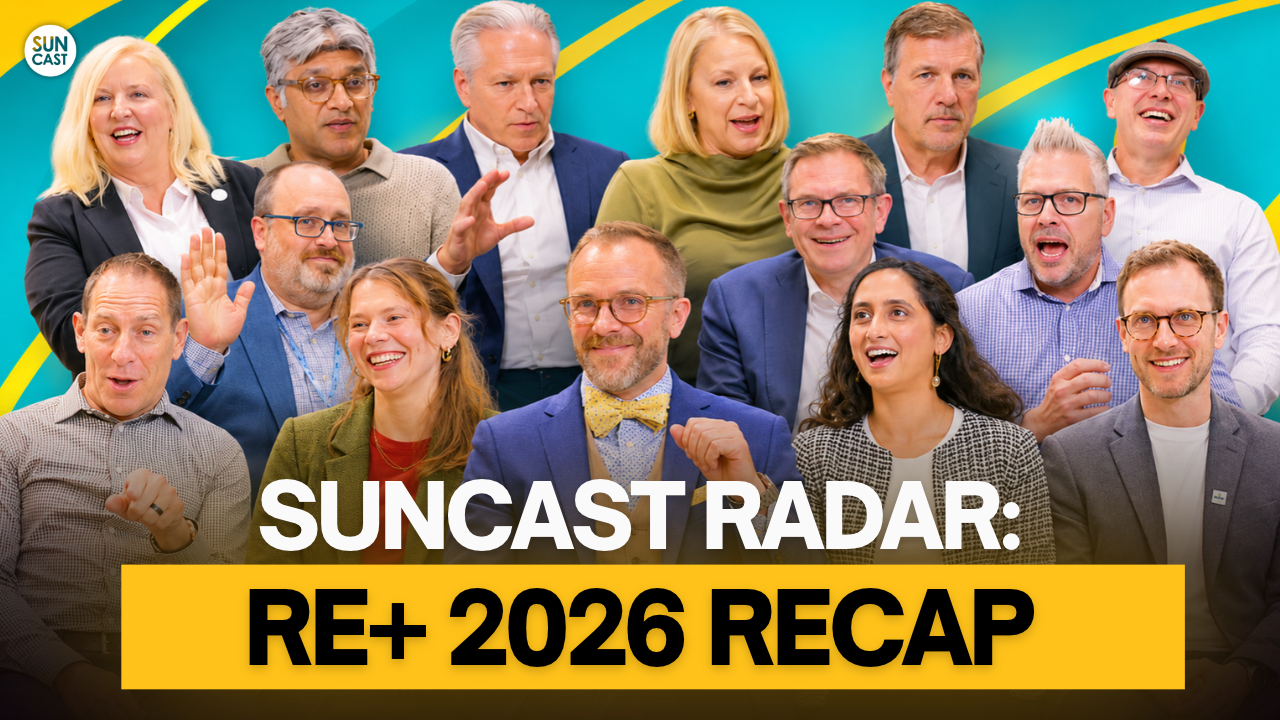
Recorded at RE+ 2026 in Las Vegas, this SunCast Radar compilation brings together highlights from Nico Johnson’s conversations with entrepreneurs, developers, policy leaders and fellow energy podcasters. They compare the opportunities opening up across the industry, the assumptions worth questioning, and the obstacles that could keep good technology from reaching customers.
Jigar Shah and Thomas Neyhart explore lower-cost residential solar, savings-based financing and the opportunity for battery-first businesses. Kevin Smith of Cypress Creek connects the Steel River project in Arkansas with American manufacturing and the work of earning community trust. Abby Hopper, Yann Brandt and Stephanie Bosh examine the tradeoffs behind permitting reform and the case for leading with affordability.
Mike Casey challenges the industry to turn its economic footprint into stronger public support. Ed Crooks and Ed Gunn question whether consolidation and bundled offerings actually deliver what installers and project builders need.
From rural solar to data-center-backed residential batteries, these conversations bring the market’s big questions down to business decisions: What are customers buying? Who benefits when projects get built? And where do existing ways of selling, financing and delivering energy need to change?
Expect to learn:
🔹 How prefabricated systems could bring solar costs to $1.50 per watt
🔹 Why Arkansas is emerging as a showcase for American solar manufacturing
🔹 How bipartisan permitting reform could reshape clean energy development
🔹 Why battery-first businesses could disrupt traditional residential solar companies
Whether you attended RE+ or followed from afar, listen for the signals that could change what you build, sell or back next.
Discover what some of the industry's most influential voices are watching as clean energy heads into 2027.
RESOURCES:
Connect with Jigar Shah:
Connect with Thomas Neyhart:
Connect with Kevin Smith:
Connect with Zainab Mirza:
Connect with Hannah Malus:
Connect with Abby Hopper:
Connect with Yann Brandt:
Connect with Stephanie Bosh:
Connect with Mike Casey:
Connect with Ed Crooks:
Connect with Ed Gunn:
Connect with Josh Beck:
(00:00) Lowering Electron Costs at RE+ 2026
(01:31) Reframing Clean Energy Around Consumer Affordability
(03:19) Cracking $1.50/Watt Rural Solar With Skidded Arrays
(08:01) Surging Load Growth and America's Largest Solar Project
(11:32) Community Benefits and Domestic Steel in Arkansas
(16:58) Winning America's Heartland Through Local Storytelling
(20:24) Inside the Bipartisan Senate Permitting Reform Battle
(27:46) Why Solar Policy Is Economic Affordability Policy
(31:45) Clean Tech Bulls vs. Entrenched Fossil Incumbents
(38:12) Countering the 28-to-1 Fossil Lobbying Advantage
(42:22) Industry Consolidation and the M&A Feeding Frenzy
(49:50) Data Centers, AI Backlash, and Social License
(52:50) Hyperscaler VPPs and the Battery-First Installer Pivot
(56:04) Tale of Two Markets: Tariffs vs. Flexibility
This Podcast is Free For You
Thanks to Our Sponsors
The following are Corporate Partners who have helped make SunCast possible:
Platinum Sponsor
The following are Corporate Partners who have helped make SunCast possible:

Noteworthy Quotes:
Yann Brandt 00:00
Energy is 7% of the GDP in America, right between electrons and molecular fuels. But the next 93% cannot happen unless you have the energy to power the economy across the country and the world. And the more solar we build, the better off that we all are. And that's that's our contribution. We're transitioning and lowering the cost of electrons for anyone that puts more solar into their grid.
Nico Johnson 00:26
That was Jan Brandt live from our studio on the show floor at RE Plus 2026 live in Las Vegas. This one's going to be a little different. You see, all last week we introduced our newest show called SunCast Radar, a morning brief and daily download every day of this show, and I brought in co-hosts who see this industry from angles I simply don't. Some of the biggest names in clean energy, some of the sharpest voices in energy media, and frankly, some very opinionated thought leaders joined me in the studio. This is the best of all that we recorded last week. The moments I keep replaying in my head, we've got affordability, the biggest solar project in the country, the permitting bill, a fading frenzy of acquisitions, and how we finally win the story. Tuesday morning, I was joined by the inimitable Jigger Shah, who's been coming to what is now RE Plus, then SPI since 1996. We were also joined by Thomas Nehart, CEO of Sunrise Financial. I asked him the question that's been haunting residential solar for a decade: Can we actually get down below two bucks a watt?
Jigar Shah 01:31
Well, I think we start from the fact that the loonami, as you call it, is not really about climate change.
Nico Johnson 01:39
Yeah,
Jigar Shah 01:39
right. It's about affordability and cost of living, right? And so when you think about all of the boosts on this floor, there's a lot of people that have technology that can save people money today, right? And so I think that there has been too much made about tax credits, about safe harbor, about step up in basis, about all of this complicated stuff that I think turns off voters.
Nico Johnson 02:09
Yeah,
Jigar Shah 02:09
right. They're just like, does the stuff work? Does it save me money? Does it put more money in my pocket?
Nico Johnson 02:14
Yeah. Does
Jigar Shah 02:15
it let me do the things I want to do? Right. And I think the answer is that there are so many technologies on the floor here that does meet that threshold, right? And I think we all need to figure out how we change the way we talk about these things,
Nico Johnson 02:28
yeah.
Jigar Shah 02:28
And focus entirely on how we make those customers' lives better,
Nico Johnson 02:33
yeah.
Jigar Shah 02:33
And that really, I think, is what the voters said, right? They said neither party has been taking care of
Nico Johnson 02:39
us, yeah.
Jigar Shah 02:40
They've been doing what they want to do in some sort of like academic tower, and now we want you to really focus on our household budget.
Nico Johnson 02:49
Thomas, how do you size up as you? I mean, you've been in this industry long enough to see a lot of technology come and go. We do, to Jigger's point, have a a history as an industry of sort of talking at the consumer with metrics and vocabulary that don't really land well, I'd love to hear your thoughts on how we, as an industry, are evolving that and what you see on the horizon that can change that landscape for how we actually make this product accessible, affordable, and ubiquitous in America.
Thomas Neyhart 03:19
I think we have to get away from talking about product. Every time I've sat at a kitchen table with a customer, if I start talking about product, if I start talking about how we're going to offset X number of kilowatt hours, et cetera, I lose the customer. When we talk about savings and how much you want to pay for your power and how much you like or dislike your utility company, that's when we start to make progress. And when you think about the ability to deliver solar for under $2 a watt, which, by the way, you know EAI and and EG four has cracked. They are delivering a fully assembled ground mount system that's portable for a buck 50 a watt. Buck 50 a watt. This is it's incredible, and that means that even with backup, and they're putting a 60 kilowatt hour backup system with it.
Nico Johnson 04:07
Wait, this is with batteries.
Thomas Neyhart 04:08
With this, with a battery, the batteries are different. The batteries are a different cost, but you're able to deliver power and backup at 15 cents a kilowatt hour. And that's what you have to start to talk about, right? How much money can we save you? How much are you paying for your energy? How much you paying for your power? They don't care if it's a bifacial panel. They don't care if it's a inverter or if it's a it's a micro inverter. They care about how am I going to save money? How am I going to impact my my budget every day?
Nico Johnson 04:35
And Thomas, another thing they care about is how are you going to help me pay for it?
Kevin Smith 04:39
Right.
Nico Johnson 04:39
You guys just announced a partnership with EG4. Tell me about Sunrise Financial. How's that going to make a dent in the market?
Thomas Neyhart 04:46
You know, Sunrise Financial is based upon what my wife and I have always believed: if you save people money, they pay their bills. Yeah. So we have never underwritten to a FICO score, never underwritten to debt income. We only underwrite to savings. If you save somebody 567 $100. Year, you're a utility replacement, and they want to pay you, and so we brought that same concept to Sunrise Financial. We've been working with some great partners up to now, but our partnership with EG4 is going to be a game changer. We're going to deliver fully assembled ground mount systems that people are going to be saving an incredible amount of money on.
Nico Johnson 05:18
This is the shed thing that I've been hearing James talk about right.
Jigar Shah 05:21
Well, I think that's exactly right. But and but more importantly, I think it's really targeted to the rural custom.
Nico Johnson 05:27
Yeah,
Jigar Shah 05:28
right. Which we've never done. You mean I think the solar industry has really been focused on suburban households.
Nico Johnson 05:33
Yes,
Jigar Shah 05:34
for rooftop, this is really going to be targeting people that have a little bit of land.
Nico Johnson 05:38
Yeah,
Jigar Shah 05:39
the ability to put you know a ground-mounted system in, and the other thing that it's doing, which I think is fascinating, is it's bypassing all of the margin.
Nico Johnson 05:48
Yeah,
Jigar Shah 05:48
right. Because when you look at companies like Cumerit or Treehouse or others, they are now installing electric vehicle chargers at your home for 1200 bucks, right? And they have like 1300 electricians on the platform, they do that stuff. This system, when drop shipped at your house, can use one of those services to connect it to the panel. It literally is like just connecting an EV charger to your panel. So now you're like, wait, who who needs to mark this up 20%? Like, why do we need to do all of these other things, right? And I think that's where this whole thing is headed, is in a place where, you know, what Elon Musk calls the idiot index.
Nico Johnson 06:29
Yeah.
Jigar Shah 06:29
Right. When you look at the raw costs of all of the solar equipment that's sold here, it's like 85 cents a watt maybe for the total equipment package.
Nico Johnson 06:38
Yeah.
Jigar Shah 06:39
Well, then why does it cost $4 a watt to install it, right?
Nico Johnson 06:42
So, what changed to make it possible to go from four to $1.50? And we've seen. I've been working in Latin America, as you know, Jigger, for the last 1520 years, and we've been in Chile at utility scale at under $1 a watt. In Australia, easily under $1 a watt. What's changed here in America, and with with some of the products you're seeing that gets us down under that threshold.
Thomas Neyhart 07:03
It's been James, right? James has taken a look at this problem and said, "How can we do it so inexpensively at a utility scale, but we can't do it inexpensively at at a residential?" And one, getting up on roofs, that takes a lot, right? Configuring thing, you're doing all this. He is basically taking utility scale and just chopping it into residential pieces, yeah. And so it comes fully assembled. You deliver it. You put. You crank it into the ground. You tip the the panels, and that's it. The inverter is already built into the box. The battery management system's already built into the box. Everything's done. And to Jigger's point, now you're just connecting it to the panel.
Nico Johnson 07:37
It's the equivalent of the of a skidded array, right? Yeah, it is. Yeah, yeah. I talked to James about it, and my dad owns like seven acres in South Carolina. He's like the prime target, right? He could just have a truck back in, drop it right behind his garage. They did
Jigar Shah 07:51
that because they they unveiled it last week or the week before at Dervos in New York City, and it came in a truck. They used a winch to put it on the ground. Yeah, yeah. All took like an hour and a half.
Nico Johnson 08:01
Well, Tuesday evening was our first daily download, and I had two new co-hosts, Zanab Mirza and Hannah Mallis from What's the Tea, and we were joined by my friend Kevin Smith, who just stepped into the role of CEO at Cypress Creek Renewables. They are building the largest solar and storage project in the United States. Before you hear where, take a guess. I'll bet you got it wrong. A year removed from O Triple B. Certainly, a couple of weeks post the Blue Nami. I feel like the the the the show floor, the conversations I'm seeing are effervescent. But we've been here before, haven't we, Kevin? We have. It's been
Kevin Smith 08:41
a it's been a roller coaster ride for the last 20 plus years in renewable energy. So so, but I mean we continued to soldier on, and then the industry has continued despite all the changes in in DC to kind of you know be the the workhorse of new electricity generation.
Ed Crooks 08:57
Yeah,
Nico Johnson 08:58
Kevin, you've as you pointed out been a couple of decades leading companies that are building this energy transition, actually putting this deal in the ground, the infrastructure. Is there anything that you have that you you perceive about this moment in time that feels different?
Kevin Smith 09:16
Well, the biggest difference is the demand. You know, I mean, I've been in the energy industry for more than 40 years, actually. Wow! And first half was more conventional energy because renewables were not commercially viable back in the pre-2000 period. But you know, electricity demand has been you know half a percent, you know percent in boom years, you know, over the last probably 25 years, and now all of a sudden, over the last kind of year, and then moving forward, we're seeing you know growth rates at you know 3456, 7%, which is you know triple and quadruple what the growth rates have been historically. So so everybody is looking at you know how can we deliver. How can we deliver affordable energy, and how can we be quick to market? So the demand is probably the biggest issue. Obviously, we've got lots of political issues we're dealing with, but I think the probably the biggest issue that we're dealing with that's a change from historical norms is the is that huge demand that we're seeing. Yeah, one
Nico Johnson 10:19
of the things that blew me away, honestly, just sort of, I think I may have mentioned this to you, sort of through serendipity of our client interactions. I had a client ask if I could, if I knew anyone at Cypress, and I was like, "Oh, actually, I do." Coincidentally, my friend Kevin just became the CEO there. Why? And they said, "Well, they're doing this huge project in Arkansas, and I was like, "Wow, a lot of land in Arkansas. How big could the project be?" Why don't you tell us how big the project could be?
Kevin Smith 10:50
Yeah, it's it's the the largest solar and battery storage project in the U.S. That's amazing. The first two phases. It's a three phase project. The first two phases are under construction. It was a three and a half billion dollar financing, 1.6 gigawatts of solar, and 1.9 gigawatt hours of battery storage. The first two phases will be 3,000,001st solar panels. I
Nico Johnson 11:14
feel like this is perfect for your show. You have to add this. Like this is a trivia question. You're gonna you're gonna trip up nine out of 10 people. Where's the largest project in the U.S. right now? 100%.
Hannah Malus 11:25
I don't think a lot of people would say Arkansas. Arkansas. No, I feel like Nevada comes to mind. Texas comes to mind.
Kevin Smith 11:30
California. California.
Zainab Mirza 11:32
Kevin, that makes me think. I spent some time at the Department of Energy Loan Programs Office where I stood up the Community Benefit Plan program, and you guys, Cypress Creek has a community foundation. You guys really, I think about the benefits of clean energy, but I think Cypress thinks about the benefits of what energy projects do for the community. And so, I think it would be really interesting to think through and for you to help us explain the difference between mitigation and an actual tangible benefit to the community, and how Cyprus approaches that when you're building out these huge projects.
Kevin Smith 12:05
Yeah, I mean, you look at I'll say the the the main the basic benefits, which is you know job creation in in the in the in the in the region. You know, the Steel River project. Each phase will will employ about 700 workers. Substantial amount of tax benefits into the will flow into the region about $300 million over the life of the project, but you can't just go in and say, "Oh, we're gonna, we're gonna." There is going to be workers in the area, and there is going to be tax benefits. You really have to go in, you know, at Cypress Creek and at previous companies I've been with, we've really kind of championed going into the communities and understanding what their needs are. So you have to go in and you've got to do the do your homework and you got to meet with community leaders. You got to meet with the school superintendent, the school local school principal. You know the hospitals, the first responders, the local fire department, and you got to kind of say, hey, we're going to be building a a large project in your in your area, and we we're going to be here for decades into the future. What do you need? You know, how can we help? You know, we're not going to go in there and say, "Oh, we'd like to do this or we'd like to do that." We need to listen to the community. You know, you know the the schools. I like. I'm I'm a big fan of doing projects with the schools because it's it's pretty rewarding to kind of see the kind of immediate effects that you that you do that. So go go talk with the school leaders and kind of say you know where where where can we help you know with some funding of a project that you that you can't get into your budget with the school board, but we can come in and help you get that done. So I think that's for us. You know every project we need to you know we've got dedicated budgets. We need to go into every project early with you know meeting the community, understanding what their needs are, and how can we help. In addition to the jobs and the and the tax and the tax issues that they'll get, which is a huge benefit as well. But but also listening to local leaders and local community leaders that that can understand where where best we can inject ourselves.
Nico Johnson 14:09
Kevin, as you can tell, we are big on storytelling here, and you are taking part in something that is so huge for our industry. I want to know how Cyprus is thinking about the narrative of such an impactful project. How are you capturing a story? How are you telling the story in a way that can help other communities come along and decide this? I want this for my community, as as opposed to what we've seen for the better part of the last two years, where folks say not in my backyard.
Kevin Smith 14:43
Yeah, I mean the the Steel River project is a bit unique in in a few ways, but I mean one of the things that that is not unique is that there is a lot of U.S. manufacturing now of of solar components.
Nico Johnson 14:54
Yeah.
Kevin Smith 14:55
So you know this particular project I think is a showcase of American technology. You know, it's as I mentioned, kind of 3,000,001st solar modules, solar solar panels manufactured in Ohio, Alabama, Louisiana. Next Power is the tracker supplier. You know, we're we're purchasing 100% structural steel. And what's unique about about this location of this project is Mississippi County, Arkansas. Unbeknownst to me, a year ago, but Mississippi County, Arkansas, is the largest steel-producing county in the U.S. What exactly? I would have picked other places, you know. But the
Zainab Mirza 15:34
map is so confusing to me right now. Exactly.
Kevin Smith 15:38
And and and there's actually two big steel mills that are that are within 45 minutes of our facility. So we're purchasing steel from from Big River Steel and from Paco Steel, and so the the all the piling are going to be stamped, kind of you know manufactured in Mississippi County. 140,000 tons of steel will be produced and manufactured in Mississippi County, and then and then you know 30 minutes down the road will be utilized to support the the project. So we've done the the Cypress Creek has done a little documentary on that the steel side of it. You know I took a took a tour of. I've been in steel mills before. I've been in in in the industry for quite a while, as I mentioned. But we took a a tour of the steel mills up up in in Mississippi County, and they're super excited. The workers are excited that they're involved in such a groundbreaking project, solar related. So so it's nice to see not only the solar manufacturing equipment, you know, solar panels and and and trackers and and batteries and those kinds of things that are assembled in the U.S., but also the underlying steel is is key. And I think, you know, the the solar industry is quietly kind of supporting the steel industry as well.
Zainab Mirza 16:58
Cypress Creek will be the biggest one, and maybe for now, right? Like, what are the next biggest ones that we're going to see? And it's this scalability. What other piece of the puzzle are we missing then when it comes to either the robotics revolution that you're calling it when it comes to solar or something else?
Nico Johnson 17:15
Yeah. Are you asking?
Zainab Mirza 17:17
Yeah.
Nico Johnson 17:17
Okay. Not a hypothetical.
Zainab Mirza 17:18
No, I'm genuinely asking.
Nico Johnson 17:20
So that's a good question. I'm not sure that I have an answer for what's missing at the moment. I think that you know, with the workforce crunch constraint that we've experienced, what's happening with robotics right now could help. I think that I mean the thing that we've all been saying ad nauseum, what's missing, is a good story, right? Like, what's missing is the heartland of America. My father, and you know, traditionally Republican-leaning Southern entrepreneur who would much rather have a natural gas generator than a solar and battery solution because he can believe it, right?
Zainab Mirza 17:59
Yeah,
Nico Johnson 17:59
that's what's missing is this belief in the irony is that like the oil and gas industry that gives them this sense of confidence has not only helped to create the renewables industry but has believed in batteries and solar for four decades, five decades
Zainab Mirza 18:16
longer than sometimes we believe in so longer
Nico Johnson 18:19
than anyone. I mean that's that's kind of perhaps the irony behind it. So I think what's missing at the moment is more channels like What's the T? More people telling the story in fresh new ways, right? With with and different faces, right? Like I say this all the time. It's one thing for me, a middle-aged white man, to start a podcast and like build a following, and and to give people sort of regular touch points on the industry. It's quite another to see women enter the fray, to see people of color enter the fray. Like my good friend Joe Ordia was walking around today. Like he has he does more views on YouTube than RE Plus has had in lifetime attendees. That's
Zainab Mirza 19:01
amazing. Yeah, right. That's what we need.
Nico Johnson 19:03
He has 100,000 subscribers. That's more than. That's twice as many people as will be here.
Zainab Mirza 19:07
Yeah,
Nico Johnson 19:07
that's incredible.
Nico Johnson 19:08
That's what we need.
Hannah Malus 19:09
Yeah,
Zainab Mirza 19:09
I think that that's like the big storytelling. I also think of like, I go to rooms and you know you're talking on panels. I look in the room. I'm like, there's 50 of you. If you all went home and wrote an op-ed in your local paper. I'm not talking about the New York Times. I'm talking about the Ocean City Today.
Nico Johnson 19:25
Yeah,
Zainab Mirza 19:26
my mom takes the Ocean City Today home every week.
Nico Johnson 19:29
Wow!
Zainab Mirza 19:29
Like that. That's what a lot of people get their local news from, right? And so I just think that there's so many creative ways to story tell that are. It doesn't have to be huge podcasts and social media followings, which we do love, obviously, but it can be so much more simple and individualistic. And it doesn't like there's no one that can't do it, right? Right? It's the three of us can go do this, and then 33,000 people on the showroom floor can go do this.
Hannah Malus 19:55
I think it's a big part of that trust building that Kevin was talking about too. You know. I think it's it's one thing to like see a project like spring up in your backyard, but how are we like building this drumbeat narrative of like folks getting used to seeing these things and seeing the benefits and getting excited? I think that that does start online, and yeah, I don't think we have to wait for a project to be built in someone's community to start telling them the benefits. I think that is a proactive thing that needs to be done.
Zainab Mirza 20:20
That's the soundbite. Yeah, preach.
Nico Johnson 20:24
I love it. All right, Wednesday morning, two people I've both admired and known for an incredibly long time in this industry, Abby Hopper and Jan Brandt. They just launched a podcast together called Boots on the Ground, which is pretty much their group text turned into a show. If you've ever wanted to hear what two insiders say to each other when nobody's listening, you should tune in. We're also joined by Steph Bosch from SIA and our Good Energy podcast. We all get into the permitting bill and talk about the one word that won the midterms: affordability. What's in a for example, Jan, where you more where you recently were just like Abby. Why don't people understand this?
Yann Brandt 21:04
I mean, it's it was both wrong and right at the time. But when the permit bill first got talked about,
Mike Casey 21:11
yeah,
Yann Brandt 21:11
and everyone like jumped over it. My first thing is like, there's no way this passes,
Nico Johnson 21:16
right?
Yann Brandt 21:16
But
Nico Johnson 21:17
why?
Yann Brandt 21:18
Well, it just didn't make sense, right? Because it was pre-election,
Mike Casey 21:22
the
Yann Brandt 21:22
timing of it was so wrong, and it seemed like a message bill. But then the election happened, and then you kind of started to see like who was behind it.
Nico Johnson 21:31
Yeah,
Yann Brandt 21:32
that all of a sudden I was like, and now everyone's a little bit negative about it. Like the people's probabilities are like oh 20 30%, and I'm sitting here and going like, of course this is going to happen. Yeah, like I I'm shocked that people that are much smarter about DC politics aren't saying it's a 90% chance. Yeah, like it's and there's no given in DC. Like things can change on the fly, but so I I'm out here saying I don't understand how this doesn't happen.
Nico Johnson 22:02
Yeah,
Yann Brandt 22:03
and that's like a little bit different than everyone else. But it's just how I feel about it at the moment. And you know, if it happens, then I'll look really smart. And if it doesn't happen, it'll it'll be
Abby Hopper 22:14
no one will remember. No
Yann Brandt 22:14
one will talk about it. I mean, it'll disappear
Nico Johnson 22:16
into the ether of things Jan said. It's fine.
Abby Hopper 22:18
Right. Right. I mean,
Nico Johnson 22:19
you're the you're the policy expert and policy maven here. What's at stake with the permitting bill for those who just don't understand what's going on?
Abby Hopper 22:26
Yeah. So if you haven't been following the permitting bill as closely as we have, it is a bipartisan bill brought in the United States Senate, and it does a number of things. Right on the parts that we care about mostly, it really makes transmission planning and citing a lot simpler. It adds some ability for distributed generation to like aggregate and go into wholesale markets. It incite and it encourages grid enhancing technologies, but has also been incredibly divisive because all of those things sound great. Who's against that? Sure. But but sort of the trade for that has been the environmental permitting, and so that it changes some of the timelines and some of the ability for judicial review. Sort of who has standing, it really takes a bite out of tribes' sovereignty, and that has been particularly troubling. And so that's why it's not a no-brainer, right? It's because it it's in an interesting way it has sort of divided parts of the Democratic Party right sort of the environmentalists and the clean energy folks and I think trying to figure out a path forward has been challenging the thing that you were the thing that people will hear if they are not sitting in Washington is they might question like well what's the election and the midterms, why aren't we just waiting, right? If this is so divisive and Dems in particular don't like it, or don't like parts of it, or their constituencies don't like parts of it, why are we not just waiting until January to try again and get a better deal? Lots of theories about that. Sometimes you'll forget we still have the president that we have. He has to sign it, right? We have to get enough people on board. He's mr.
Nico Johnson 24:02
Vito.
Abby Hopper 24:03
He is yes, he is mr. Vito, or and you wouldn't get 60 votes in the Senate, right? Right, in a in
Yann Brandt 24:09
a bill that's not written on a bipartisan basis. Yeah, right,
Abby Hopper 24:12
yeah. So we've already seen what happens when we don't get bills out of bipartisanship. We've been here.
Yann Brandt 24:16
We've been here before. Yeah, we passed the ITC extension some 10 years ago by trading it for an oil export ban lift,
Mike Casey 24:23
right,
Yann Brandt 24:23
right. So and they guess
Abby Hopper 24:25
what? It was durable.
Yann Brandt 24:26
Yeah, I mean it was great for the solar. Yeah, like
Abby Hopper 24:28
it didn't go back and forth.
Nico Johnson 24:30
Yeah, it was great for the solar industry and it was great for the energy industry broadly. Yeah, it it ushered in a new era of of U.S. hegemony in the energy sector that we didn't have. Right.
Abby Hopper 24:39
So the irony is, you know if you go to any happy hour around here, you will hear you know what we need. We need to make solar and storage policy more durable, and we need to make it bipartisan. Yeah. So we have a bill in front of us. It's called the bipartisan. What's it called? American and Affordability Jobs Act. Look at us. And then we have, and that will make it durable if it's if it is passed by both parties. So like, they're about to deliver something that we've asked for.
Yann Brandt 25:10
And look, here here's the kind of getting back to the morning radar thing of this. One of the things that everyone's like really nervous about is like 2030 cliff and like, but tell me the last time that the solar industry was worried about something three years from now, right? Like we we we we've lived in three month increments, and what this bill does there there's a short term thinking about it, you know, and I and I was there too, which is like this isn't the solar permitting bill. This really doesn't because it's a federal bill. There's not that much solar on federal land. There's some like 17 gigawatts in a queue, so it's not insignificant. But here's the other part of it, right? Like this bill gives significant executive authority to the president, the any president, right, to approve things with the like with the inability for the next guy or next woman to not undo that, and so at some point, someone that likes solar will be in the White House and can approve a lot more going down. But here's actually what I would challenge the industry on that works in advocacy. There's now there's a lot of states that flipped to Democratic control. There's six new states that became Democratic trifectas that are governor, house, and senate. Take this bill, and now go pass it at the state.
Nico Johnson 26:31
Yes,
Abby Hopper 26:32
yeah.
Yann Brandt 26:32
Go fix permitting and interconnection at the state level, and make state permitting reform, and use this as the the blueprint for that.
Abby Hopper 26:45
There is an element of a lot of a lot of even if you're not on federal land, a lot of projects have federal nexus, and so it is it is impactful far beyond just what's on federal land. But you are right; there is an element of that.
Nico Johnson 26:58
Joining us in studio, Miss Steph Bosh of the Good Energy Podcast. We will have three podcasts represented. How are you doing? Thank you. I'm
Stephanie Bosh 27:06
doing very well. I'm so sorry that I'm late. All right, I'm right on time.
Nico Johnson 27:10
Oh, I'm so sorry. You are right on time. You are perfect. Yeah, you're perfectly on time. We were just saying
Yann Brandt 27:15
how you think that the permit bill is a done deal and it's passing tomorrow.
Abby Hopper 27:18
We can all go home. Wouldn't
Stephanie Bosh 27:19
that be great? Wouldn't that be great?
Yann Brandt 27:23
I'll play host. Would it? There you go.
Nico Johnson 27:24
That's
Stephanie Bosh 27:25
yeah. I mean, honestly, I think from a timing perspective, if we don't get it done now, we're looking like three or three years at least down the road. Yeah. So, how far does that push the ball further down? Kick the can down the field, right? In terms of our ability to get that done. So, yeah, yes, it would be great if we could get it done now.
Nico Johnson 27:46
I think one thing that's interesting for me is it hinges on. In fact, it's buried in this, or it's not buried. It's it's part of this act that is all about affordability and leading into this what became the Blue Nami, right? Leading into this election cycle, affordability was the was the the the tailwind of every sort of campaign decision. Where are we missing the mark on this whole like as an industry around leveraging this concept of affordability? Where can we be doing better?
Stephanie Bosh 28:16
Yeah, listen, I mean that's a tough one for me because we're pushing that narrative through every channel we've got,
Nico Johnson 28:22
yeah,
Stephanie Bosh 28:22
right. And I think you're you're spot on. The the American people can't afford their lives, right? Yeah. So it's not just energy prices; it's the cost of groceries, it's the cost of medicine and healthcare. So it's just become an impossible scenario. And you know, a word to the wise for anybody who's ever going to run for president to remember that it's the economy, stupid. So jobs, jobs, jobs, money, money, money. It's kitchen table issues.
Abby Hopper 28:52
Well, so I was going to say you answered it. You answered it, which is like, what? Where? Where are we missing the mark on affordability conversation? And yeah, what I heard you say is, she is doing an amazing job, and I would totally concur with that. I think what we could do a little better as businesses, right, is provide solutions. Be like lead with affordability as a business proposition and as a political proposition. And so the examples Steph used: gas prices, grocery prices, medicine prices all comes down to energy, right? Maybe it's not the electron version, maybe it's the molecule version, but energy is the predicate for everything. And so, great news! Like we have a solution. Yeah, like we have a solution. And so, not shying away. Like we were talking about the state, the state elections, and all these triumvirates is that we're calling it. Perfect
Nico Johnson 29:42
trifecta. I
Abby Hopper 29:43
don't even know what triumphant means. That
Stephanie Bosh 29:44
means when you've got control of all three, you've got the yeah. We won it all. Executive rule. Yeah, control of both. We won.
Abby Hopper 29:51
It means we won. Yeah, I get to be a Democrat again. You like that, Mike?
Yann Brandt 29:56
But look, fundamentally, and. We're here now because of everywhere that solar's been over the last 30 plus years. Yeah, solar policy is affordability policy. Yes, there's nowhere in America where if you put solar on your house, your business, the grid, yeah, at any level, community solar, utility scale, that it increases the price of of energy. Right, it lowers it, and it lowers the cost of the infrastructure that you have to build for all of the other infrastructure. We need to build more GDP growth,
Nico Johnson 30:27
right?
Yann Brandt 30:28
Right. Like fundamentally, energy is 7% of the GDP in America, right? Between electrons and molecular fuels, but the next 93% cannot happen unless you have the energy to power the economy across the country and the world, and the more solar we build, the better off that we all are, and that's that's our contribution. The more we can do to lower the cost of solar, right? And we're in like the hyper moment where we're going through a 232 and FCC rule and a bulk power rule and debt prices are as high as they like all of the capital costs, but even here and now, we're transitioning and lowering the cost of electrons for anyone that puts more solar into their grid.
Stephanie Bosh 31:14
Right, and remember, like you can't block the sun, so I agree with you completely, Jan. At the end of the day, when you when you build out renewable energy, you're you're taking that piece of the equation where you have to be vulnerable to the volatility of of the costs of oil and gas. So you can plan for the future, and the flexibility of solar and storage make it a wonderful opportunity to to actually secure the grid at the same time, so spot on.
Nico Johnson 31:45
Rounding things out Thursday morning, the final day of the show, I was joined as co-host by Josh Beck from SunCast and the reigning king of this week in clean tech, Mike Casey from TigerCom. Mike spent all week sitting down with the journalists who actually cover the industry, so I wanted to know what they're seeing. One of the things that we have really been thinking about here on the morning brief is what are the narratives that are changing? Like what's shifting this week as we get into conversation and folks really start to unpack kind of everything that's happened in the last year, but last even the last month, one of the things that I really appreciate about this week about this week in clean tech is you've been very intentional about engaging the journalists. I would dare say, no podcaster for sure, and probably no other media outlet has given journalists a venue to really talk about what they're experiencing the way that you and Paul have, so I'm curious what the conversation has sounded like for you with the many journalists that you've engaged this week, and and where are their heads at as they try to cover the renewable industry in its current form?
Mike Casey 32:55
Good question, and I actually asked Mark Shediac from Bloomberg, our guest, that you were so gracious to host us here to to have to talk to him. I asked him that very question. I said, "What are you noticing that's different?" Because this has been his third show.
Nico Johnson 33:11
Yeah,
Mike Casey 33:12
ditto for Kelsa Tamburino at Politico. Yeah, not the cells, and he volunteered. Storage is bigger.
Nico Johnson 33:21
Yeah, the
Mike Casey 33:23
case making for clean tech is affordability. Good, and that, and I'm going to now add one thing. I see the case being made by the this group of leaders I call the clean tech bulls, Kevin Smith, Steve Favrek, our friend Jigger, and Dan Sugar, and I think you can put Abby in there as well. But in terms of like people running companies where they're they're making things or building things,
Nico Johnson 33:57
yeah,
Mike Casey 33:58
they make this very strong case that the economics of solar plus storage are going to win out in the race to power data centers.
Nico Johnson 34:08
Interesting.
Mike Casey 34:09
And I am of the opinion that the the skulduggery the last two years,
Ed Crooks 34:13
yeah,
Mike Casey 34:13
first time in American history that the federal government's been weaponized to kill a nascent beneficial industry.
Nico Johnson 34:20
Sure,
Mike Casey 34:20
I'm a historian, but I read a lot of history, and I can tell you it's first time. And why is that happening? Well, I think that's because the gas lobby wants it.
Nico Johnson 34:31
Yeah, they
Mike Casey 34:31
look around; they got 10 trillion plus dollars of sunk industrial costs around the world.
Nico Johnson 34:36
Yeah,
Mike Casey 34:37
they're building LNG terminals to export their product overseas, so they can make 2x in Europe or 3x in Asia. What they make here, and they're looking around, going, "Oh my God, those solar guys now less expensive than us." And here comes all this load to service.
Nico Johnson 34:49
Yeah,
Mike Casey 34:50
what do we do? Well, if you can't, if you can't beat them, cheat them.
Nico Johnson 34:53
Yeah.
Mike Casey 34:53
So that's what they're doing. They they they flew down to Mar-a-Lago in October of 24, and they made a bargain with Trump. And it was we're going to give you a lot of money, and you're going to do whatever we need. And he's they did, and he didn't. And I think the tale of the tape here is it looks like the sector's going to come through
Nico Johnson 35:12
it. Yeah.
Mike Casey 35:13
Are we going to come through it with a with as enough climate impact as we all like? Probably not.
Nico Johnson 35:19
Yeah. Are
Mike Casey 35:19
we going to scale up as smoothly as we should be able to, probably not. But I think the survivability is now clear.
Nico Johnson 35:28
Yeah,
Mike Casey 35:29
I take no pleasure in saying I told you so. But I remember 15 years ago speaking before the what was then the American Winter Association's boards, their executive retreat, and I went up to Anchorage, Alaska, and I made an inconvenient truth style deck saying, "You're not a new industry. You're a new sector within an industry dominated by powerful incumbents."
Nico Johnson 35:57
Right,
Mike Casey 35:58
and these guys are not going to just Cyclops and all of Ulysses' guys are gonna walk past the Cyclops and take the Cyclops's toy and not get their head bitten off. Like he's going to wake up, he's going to grab you and bite your head off. That's the way powerful entrenched industries work.
Nico Johnson 36:18
Yeah,
Mike Casey 36:18
and so that's our original sin. Our original sin was confusing new sector with new industry, and the manifestation of that is if you know I'm a new sector, you're building into your business plan an a unusually large amount of public case making. Yes, I make my living in public case making, so yes, that's a self-resident point. But nonetheless, it's absurd that we are physically present, economically present to the extent we are in the United States, and we're enthusiastically represented in government by such a more limited map. No mature industry would tolerate that. None.
Nico Johnson 37:02
Yeah, yeah.
Mike Casey 37:03
And it's and we have only ourselves to blame because if you're gonna play varsity, you better put your pads on.
Nico Johnson 37:12
Yeah.
Mike Casey 37:12
And we just walked on saying, "Hi, we're just we're we're just here as the cheerleaders." It's like, no, you're not. You're you're you're playing, and you're gonna get knocked around, and that's just that's just the way it is. So I I will say I take heart in the uneven, slow, but clearly advancing realization that we have to close the gap in the maps, and maybe it took getting people's heads caved in for a while for them to understand that. But still, a lot of magical thinking out there. I hear it all the time. Like I, Abby gave a presentation on the checkoff program, and in a state, and had a person working at a major developer, say, well, why is it such a big deal that the fossil lobby outspends us 28 to one? Why is that relevant? And you are like, oh, what's the inverse of Captain Obvious? I don't know. What's
Josh Beck 38:12
28 to one? Is that the number, Mike? Yeah,
Nico Johnson 38:14
yeah, we're
Jigar Shah 38:15
outspend 28 to one as an 28 to
Mike Casey 38:16
one. Yeah, gentlemen had a book here saying three to one or six to one. No, it's 28 to one.
Nico Johnson 38:21
Wow,
Mike Casey 38:22
it's massive.
Nico Johnson 38:22
Yeah, wow. Mike, I'm
Josh Beck 38:25
curious your thoughts on what are the right talking points? What what should we be rallying around that's going to really resonate in the halls of Congress and with legislatures and with like the regulators?
Mike Casey 38:35
Public relations, the art and science of getting targeted groups of people to engage in an awareness, attitude, or behavior change in that order. So the answer to your question is nuance because you have a whole lot of people, new people coming in. I'll say the most obvious, the the most clear thing: we spend almost no time talking about our our opponents' vulnerabilities. They are a bunch of welfare bums. What is the definition of a welfare bum? You have been on welfare for a while. You are able-bodied. You do not deserve it. You do not need it. And I am shelling out for you. That is exactly what we have with the fossil fuel lobby. Let's think about this. The fossil fuel lobby is like a bunch of college frat guys that you you own the house next to you, and you rent it to them for the semester with no security deposit, rock bottom rents, and a clause that says we'll come clean up your beer cans on Sunday morning while you sleep. Like it's just it's absurd. We give them we give them rock bottom priced access to public property, the the commons, and we clean up after them, or we're just like, yeah, you know, trash in the front lawns just fine. You guys can keep on with your you know your butt sliding around the yard at 2o'clock in the morning with your friends. Like it's just we tolerate from them absurd levels of bad behavior, and we've and. We just watch them passively. It's insane. So here's what I know: I know that if we both associations' budgets should be quadrupled overnight, if if I had my way, they'd have quadrupled the budget, and a portion of that would go toward accounting for all the ways that our tax money goes to underwrite these guys. Why is there a Department of Energy fossil fuel office?
Nico Johnson 40:24
Yeah.
Mike Casey 40:26
What do you do? And I've asked them years past. Well, we came up with a fracking technology. Oh, you underwrote their fracking technology. Oh, got it. Okay, they can't do it themselves.
Nico Johnson 40:36
Yeah.
Mike Casey 40:37
We're paying offshore wind companies $3 billion of our money to walk away from power producing leases and go invest in the oil and gas industry. Did you notice that we have crossed the $40 trillion national debt mark? So I'm just you can go on and on. But my point is, the messaging I think it works is we are the lowest cost, we are the fastest to deploy, we are a hedge for national security.
Nico Johnson 41:03
Yeah,
Mike Casey 41:04
flexible distributed grids based on renewable energy sources are much more resilient from a hacking and terror standpoint, and we are also the ones that stick our nose in the in the public trough the least, by a lot,
Nico Johnson 41:23
yeah,
Mike Casey 41:23
and we don't talk about that. And I think we just ought to drop the niceties, drop the decorum, and just call BS on BS.
Nico Johnson 41:31
Not only do we not talk about it, but we take it on the chin when it is said about us that we are welfare babies.
Mike Casey 41:37
Yeah, yeah, it's crazy.
Nico Johnson 41:40
Yeah,
Mike Casey 41:40
it's absolutely crazy. People don't. We we had we had Amy Harder with Axios on the show, and she said that she. I'm extending a little bit out from what she said under reporting that basically American Petroleum Institute has a firm like mine. They've paid to degrade the cultural positioning of renewables, including pitching Taylor Sheridan,
Nico Johnson 42:01
yeah,
Mike Casey 42:02
to put anti-renewables tropes and propaganda into episodes of Tulsa King and Landman. And when we surveyed rural Americans for their opinions about us and building in their midst, one of the information sources that popped in the poll is Landman
Nico Johnson 42:18
for sure. Yes,
Mike Casey 42:20
so stuff matters.
Nico Johnson 42:22
Yes. Backing up a bit to Wednesday night's daily download, I was joined by Ed Crooks, Vice Chair of the Americas at Wood McKenzie and host of the Energy Gang, Ed Gunn, VP of Revenue at Lunar Energy, proving two Eds are better than one. And we rounded up the group with Ben Centar from PV Magazine. And this conversation dug deep on industry consolidation and commercial industrial storage bonanza.
Ed Gunn 42:46
Another theme that I've picked up from speaking with all of our solar partners, our installation partners, and prospective partners is just the chop and change in the industry that they have to contend with. OEMs don't make it easy for them because OEMs come and go. You know, there's been a lot of Chinese OEMs that have come in that have been really stung and had to move the market, move elsewhere. Finance companies are not making it easy for these contractors because the finance companies pop up and the good ones stay. But there's been a lot of challenges, macro challenges on the finance side, and all these teams just want to do is run good businesses and deliver really cost-effective, thoughtfully installed electricity and devices to customers, and it makes it so so hard if there's a two-year swing or a one-year swing. There's no consistency in the industry. So the the overriding theme that I've seen is, can we just get some consistency, get some OEM consistency, battery consistency, solar consistency, policy consistency?
Nico Johnson 43:49
The thing that I'm observing and sort of watching the most right now is what I consider to be the feeding frenzy, or at least the one that is coming. I don't even think we've seen the tip of the iceberg yet of the consolidation that's happening in the industry, I think that what's happening with Shoals and ATI is just it's it's a it's not a flash in the pan. It is a symptom of what's happening in the broader market. You can look at the near hostile takeover of Intertek CEA by EQT. EPC Power was just bought by another private equity company. Everything that Quanta touches gets acquired. So, like the the transmission side of the business is basically consolidating. I think what we're seeing is an infusion of private equity that could create something. You have to be super pro capitalist to like this, but it could create something that will help us in the long run, which is stability for those that are actually building high-performing businesses, because I mean, you've got the Quantas of the world, or the EQTs of the world, the Blackstones and BlackRocks of the world, gobbling up all of the good players, the the stable players that are just basically what they're running into. You look at like Encore Renewables; they ran into a capital call. Where they couldn't pay the debt, they had. I need to get into the economics of it, but they basically became a Brookfield company, not by Brookfield's desire or Encore's desire, but because of a promise that they had made eight months earlier. But Encore is a really well-run organization that ran into sort of market dynamics, and one of the things that I've noticed in the conversations here is the number of folks talking about acquisitions. The number of folks that came up to us and said, "Hey, if you see someone, if you know of this, a major, major EPC, a name brand, like a household brand that you would recognize, is literally saying, 'We're going on a buying spree. Watch out!' Like here it comes." And the question you have to ask is, "Okay, well, what's the market benefit from that? And there's some stability that it provides in terms of it's going to suck up all the capacity, right? It's like somebody else was here yesterday and said, you know, the biggest. If I were a module manufacturer, I'd be afraid because Tesla just told everyone that not that they're entering the module market, who cares, but that they have the capacity and will to suck up all of the inputs, all the copper, all the silver, all the right, all the things that make up a good module. Tesla can just hoard because they have a bigger business and they have the capacity to do so. And so every other module company is going to work, is going to sort of be at the table for scraps. I propose that most of the companies that are midland to faring, as we say in in the south of America, are going to be picking up table scraps and trying to figure out what to do when all of the private equity sort of sloshing money around essentially gobbles up all the capacity of modules, inverters, trackers, etc. And I'm I'm eager to see how this plays out? Yeah,
Ed Crooks 46:41
I mean, I have some thoughts on that. I mean, I think I agree. That's been one of the big themes of our equ.
Nico Johnson 46:47
Yeah,
Ed Crooks 46:47
we're hearing a lot about that, and I think it's really interesting. I have, I think, possibly more questions than answers. Yeah, I don't know. I think I think you raised some great questions, and I don't know that I have answers. The two things that strike me are one is, as you say, a lot of this is being clearly financially driven, and you know it's a hot sector. AI is literally the hottest sector in the world by miles, and power then, as a result, is kind of in the in the glow. It's in the kind of yeah, it gets AI adjacent, it's AI adjacent to enabler exactly, and so it becomes hot for that reason, and so capital is available. Lucky us, exactly, exactly. If you want to do deals, at least you know for the time being, until that changes. For now, that is the case. And one of the things I heard a lot from people I've been talking to for the past couple of days is this idea of consolidation in order to serve markets better. And people talk about being, you know, the kind of the one-stop shop, and people are saying, you know, if we can provide sort of the inverters and electrical balancer system, and you know, the the trackers or whatever, you know, package things up together, provide that to the EPCs and to the IPPs. Yeah, that's something that everyone's going to want, and this is going to be a better service. I wonder. Have you asked any pieces that? Well, yeah. So this is this is a question I need to start because I think that's exactly right. Right. You know, this is the picture that a lot of people are making. Yeah. Is that really what the market wants? Yeah. I don't know.
Nico Johnson 48:14
I had well, I had Rob Binjian, and and he was talking about you know instead of the one throat to choke, we think of it as one handshake. Right. I say that that's a very Dan Sugar way of thinking about it, honestly, and I and I don't disagree, but I am also in the back of my head thinking, well, is this how Moss thinks about it? Is this what Solve wants? Is this what? And and if we go a layer below that to the regional EPCs, the you know in Chicago, the Pepper Energies of the world, do they want just one supplier? Does is that good? Is that good for the market?
Ed Gunn 48:42
It's a it's a really chewy question. Yeah, talk about it a lot at Luna. To your point around kind of vertical integration from a OEM perspective, but then thinking about all the services that an EPC or an installer requires, they need good OEMs, they need good financing, they need an internal sales teams sometimes they party with other external sales teams, but when it comes, I think the vertical integration play is useful in certain circumstances, and I like the idea of the one throat to choke. It's actually one handshake deal. It very much depends on who you're selling into, right? So, I think from an EPC perspective, an installer perspective, it's very healthy for them to have two to three OEMs on the channel side, or the racking side, or the storage side, because it's a Brice hedge for them. Right? It allows them to deliver a consistent, build that consistent business, even though there's going to be chop and change within their within their suite of services. And on the financing side, I think it's very healthy to have one or two, or definitely at least two, financial products that they can transact on to manage that chop and that risk in the industry, that inherent risk.
Nico Johnson 49:50
About a half hour into that same conversation, we got into data centers and the communities living next to them, and how angry these communities really are. And Ed Crooks explained why Dune, yes. The book and movie got it right and saw all of this coming.
Ed Gunn 50:04
I feel there's a level of cynicism now with some of the hyperscalers, where some more than others are saying we just need batteries in resident residential homes. We need batteries because it's going to drive really good consumer approvals. You know, it's going to give us better column inches in the in in marketing speak, but I think above the cynicism, I think there is a there is a meaningful value add to low middle income homeowners or low middle income renters adjacent to data centers who otherwise are not there's not an easy mechanism for them to be recompensed for the imposition to their lives. I think it is. I think residential storage in that case is a tremendous use case to drive, honestly, better social adoption, but also, frankly, drive like help us avoid fuel poverty for those who can least least afford to do something about it themselves.
Ed Crooks 50:57
But and and that issue of the social license to operate for data centers and AI in general is so crucial now. I think, to an extent,
Kevin Smith 51:06
so
Ed Crooks 51:07
I think it's so crucial. I still think it's not really fully appreciated in the industry, in the AI industry, or probably in the power industry as well. Is you know just how angry people are, just how strong the pushback is. I still feel like it's you know I mean you saw it reflected in the midterms and the way both went to the midterms. I still think it's got a lot more to run.
Nico Johnson 51:26
Sure,
Ed Crooks 51:27
I think about I'm I don't know who else here is a Dune fan. I'm excited. Oh yes, very excited for three coming out exactly. Looking forward to that. And I can remember so I I read Dune at about exactly the right age. Yeah, I was about sort of 12 or 13 or so, and I remember, you know, reading about the butler in jihad and thinking, which is sorry for the benefit of any non-Dune fans, is the the human backlash against AI that leads to AI being banned. And I remember thinking at the time, this seems kind of crazy. This is a bit of a stretch by Frank Herbert because why would humanity seek to ban AI, which would be so useful? Here in 2026, I 100% understand it. Yeah, I think it is. It is actually as in in this, as in so many other things. Frank Herbert was a real kind of visionary. Could see the way things were going to play out, and I think that's still, you know, I mean, maybe in a kind of a softer way, we're not actually going to see people with baseball bats going around smashing up servers. But you know, it's kind of it's not that far away. There is definitely that pressure, and so as you say, anything that you can do to build a constituency, build support for what you're doing in local communities near where the data centers are located, to show people there are concrete benefits to them of the investment that's going in. That's super important.
Nico Johnson 52:50
All right, let's bring it on home with Jigger and Thomas from day one because I think they called the whole week before it even started. Who's moving? Who's stuck? And what it takes to make it through the next four years? How does the rubber meet the road? Like, are we gonna? Are we actually seeing companies that are partnering with the Googles, the Metas of the world to deliver? Like, is it gonna come from OEMs? Is this a business opportunity for solar companies? Where does it? Like, where does the rubber meet the road to actually get those assets installed in those communities?
Thomas Neyhart 53:19
Yeah, I think that's a great question, and and you're seeing these programs come together. Voltus is the perfect example, right? Yeah. Contract with Google. They turn around contract with us. We were part of their press release. We want to deploy 4,000 batteries across the three markets that they're talking about over the next four years, and that's extremely ambitious. And we're doing that in a partnership with and Google pays for
Nico Johnson 53:39
that.
Thomas Neyhart 53:40
Google pays for it, and Voltus pays us for it, right? And so we pay, we we work with EG four and other groups to be able to do this. And but it also goes down to the community. I think what Jigger said is is right. You have to listen to what people want, and you have to have that discussion before you start your work. And then you look at programs up in Connecticut with the the VPP, and you're able to go into a customer's home and say, do you want resiliency? And can you support the grid by having us put a battery in your home, or put it in your garage, or on the side of your house with an EG four? Yeah. And I think that's where the conversations are going. And you know, we can be at a customer's home and installing a battery in 30 days. There's no other power supply anywhere that you can get online in 30 days, and that's what it's going to take. It's going to take the flexibility. It's going to take the distributed energy, right? It's not going to be the big solar fields. It's not going to be the you know five megawatt container batteries that they're trying to find a place to hook up.
Jigar Shah 54:34
Well, and I think the other thing is that they announced the Voltus battery network yesterday.
Nico Johnson 54:39
Oh yeah,
Jigar Shah 54:40
in the morning, with like I think the first 35 partners, and what was interesting was how all of those companies were battery-first companies. None of them were solar companies that converted to batteries.
Nico Johnson 54:52
Yeah,
Jigar Shah 54:53
right. And so
Nico Johnson 54:54
these are installers,
Jigar Shah 54:55
installers, but they're you know the developers, right? They're the ones selling to. Customer, it's interesting to me that the solar companies haven't really been able to do the pivot. And when I talk to them on the floor here, a lot of them are saying we don't even have a new way of providing commissions to our salespeople for battery-only systems. So they're not even allowing their salespeople to sell battery-only systems. They're only allowing them to sell batteries with solar, and so I feel like this is another place in the solar coaster where folks are going to go out of business in the existing solar industry, and these new battery-first companies are going to take over. I don't want that to be the case, but I think it might be. Because
Thomas Neyhart 55:37
that's hysterical because I called up a friend of mine in Connecticut and I said, "Hey, we're going to do a pilot program. I need two customers that want free batteries. Free batteries, simple, right?" I called him back two days later. I said, "Do you have the addresses?" He goes, "I can't get my people to sell it."
Nico Johnson 55:51
Wow! I said,
Thomas Neyhart 55:51
"You can't sell free. What's going on?" He said, "They just don't know how. They don't know what to tell the customers. So people are either going to train themselves, they're going to get serious about this, retrench and understand it, or they're going to be gone,
Nico Johnson 56:04
fellas. There's a a lot of things you know. Attention is is scarce these days. We're in the attention economy. Where do you see folks' attention going this week as they're walking around RE Plus?
Jigar Shah 56:16
What I've heard is two distinct groups of people. There's one group of people who are really upset by the fact that they spend a bunch of money safe harboring projects, yeah, and tariffs and 232s and this and that and FIA and whatever is all in their way. They're in a glass half empty mood,
Nico Johnson 56:40
yeah,
Jigar Shah 56:41
around how you know people have eaten their lunch. Then there's a bunch of people in the battery and demand flexibility space who are going. This is our moment. The natural gas industry has you know tripped, and they're not going to be able to deliver their megawatts until 2032. So we have open season for the next four years, to really deploy at scale and show people what we have and what we can do, and so sort of a tale of two groups, I think.
Nico Johnson 57:09
Yeah, Tom.
Thomas Neyhart 57:10
You know, I I agree with Jigger. It's funny when Katrina hit. I called up my friend and I said, "Man, our stores are gone. They're underwater. I don't know what I'm going to do." He said, "Go rent a semi, go buy as many mattresses as you can, and go down and start selling mattresses. You need to you need to look at what the community needs and go deliver it. And I think that this is a pivotal time. If you can pivot and understand what needs to be done and the programs you can work in, you can be tremendously successful. If you want to use what you were doing yesterday, put new wine in an old wine skin, you're going to fail.
Nico Johnson 57:42
Well, there you have it. The best of SunCast Radar from this year's RE Plus 2026. I'd like to know what you think about the SunCast Radar, our morning briefings and daily download. Is this something that you'd like to see us bring more to the SunCast feed each and every month? I would certainly love to see all of these co-hosts, and would love for you to nominate others that you think would be fabulous co-hosts as well. We've got their finger on the pulse of everything that's going on in the industry, and would give us their weekly, daily, monthly download. What's on your radar? Reach out to us, team at SunCast.me. I'd like to give a huge thank you to everyone who sat down with me this past week: Jigger and Thomas, Kevin, Zanab and Hannah, Abby, Jan, Steph, Mike, and Josh. Of course, both Eds and Ben. And if any of these got you thinking, I hope you'll keep an eye out for all these conversations, which will be going live at SunCast Live in the coming days, all of our guests' social media are, of course, LinkedIn. The show notes. Thomas said it best: This industry is changing fast, so don't pour the new wine into old wine skin. Change with it. We'll see you on the next one. Remember, you are what you listen to. Thanks again for showing up, Solo Warrior. It's half the battle.
Unknown Speaker 58:57
Yes, Solo Warrior.

Nico Johnson
Entrepreneur & Podcaster
In my 20 year career, I've worked with dozens of entrepreneurs, intrapreneurs and professionals in transition to clarify their mission, set or stretch their goals, and work through the barriers to their growth.

Latest episodes


We’re Excited to Hear from You!
Don’t hesitate to reach out—whether you’re here to learn, share ideas, or work with us, we’re ready to connect.