
We'd love if you'd leave us a 5 ⭐ rating & review and it's never been easier: www.ratethispodcast.com/suncast
One of the most common assumptions in business is that responsibility should be earned only after years of experience.
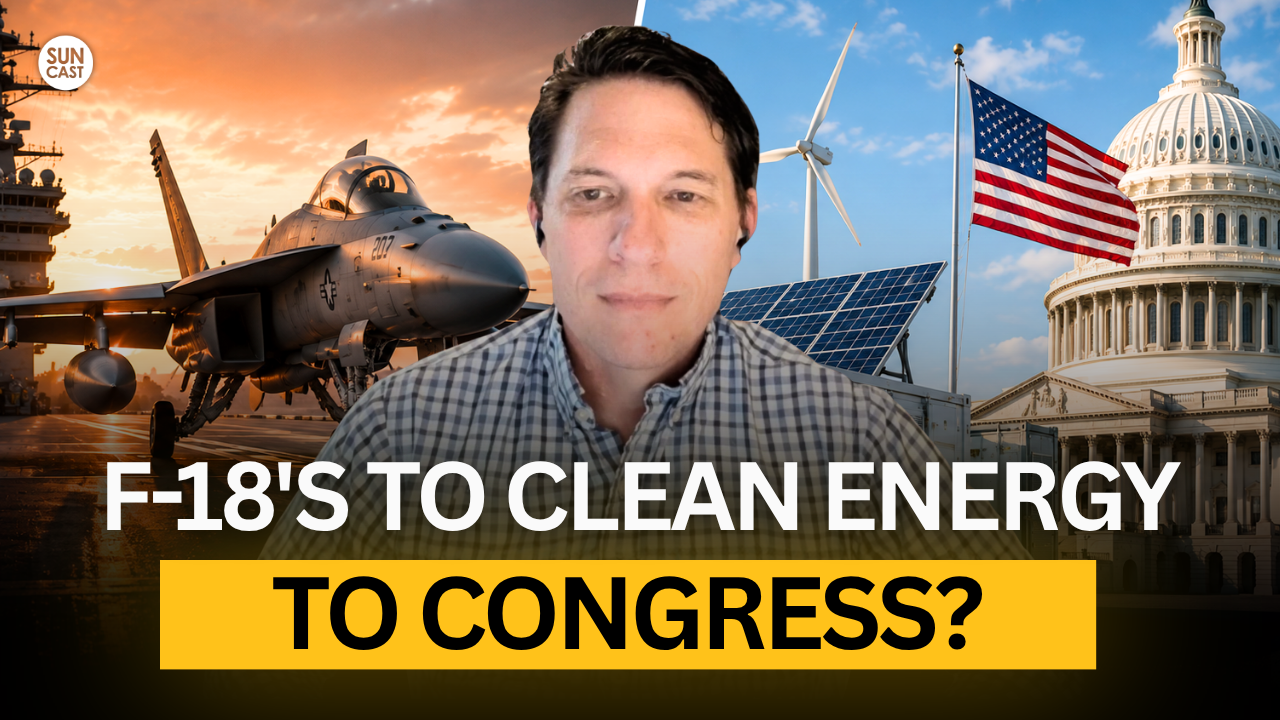
After more than two decades as a Navy F/A-18 fighter pilot and instructor, Jason Knapp came to a different conclusion: capability often follows responsibility, provided organizations are willing to invest in training, honest feedback, and continuous learning.
That philosophy shaped his transition into clean energy, where he worked across battery manufacturing, supply chains, and policy advocacy, helping lawmakers better understand the technologies shaping America's energy future. Now, after years of advocating from outside government, Jason is running for Congress because he believes the people writing energy policy should understand the technologies, industries, and communities those decisions affect.
This isn't a conversation about politics. It's about leadership, organizational culture, and why expertise belongs in the rooms where important decisions get made.
Expect to learn:
🔹 Why the military trusts young people with extraordinary responsibility
🔹 How continuous learning creates stronger leaders and better teams
🔹 Why battery storage is about reliability, resilience, and national security
🔹 What clean energy leaders can learn about public service and civic engagement
Whether you're leading a company, developing clean energy projects, or thinking about how our industry can better shape its future, this conversation offers practical lessons on leadership, responsibility, and service.
Give it a listen.
RESOURCES:
Connect with Jason Knapp:
Check out Jason Knapp For Congress:
"It doesn't change through wishes, it changes through action." - Jason Knapp
This Podcast is Free For You
Thanks to Our Sponsors
The following are Corporate Partners who have helped make SunCast possible:
Platinum Sponsor
The following are Corporate Partners who have helped make SunCast possible:

Noteworthy Quotes:
Jason Knapp 00:00
We lost 1000s of people just in the transfer of fuel in Iraq in Afghanistan. As we see electric vehicles coming into play, as we see drones coming into the battle space, as we see more opportunities to use electrified machines for our war fighting, it becomes a place where we could simply, you know, airlift in battery energy storage systems. Iraq and Afghanistan really showed how dangerous the transfer just of fuel is in a war zone, I
Nico Johnson 00:43
Hey, welcome back to SunCast, all the warriors. One of the things that I've really come to appreciate after nearly 1000 conversations over the last decade of SunCast is that the energy transition does not just need better technology, it needs builders and operators, it needs people who've actually had to make difficult decisions under pressure. Today's guest brings one of the most unusual backgrounds that we've had on the show. Jason Knapp spent more than two decades serving in the US Navy as a FAA 18 pilot and instructor. Following his military career, he worked across our clean energy sector, from batteries and domestic manufacturing to supply chains and policy advocacy, helping lawmakers understand the real world implications of the energy decisions they make along the way. Jason worked with organizations like Clean Energy Associates and Core Power, gained first-hand experience with the opportunities and challenges facing clean energy deployment in America. Now he's taken yet another step into public service. Today's conversation is not about politics, it's about leadership. It's about what the clean energy industry can learn from military service. It's about what Washington gets right and often gets wrong about energy, and ultimately it's about why expertise matters when building the systems that power our future. Let's get ready to tune up your skills, Solar Warrior, as we tune into another powerful conversation here on SunCast. Jason Knapp, great to see you. Thanks for joining us on SunCast.
Jason Knapp 02:10
Yeah, thanks, Nico. Thanks for having me.
Nico Johnson 02:12
You know, I heard that in your childhood bedroom there are three posters on the wall. Of the three, I think the one that sticks out the most to me is Heather Locklear. I wanted to, I wanted you to take me back to that nine year old version of yourself. What were those posters? What drew you into the world that you surrounded yourself with?
Jason Knapp 02:30
You know, growing up at that age, you know, I was surrounded with my mother and having military, you know, folks in that life. You know, Heather Locklear, obviously, you know, a beautiful woman, and for a nine year old at the time was, you know, a pinnacle, if you will. You know, and interestingly enough, it turns out, you know, she's a military brat, you know, with, with her head in, as a, you know, in the Marine Corps, you know. Additionally, I had the USS Nimitz up on my wall, and at 14
Nico Johnson 03:02
aircraft carrier, yeah,
Jason Knapp 03:03
and also an F 14. These two things were some of the things I thought, okay, this is what I'm gonna do, this is what I want to do with my life, you know. And it was exciting, it, it was something that would give back to my country, it was a service thing, and yeah, nine years old, that's that, that was the goal of my life.
Nico Johnson 03:23
When did that dream finally become reality for you?
Jason Knapp 03:26
You know, I was able to, you know, again with, with the help of my family, you know, go to university, become an aerospace engineer, and you know, I was in ROTC when I was in college at UVA, and you never know fully until you actually get selected for those spots, and first, as I graduated, got selected for aviation, and then you go through flight school, and in flight school is when you find out whether or not you're going to get to fly jets, props, or helicopters, and I was lucky enough to get to select jets, and you know, eventually F 18, so you know it wasn't there, was no single moment, you know, when it was like all all together, the goal was reached, it you know, it took you know probably you know six or seven years of time from college on to flight school before I finally got that, that selection, and then the irony is the very first aircraft carrier I was assigned to was the USS Nimitz.
Nico Johnson 04:27
Get out!
Jason Knapp 04:27
Yeah, it was..
Nico Johnson 04:28
oh, that's that's wild. Talk about vision boarding. Yeah,
Jason Knapp 04:32
yeah, it was.. it was amazing. It was a.. it was crazy when that.. when I got assigned to CAG 11 and found out that the Nimitz was going to be my ship.
Nico Johnson 04:40
Tell me, your mom saved that poster.
Jason Knapp 04:43
I honestly, I wish I could say that, you know, there's a chance that it is rolled up in an attic somewhere, but I would have to go through, probably, you know, 30 years of other stuff to try and find it. There's a chance, though.
Nico Johnson 04:58
What surprised you the most about the. Becoming a naval aviator, maybe. What, what was most unlike what you had expected?
Jason Knapp 05:06
It's an exciting job, it really is, but it is. I think it's a lot harder than people fully appreciate, because it's not just the flying. The flying is actually just a small part of the job, I think. What is most unknown to folks is at least in the Navy, you have actually a real job, if you will. So you know, when you start out, I was what's called a division officer, where I had a number of people who, you know, a number of groups that worked for me, you know, I was in charge of what's called the AV arm division, where I had the avionics technicians, the electrical technicians, and the ordnance guys, and you know, all of the folks that help make our planes work. You know, I was the, yeah, I was the officer in charge of them, and that's the real job, is making sure that they have what they need, making sure that you know they're getting their evaluations done, you're helping out with their families, you know they have issues as well, and you're trying to make sure that their education is going well, you have disciplinary actions, and
Nico Johnson 06:17
then sounds like running a business, then
Jason Knapp 06:18
on top of it, you're still studying and training and learning and flying, and so it's a, it's a very, you know, it's a fulfilling job, but it's, you know, it's definitely easily 12 to, you know, anywhere from 12 to 16 hours of real work every day.
Nico Johnson 06:35
How old were you at the time that you were the, so that
Jason Knapp 06:37
was so 25 or so, yeah, 2526
Nico Johnson 06:43
How many? And how many people reported to you?
Jason Knapp 06:45
Oh, at that time, probably 40, you know, between 40 and 50. Av Arm, Av Arm was the one of the larger divisions on in the, in the squadron, and so, yeah, about 40 or 50, and I mean, all you know, great sailors, great sailors, I had great chiefs, and that's what really got me through it all,
Nico Johnson 07:07
man. I love that you like your instinct as well is to give credit and praise to the folks that work for you. The military, here's what astounds me, I have a lot of family who've served, I've never, I've never served. I'm really grateful for you and everyone else who has sacrificed their time and many of their lives to give us the freedom to choose not to serve, but the thing that stands out to me is that most, most of the folks I meet in the middle that are that have military experience, the by definition, they are some of the most disciplined people I've ever met. They are some of the most trustworthy people I've ever met. The military, by extension, trusts routinely trusts people in their 20s, as this example with aircraft or machinery worth tender 10s or hundreds of millions of dollars. Well, we see this all the time. The business world often hesitates to hand someone meaningful responsibility. What does the military understand about trust that business gets wrong?
Jason Knapp 08:04
You know, that's a fabulous question. I think the biggest thing that we could do better in business is to recognize that people will surprise you, people when given trust, when given the opportunity to prove themselves will show that they are, you know, well beyond what people think in their years, what their capacity and capability to do work is, you know, the military, we, you know, we put trust in very young men and women, when I, as an example, when I walk out to the jet, the person who I meet, the plane captain, you know, could be somebody as young as 18 or 19 years old, and I know, you know, I will still do a pre-flight on the airplane, but the truth of the matter is that pre-flight, that check of the systems on that plane is cursory at best. I know for a fact that that young man or woman has done their job, and that the plane that they've just, you know, handed me, if you will, is safe to fly. I, you know, I place my trust in the fact that they did their job, and it never,
Nico Johnson 09:19
yeah,
Jason Knapp 09:19
you know, and it never steered me wrong. I've never, that trust was never broken, you know. And I think that when we look at business, people assume that just because somebody may not have, you know, all of the experience in the world, that they don't necessarily, you know, we somehow relate experience to trust, but trust is something that doesn't necessarily have to be an experience-based thing. It is simply they have said they've done what they were told to do or asked to do, and you believe them, and you know, and trust is continuously built through that, and I think if we in the in the business world allowed ourselves to. Accept that a younger person is going to do exactly what they said they were going to do. I think we'd be, you know, I think people would be a lot more surprised. I think we should be doing this more, and we'd be, we'd be better for it. I
Nico Johnson 10:14
know that this, there's entire courses and leadership training for programs that are years long. Is there a way to encapsulate, how do you build people capable of handling responsibility? Like, are there core building blocks that you have identified?
Jason Knapp 10:30
The, you know, it's a great question, because the I think what it comes down to, obviously, the military has long had a history of using, you know, younger people are who join the military initially.
Nico Johnson 10:45
Yeah,
Jason Knapp 10:46
and so we, we have built this, this acceptance of younger people doing immensely difficult jobs, and what I think we need to look at is it has, you know, if you want to start employing and using younger folks in work in business, the first step is to, to let them try. You know, we would have sailors, you know, they might make a mistake, they may have a failure, and one of the best parts about it is you always have, you know, there's always somebody you know slightly above them, that's this, you know, watching over it, making sure you know, because the greatest way of learning a lesson is by, you know, a mistake. I think that if we give people the opportunity, that's where you become surprised initially that, oh, wow, this young person is completely capable of this task that I thought could only be done by a seasoned veteran or seasoned professional, right. And what you'll find out is, in a lot of regards, they are 100% capable of doing it, and it becomes easier for you, because again, now you're even building trust amongst your colleagues that they're going to get the work done, and I think what's very important that people realize with young, young people is they want to be trusted, they want the opportunity to succeed, just like we did when I was 19. I wanted people to trust me, and I wanted to bust my butt, so that they never were disappointed in the work that I did, and I think that we, we have the opportunity, in certainly in the clean energy space too, and business across the board, but to start that process and allow that to start building now, because I think we're, you know, we're wasting time in a lot of regards, having to wait for people to become older, as if age alone somehow breeds wisdom.
Nico Johnson 12:44
I wonder if the process of becoming an instructor pilot further developed your instinct around leadership. They often say, if you want to learn something, teach it right. If you teach something, you learn it twice. Can you unpack a little bit the sort of the maturation of your leadership skills through becoming an instructor pilot?
Jason Knapp 13:07
Being a flight instructor really was a, you know, a very eye-opening experience, and it really built, I think, it helped build me much faster than any, some of any of the other experiences I've had, because it is both a combination of trying to teach somebody who, who again is working as hard as they possibly can to succeed, at the same time you have to allow them to make the mistakes that will be something that they will carry through, because again we make our greatest leaps in terms of our abilities when we make mistakes and learn from them, and so you have to, you know, you have to give your student enough leash to make that mistake, but not so much leash that you both get killed, and I will never forget the greatest lesson that I had was when I wanted to give a student, you know, enough leash, and I just had that. I remember assuming he knew that we were below an altitude, because it, to me, it was very obvious, you know, we were doing an approach into an airfield, and it was at night, and I was just waiting, waiting. He's got to see it. He's got to see that he's making a mistake. He's got, oh, there's a tree, and as the tree goes underneath the wheel, and I said, no, he doesn't see it. And
Nico Johnson 14:37
yeah,
Jason Knapp 14:38
and I think it was one of those, the experience
Nico Johnson 14:41
could have cost you, yeah, exactly.
Jason Knapp 14:42
And what the experience was, was it was instructional to me, and that's one of the why it was such a memorable experience, because as an instructor I gave myself too much leash in terms of how much I was allowing the student to try and learn his lesson, and so. Combined in that, that moment I realized, you know, even in an instructor role, even when you are experienced in the actual ability to do something, when you're teaching somebody, you also have to recognize your own limitations and allow, you know, yourself to make a mistake, so that you can learn from it, and I, and from that point on, I think I realized, very, you know, that there is, there's an amount of leash that you need to give, but you also need to keep yourself and the, you know, the crew safe, and it was just very educational, and I, you know, I still keep in touch with that pilot, he's, he's a, he's a fantastic pilot, he was a fantastic marine, and you know, I still am good friends with him, and you know we still even talk about that night, because of how much we both learned in that moment, and I think that's one of the greatest lessons I took was you as a senior person can learn from junior, and I think too often we also sometimes forget that we're always learning, even when we are the more experienced person, we, we have to realize that we're in that learning process as well.
Nico Johnson 16:04
We're both fathers and entrepreneurs, and we've gone through this experience, certainly that others are going to identify with. Is you have to think about as we get older and begin to take on leadership roles, like how do you position something as a suggestion vis-a-vis a question, right? How do you actually communicate to someone that you trust them, but you also are curious if they see it, see it the way you see it? Like, in that scenario, you could say something similar. I think about it with my kids, but in that scenario, you might say, you know, whatever you would address him as, like, how do you identify when you're below the deck, or how do you identify, you know, obstacles that are, that are close, too close to the aircraft, aircraft, or something like that, right? Like, just a generic question, but I think about it in leadership a lot, you know, what are the what are the appropriate ways to reframe a question so that it doesn't look like an interrogation or an accusation, but it clearly flags, like, hey, I'm curious, if you see this the way I see it. One of the ways that the military has institutionalized this is a debrief, right? Like, we often talk about it in business, after you lose a deal doing a post mortem, which is a really morbid way of thinking about it. But what does a great debrief look like?
Jason Knapp 17:20
You know, so one of the very interesting things about naval aviation and military aviation as a whole, not to say it's just in the navy, but you know when we do a debrief, you know, so we might have a brief for a flight, and the flight, the brief for the flight could be as many as three hours before the flight, and then you'll have this, yeah, and it could be a very large, you know, if it's a large force exercise or a very complicated mission, or and even in training when you're really trying to teach a student, and it can be, you know, exceptionally long in terms of, in terms of that, and then you, you pre-flight, then you fly for an hour and a half, and then you'll come back, and I've been in brief debriefs that have lasted for four or five hours, and what's interesting about the debrief is that the the portions of the flight that went well, the portions of the flight that we did exactly what we were supposed to do, and that, that includes, you know, even marshaling, so taxiing onto the, you know, on the tarmac, and just lining up, you know, that that is actually part of the debrief, you know, we all gotten in position on time, yeah, good portions of the of the debrief might last for any, anywhere from 10 to 30 minutes tops, and the point being, yeah, I don't need to debrief all the stuff we did right, because you did it right, good job. We don't need to talk about anymore, and then we talk about everything else minute by minute, sometimes even second by second, when we're in certain parameters, and and it's one of the ones where, and this is where call signs come into play, and one of the reasons we use call signs in the military is because when we're in the plane, when we're in the fight, when we're in the brief or the debrief, there needs to be a lack of rank structure, because you need to be able to tell your boss, or if you're junior, or if you're the senior person, your junior pilots need to be able to tell you if you messed up, and they need to be able to do it in a way that is not, you know, there's going to be no retribution, and so I think that one of the aspects of that is that in debriefs there is no rank per se, of course. There's still, you know, prop, you know, proper, you know, you'll, you'll still say sir and whatnot, but you're not afraid to call out the person who, who didn't do something correct, because again, everyone's trying to learn from that flight, and I think that, in, you know, in a business. A scenario, there's a lot that can be learned from that perspective, because there is no, there should never be a notion that the most senior person in the room, the most senior person in that deal, the most senior person you know in the conversation has, you know, they obviously have the experience, but they're not infallible, and one of the problems that we, you know, you often have is once you gain great experience, you start to feel that you know everything, and are a little bit, you know, it becomes a little bit more difficult to see your own mistakes, and so it's important for junior people to be able to tell you with again without retribution that you know, hey sir, I believe that that was a mistake, or I know that was a mistake, you were not doing something correct, and we need to correct that for the next flight, and I think that that's one of the reasons that military aviation is so good at what it does, is because when we do debrief, when we are in the plane, and somebody is messing up or not doing where what they're supposed to, you, you call it out, and it doesn't matter whether that's a that person is an admiral or a lieutenant, they need to do what they're supposed to do, and and breaking down some of those barriers in those positions really does help all of the people in the event, you know, learn from it.
Nico Johnson 21:26
So, coming out of your experience in the Navy, you could have taken your career in countless directions. Why did you choose clean energy?
Jason Knapp 21:36
It's a great question, because it's - it was definitely not the normal path, you know, the vast majority of my, my close friends and squatter mates, you know, they fly for various airlines, both, you know, commercial airlines or the cargos. There was a point where I thought about that, and it certainly would have been, you know, a fine life, and they are all great people, and they do good work, and we need them, I guess. In my mind, there were there were two things that really drove me to this. I think one of them was the desire to, to build, the desire to make, you know, make things better. There's always been a bit of a background in my, in my life, and it very well is part of, you know, my engineering background, where, you know, I wanted to, you know, do, you know, do something to the benefit of, of a lot of people, and, you know, in the military, we see a lot of the world, I've seen I've seen places in the world which are extremely poor and would greatly benefit from, you know, greater technology. As somebody who, you know, has a large carbon footprint, it did not escape me that, you know, flying an F-18 for all those years, you know, we talk about carbon footprint. I've got a pretty big one, you know. We, we burn a lot of fuel in tactical aircraft. Spend the rest of your life. Yeah, I couldn't plant enough trees in the, you know, in many lifetimes to make up for it. And so it.. there was a, there was a bit of a personal aspect of, you know, recognizing that there is, you know, that recognizing that there is still a place for fossil fuels that is not yet that we can't supplant at this time, there are places where we can, and so that's that's a lot of what drove me to want to get into the clean energy business, to, you know, make things in a way that would advance our society, would, you know, become a, you know, a progress towards eventually, at some point, getting off, if we can, off of fossil fuels, which won't happen in my lifetime. There are just so many applications where it is still the only, you know, the only fuel or energy source that is, you know, applicable. But that doesn't mean that we shouldn't be looking for all of the other ways that we can make things better, you know. One of the, one of the things, when I used to, you know, when I was beating the streets of Capitol Hill, talking about batteries, you know, and I could, I would walk into different offices, you know, and they might have been Republican offices or West Virginia offices, as an example, and you're walking into, you know, you know, Cole Coalfield, you know, I'm type focus, and what I would look at it and say, hey, listen, I'm not trying to tell you that West Virginia needs to stop doing what it's doing, I'm telling you that we can do it more efficiently, and one of the steps in clean energy, in my view, one of the. Steps in getting to a more clean energy world isn't just in getting rid of types of energy sources, in the meantime, until we can supplant certain types of energy, we certainly can make it more efficient, and so whether you're talking about wind turbines, who are producing more energy than you know, a 240 kv line can can handle at that moment, or you're talking about a coal fire plant that has, uh, does not have the demand for how much energy it can produce at that specific temperature, and you know, and throttle, well, that's where battery storage can come in. We don't have to waste that energy, we can, in fact, store that energy and continue to use it, so that we are getting the most, you know, the most electrons out of whatever that energy source is, whether it's the wind, turn, you know, turning the blades, you know, the, or the, you know, the coal, you know, you know, making the steam plant go. We want to get as much of the energy out of that system as possible, and that is a step forward in being as clean as we can.
Jason Knapp 26:13
There will be a point where we may never use coal again, again, maybe in my lifetime, maybe not, but in the meantime, we shouldn't be just dismissing clean energy practices, even when we're talking about fossil fuel energy sources, because when we talk about efficiency, by definition, we're making things cleaner, we are burning less for the same amount of energy that we want to get, and I think that's one of the things that people need to focus on, is that the clean energy space is not just about getting rid of traditional or fossil fuel energy, it is also about making the energy sources that we are still required to use as efficient as possible, and as economic as possible, and as clean as we can get them,
Nico Johnson 27:03
I recently had four-star General Robert Kneller, former commandant of the Marine Corps, on, and we talked a lot about leadership. One of the things he talked about was, as well, national security, and it's a recurring theme with folks that I speak with who have been on the front lines, not of the energy transition, but of our, of our, of warfare, that there are, you know, there are real more than economic issues that clean energy helps resolve, like logistics, and notably dependence on foreign materials. When did energy, for you, become more a national security issue than just an economic or efficiency issue.
Jason Knapp 27:44
That's a fabulous question, and it's, it's twofold, and I could not, I don't know if I could tell you exactly which one was first in my mind, but the two, the two sides of this coin are one, the supply chain aspect, we have to admit that, that China is, you know, is currently taking out the Iran issues at present, but China is our, our largest adversary, if you will, right, second largest economy next to us, and right now, you know, the vast majority of all of our, you know, resources in energy storage, etc. come out of that country, and you know, one of the things that we need to understand is, it is, it's almost the threat is almost what happens if they actually was were to just shut off the spigot and say you don't get any more of this equipment, and we've seen it happen when we, when we tried to play critical mineral games with China, where we, you know, increase tariffs on various critical minerals, and they said, "Oh, okay, how about if we give you none, and it sent our economy into, you know, a bit of a terrifying nature, because all sudden we realize, oh wait, no, we're just kidding, please don't stop sending us critical minerals, we need those, and so I think that you know, from a supply chain and a logistics perspective, we need to understand that we, we need the manufacturing, we need the capacity and capability to do that work here, because when a supply chain, if the first two links are out of your control, then ultimately the chain itself is is as weak as it could possibly be. So having a complete supply chain in which you are able to manufacture or produce the goods that you need for your own country and specifically for national security is a national security issue. I think the other part, though, and this, this goes a bit more direct to my military background, is you know we lost 1000s of people just in the transfer of fuel in Iraq in Afghanistan, you know, through I. IEDs, I mean, we, we, we lost, I mean, countless people just so we could transfer fuel up roads, and there's really no good way to transfer large amounts of, you know, jet fuel or diesel, other than by, you know, you know, by tanker truck, and as we see electric vehicles coming into play, as we see drones coming into the battle space, as we see more opportunities to use electrified machines for our war fighting, it becomes a place where we could simply, you know, airlift in battery energy storage systems, we could simply bring in a system and remove one, charge it in a safe location, and bring it back in, and we've, we've talked about, you know, these transportable best systems that could be used right to charge up vehicles, to charge up drones, to help supply electricity and stuff instead of diesel gen sets. I mean, I don't think we're there yet, but I think that when you start looking at what the human cost is of transferring fuel in a battle space, and we see it in Europe, we see it in Ukraine, we see it, we saw it in Iraq and Afghanistan, we want to limit the threat, and by having fewer tanker trucks having to drive on those roads, you do, and so this is one where, from a life-saving perspective, the fewer times we have to have tanker trucks go up those roads to transfer fuel, the fewer folks we're going to see lose their life due to IEDs on those roadways, and I think Iraq and Afghanistan really showed how dangerous the transfer just of fuel is in a war zone.
Nico Johnson 31:53
As you progress in your career, one of the one of the important stops that I see in the timeline through your clean energy advocacy and work is the time you spend at Clean Energy Associates. We've had several folks from CEA on to help us sort of unpack and explain what's happening with quality and manufacturing risk supply chain around the world. I know they played a major role in helping at they, along with other key players, have helped us navigate the quality of manufacturing risks. I'm curious, though, through your experience, what did that teach you about where our supply chains are strongest, where we have vulnerabilities, where as an industry we have blind spots, perhaps, and hidden risks.
Jason Knapp 32:38
We, as a country, have had a very, you know, when we talk about supply chain, you know, let's start all the way at the beginning, and that comes down to mining, you know, this country has had a very tumultuous relationship with mining, you know, in this country, you know, I look at mining as one of those, you know, it's a necessary requirement, you know, the things that we need exist in the ground in a lot of regards, and so we need to, we need to pull those out. One of the things I used to, you know, talk about when I would actually work on the hill, when we chat about mining, is I'd always pretend or ask the person I was talking to to imagine what a miner looks like in their mind, like close out, you know, what, what, when you picture on mine, or what do they look like? And I would say nine times out of 10 they would, I would ask them, then you know, is it a black and white photo of a guy with soot on his cheeks, and nine times out of 10 it was. And I think that that's one of the paradigms that we need to correct in our country. Obviously, mining can have detrimental effects to the area and to the region, but we also have a paradigm where people don't fully understand what mining looks like today, and so there's great resistance in a lot of regards to, you know, to mining in our country, from both from a human rights perspective and an environmental perspective, etc. But I also look at it and say, but wouldn't mining isn't mining here probably the cleanest type of mining in the world, if we care about the environment, if we care about people, I would say that the mining that we do here in the US is far better than the mining that is done, say, in China, or say, you know, in, in the Congo, when we have, we see, you know, young boys having to go into, you know, these these areas to mine cobalt, and I think that one of the things we need to come to grips with in our country and our supply chain is if we want these products, if we want clean energy products, we have to recognize that there are certain steps along the way. If we do truly care about the environment, then we need to care about the whole of the earth's environment and the mining that goes up goes on. If we really care about human rights, it can't just be the human rights of American workers, it needs to be the human rights of of people across the globe who are mining these products, and I would suggest that you know the work that we. Do here is probably the safest, is probably the most environmentally conscious, even with the detrimental effects that might go along with that.
Jason Knapp 35:07
You know, you can't pretend that just because you know you didn't see where your iPhone was made, that it somehow, you know, materialized, you know, via angels and a perfect, you know, a perfect construction model, and so I think you know we need to have a real conversation in this country about what it means to be environmentally conscious, what it means to care about human rights as it applies to our own supply chain, and so you know we need to be better, I think, at understanding supply chains here, both from the critical minerals perspective, from simply a materials perspective, we need to understand that when we leave the quote unquote dirty work to other places, that doesn't make it cleaner, it just makes it hidden behind a veil of ocean cargo ships that we don't see, and so it's important for us to be honest and real with ourselves that if we do in fact want these clean energy tech inventions and technologies here in the US, it comes with all of those things that go along with it, and we need to just be honest with ourselves that it starts a lot of times in the ground, and so you can't pretend that it doesn't, and we need to be a bit more focused on cleaning up our own supply chain, but also, you know, domesticating it, so that we are not relying on, you know, other actors who may not care as much about human rights or the environment as we do.
Nico Johnson 36:38
There's a parallel conversation happening, even in Washington, even now, around critical minerals and bolstering our national supply of or availability of critical minerals. I had Mark Lover Geta on from Ree Element Tech recently, got another fantastic entrepreneur from a lithium mining company coming on. I think that's that story, and that we could go down that rabbit hole, but probably, probably should avoid at the moment. I just wanted to reiterate, for listeners, that it's not only the mining that is evolving in terms of how we think we have to be willing to pay the price, because if we don't pay the price economically, somebody else pays the price in human capital, and that is a human rights issue, and that's something that far too few people internalize and think about, that they're more all too happy to keep their petroleum-based or critical mineral-based technologies and and fabrics without consideration for the upstream, upstream, the mining requirements to produce that luxury in their lives, and I would encourage folks to listen to some of the episodes, like the one I mentioned from Mark La Vergeta, because we are in a rapid evolution of how we refine these materials, and you know that that kind of goes into the whole recycling conversation as well, you mentioned specifically with regards to national security and with regards to sort of frontline deployment, how batteries came into the conversation really over the last five to six years. I would say in a more mature way, you were at Core Power, one of the one of the domestic battery companies that has had great traction there, but you also served as a translator of sorts on the hill, found yourself really helping translate these issues for policy makers, and you spent years helping policy makers help help them understand the battery technology. I'd love to know what was the biggest misconception that you encountered about batteries when you're walking around talking to lawmakers,
Jason Knapp 38:42
yeah, you know, at first it was very divided along political lines. There was, there, you know, originally there was just this feeling or belief in in Republican offices that that batteries were somehow just simply going to displace fossil fuel energy overnight, that you know, the fact that it was, you know, maybe clean or considered cleaner was somehow a bad word. I think that we finally, at least with batteries, have gotten past that. I think people, bipartisan in a bipartisan fashion, now understand that batteries don't care what the electron tastes like, they don't, you know, a battery doesn't care if it came from a gas turbine or a hydro or a nuke, or, you know, when that really it is about efficiency, it's about storing, you know, it's a bank, for you know, for all intents and purposes of energy, and so you know we've.. it took a while. I mean, it took a number of years to get to get through that. I think what.. what is now the most critical component here is, is that we need, you know, the traditional batteries that people now. Think of in terms of their cars or their home storage systems, etc. is, you know, known as NMC, right, Nico Manganese Cobalt, which is a tried and true battery chemistry. There's, you know, obviously we're moving into, you know, iron phosphate batteries, LFP, and there's all types of other chemistries that we are seeing, whether we're talking about graphene or silicon, you know, solid state. The thing that I would want, and I continue to beat the drum on in every conversation, is, you know, these technologies, they have to be supported, right. We recognize that NMC, while a great battery chemistry for what it does and what we expected, is not the cleanest of the chemistries. It involves cobalt, which it goes back to our discussion, you know, in terms of, you know, Congo, you know, and the sooner we can get off of, you know chemistries that involve that type of mining or that type of material, I think the better, but what we also have to recognize is that in America, in our capitalist society, there is a desire on one side of the aisle to just simply let the market decide wholly and just disengage from supporting the technology, supporting the advancement, supporting the research, cutting, cutting, cutting, and the issue with that is it only serves to hurt our advances, because you know our near, you know, our main competitor in this, who is really the true, you know, competitor in this is China, and they, from their government perspective, invest heavily, invest almost entirely in these systems, you know, the companies are not necessarily having to try these things out all by themselves, they are being supported through their government and government payments to advance these technologies, which is why they have advanced further and faster than we have, and so not advancing, not researching, and paying for that research at the government level is fundamentally is a lack of our own investment in in the future of these technologies, and you know, the longer we allow China to do the work, the longer or the greater they will be in the long run, and so I, I strongly believe that if we want this technology to be on short, if we want any form of domestication of this, we have to invest in it, and it's not just going to be the, you know, the businesses who are trying to make a buck, you know, because they just don't have the type of capital and resources that that a government can put into it, and I would like to see, you know, we saw great advancements with DOE under previous administrations, we saw all of those dry up in this administration, with many projects, you know, canceled, shut down, funding opportunities cut off, and the only thing it is, you know, the only thing I can liken it to is, is just, you know, somebody who just decides one day, you know, what I'm no longer going to invest in my own IRA, I'm just gonna just take what I got, and yeah, and not, not do it anymore, and the only, the only thing it does is hurt us in that regard, because the return on investment for our future is absolutely worth it,
Nico Johnson 43:33
and we have to remind folks, the lithium, the lithium ion battery that the world deploys right now was invented right here, just like wind, just like solar. All these technologies were invented right here at home in a combination of our national and university labs, right down in the heart of Texas. The I think it was a Nobel Prize that was awarded to the physicists that created the current lithium ion technology, but China, just like Europe before them, is so fast outpacing us. Just in the last year, C A T L, the largest Chinese battery manufacturers, announced their sodium battery that will dramatically transform the way that we think about capacity, especially long duration. They've got these, I was reading about the condensed, their electrolyte condensed battery, the shelene battery, that, like, is promising something like 1000 miles per charge. They've got these super fast charging in route for LFP that can charge up to 80% in four minutes, right? Like, when we recognize all this is literally tearing down every argument from the right or the middle against like the notion that like clean technology can't participate in stability and reliability of our electric grid, all of that, by the way, it's just been completely debunked in external markets, predominantly China, and places where China has. Say, like, free reign to act with commercial within their commercial interest, and deploy this technology. Those places are seeing below-grid parity deployment of renewable and battery technologies to stabilize their grid, not just to offset fossil fuels anymore, but to stabilize their grid. I think it's really important that we have a voice like yours inside those political arenas, so that we can cons, we can have more civic engagement. We're doing a whole lot more here on SunCast, and having you on is one of the examples of that, of trying to say, guys, you know, folks, there's a, there's a larger story, like we have to be on our toes, we have to be leaning forward, we have to be creating the narrative, we have to be investing capital into more than just good intentions, we have to be effectively participating in shaping the narrative so that it is truly bipartisan, and we see this in agriculture, we see it in Hollywood. There are industries that have created a narrative, even the crypto industry, in the last three years, has been able to create a narrative that is truly bipartisan and defends them against the whims of politics. I'm inspired by your desire to leave industry and go into politics, officially tossing your hat in the ring. Could you tell me a bit more about the desire to do that, the decision to do that, and sort of what that manifestation looks like for you specifically? How you're taking more civic action to to help shape the narrative.
Jason Knapp 46:44
Yeah, I mean, getting into into the political side, I mean, obviously working in within politics, you know, and trying to get certain, you know, legislation passed, trying to assist with that, trying to educate folks on the hill, you know, it's given me quite a bit of experience in terms of those, you know, those folks on the hill who maybe align with my views that we need to be, you know, investing smarter in our energy technology, but it's also a factor of, you know, there is this, there's a notion right now in our political system where, you know, we, it's almost like a dividing line, somehow. You know, there's still this view that, you know, clean energy equals something bad from one side of the, you know, political spectrum. And I just, I find that to be, you know, unacceptable in terms of a narrative. You know, you know, I'm the first to, you know, I don't know if I'm the first, but I will, I will clearly say that we are a country that currently requires all forms of energy. You know, there are certain places where you cannot have an EV, you know, if you're, if you're a mining company up in Alaska, and you've got a giant, you know, excavator that's in, you know, sort of no man's land up there. It's probably not going to be an electric vehicle. It's probably going to run on, you know, a form of fossil fuel, and we don't have a fix for that. Similarly, you know, we have nuclear facilities, we have, you know, wind, we have the whole gamut, and so I, you know, I very much view the notion that we need to still be looking at advancements in all forms of energy, but to discount different forms of energy simply because it doesn't fit a narrative, and I would suggest the narrative being driven by corporate interests or and corporate political spending. I just.. I wholly disagree with, because it only hurts our country in the end. You know, let's look at.. you know, let's look at electricity. You know, electricity is developed from all of those energy sources, but right now we have a position where, while America might be a net energy exporter, we are still dependent on a global market supply for the cost of oil, and that cost translates into electricity, whether you're getting it from your local utility or you're putting it into your own car to drive around, so we are still somewhat dependent on a global supply supply chain, because that's what drive the prices. If we had less of that, if we were more on a, you know, energy storage or clean energy system, we would see costs go down. You know, when I look at our advancements in battery energy storage versus peaker plants. We're still building peaker plants, you know, across the country, and these are both expensive and, you know, probably some of the less efficient systems that we have, whereas we could easily be using energy storage in these systems and. And I think that there there needs to be a push, there's a point where you know politics is is both the desire for for people to get the type of government that they want, but there is also the ability for government to, you know, instill trust in a certain, you know, system, you know, education, we support it through the investments in, you know, whether it's DOE or at the university scale, that you know one side of the spectrum politically seems to be opposed to that, for fear that we are somehow going to squash the oil industry. I just don't see how that is actually possible in the near or long term future, and so my desire, you know, in politics is to, you know, amongst other things, is to bring some semblance of knowledge to the congressional body that, that doesn't exist right now. I mean, there are people up there making laws who do not understand what a 240 kv line is. They don't understand what a peaker plant is. They don't understand right that there are different battery chemistries that come with different attributes. They don't understand that there are different types of solar panels.
Jason Knapp 51:15
They don't understand how the supply chain actually works, from, you know, start at the mining point all the way to refining to, you know, it being put on your house, and this is a, you know, this is an organization that is making all the decisions on behalf of the people, and I think that we need a greater knowledge base up there, and that's just again of just one of the many reasons that I kind of got into this, because let's be honest, energy is the lifeblood of the way a country works. It is how we advance our society. It's how we do pretty much everything is based off of energy, and yet it seems to take, you know, second place to a lot of other issues at hand.
Nico Johnson 52:03
I think that one of the things that you are doing that underscores for me something that we've been saying a lot here is there is a need for industry leaders like you to have more civic engagement instead of simply criticizing from the sidelines. How do you discuss that responsibility with peers and how does that inform your campaign specifically to, to take a, to take a seat in what will certainly be a difficult race.
Jason Knapp 52:33
Yeah, it's a, it's a fabulous question. You know, one of the, one of the things that we need to, I think, you know, I'm obviously running as a, you know, as a Democrat, and I think that we as a party, we need to be more aware of how corporations and how corporate interests have influenced even our party in ways that I don't think are positive. You know, one of the things that you know, for instance, we, we in our campaign don't take any money from any corporate PACs, any utilities, and part of the reason with that is because, as you know, as members of Congress, you are supposed to serve people, and it's ultimately people who you know vote, they are the people who are who you are supposed to represent. Clearly, we have interest in how business within the district, or within the state, or within the country, you know, works again with, you know, with us and with Congress, but ultimately, you know, representation is about representing the constituents, and when we as a party take money from those organizations that are working against those ideas and those beliefs, you know, I think that that that is a, that's a negative, I think that it somewhat sets a precedent that you know people that, regardless of the party, are somehow you know beholden to some of the greater political corporate structures, where it becomes important, though, in terms of you know advancement, we need to be able to sort of go into this with our hands as clean as possible. It's, it, I recognize that politics, you know, life is is never as black and white as we might want it to be, but walking into a room and being able to know for a fact that this is a better policy than that, because of the returns that it provides people that provides the country as a whole, I think, is a better, you know, way of looking at things from a government perspective. Obviously, we want our corporations, we want our businesses to grow, but we don't want that to be done on the back. Backs of working families on the backs of people who are struggling to afford their power bills, you know, we need advancements to happen, so that we can bring those costs down, so we can, you know, improve the cleanliness of our environment, and so it's another reason getting into this is to, you know, be adamant that you know we don't want to, at least my campaign, we don't want to work for companies per se, we want to give them all of the opportunities that we can give them to grow, but we also need to make sure that we are protecting the people that we are elected to serve, and so I think that that's a, that's a critical part, and you know, it raises a point here. Virginia, as you know, is right, is sometimes referred to as data center alley. You know, we have data centers going up left and right. You know, I spoke recently, actually at a at a county commission meeting on a data center that was actually voted down by the committee, and there were a lot of discussions about what that data center, the negatives of the data center brought in, and there was some discussion right there. Well, there's a lot of discussion about the water usage, which is a, which is something that is critical to to these systems.
Nico Johnson 56:19
Yeah,
Jason Knapp 56:20
and I didn't speak on that, but what I wanted to speak on, and did, was that when we're talking about data centers, we need to make sure that it is not the people who end up funding these centers, you know, there's there are transmission requirements, there is future generation requirements associated with, you know, large scale rate payers, such as a data center, and it's not appropriate for, you know, the people to, you know, without basically against their will, end up subsidizing that future generation need, because it ends up just being, you know, an increase to their rates, and so we, you know, I wanted to raise the point of, you know, data centers currently typically use diesel gen sets for their backup energy for a black start scenario. We don't have to do that. We have energy storage, both, you know, both Google and Microsoft are already replacing diesel systems with battery storage, so the technology exists. We can be doing and using smarter technology. It comes with a slight cost. I get it, but if we're going to be doing this, if this is something that is in fact going to be a long-term thing happening in our country with the increase of data centers, this has to be part of the equation. They have to come to the table saying we want to minimize all of the negative effects that this potentially poses to you, and so that you know, from a very, you know, specific electric perspective, there is no reason that we should not be looking at rooftop solar to help defray those energy demands. There's no reason that they should not be coming to the table with battery storage as part of the, as part of the mix, and I think that it's important, for you know, I think it's important at the federal level that there should start to become standards, a minimum standard for what data centers are allowed to bring to the table, because this isn't just a Virginia issue, we're in the headlines because it's, it's so, you know, ubiquitous here, but this is a national issue, and so a national issue needs federal, you know, needs federal engagement on that, and I think that at a minimum we should be, you know, inquiring why we're not using advanced technologies in these systems to help ensure that the people don't, don't suffer for the inclusion of these large rate paying data centers.
Nico Johnson 58:46
Jason, if you get elected, you'll have a brief window of time to, I'll say, like prove yourself and establish your credibility in Washington, just because of the nature of the political cycle, before you have to go prove to your constituents that you deserve to be reelected. What would be the core focus for you as a freshman senator if you, if you are successful
Jason Knapp 59:09
right now? The biggest things affecting the district and affecting the country nationwide is affordability, and affordability is tied to a huge number of things I think one is obviously the increase in fuel costs due to the, you know, due to this war in Iran, that you know, I having having carried weapons in that part of the world before, and having seen, you know, not having a, you know, a fallback plan, you know, it's it's watching the same horror story play out all over again, but you know, worse. I think that we need to have an understanding of how that all plays into this. You know, it's the fact that this administration has used tariffs, which is a tool, not a policy, in its weaponization against other. Countries, but it, you know, it hasn't really harmed those countries as much as it has harmed ours, and the people who can't afford, you know, groceries, who can't afford the electricity. I was canvassing just a week ago, and the woman I spoke to in Hanover, Virginia, she had just come home from work, and we were talking, and she said, "Yeah, I had to stop at the food bank. So she came from work, stopped at a food bank to get food, because she couldn't afford to go to the grocery store, because her power bill was $800 that that previous month, and so, so we have, we have a point where people are literally deciding between getting groceries, getting medicine, and paying for their air conditioning, you know, here in Virginia, and that's just something that is unacceptable, you know. This is the richest country in the world, and we have people that are living in a way that they go to work and still are having to go to a food bank, that's unacceptable, and so what I would like to see is, you know, us take away the ability for any administration to use tariffs in such a - and there's a very technical term - willy-nilly way, where they just apply it as they wish without any form of oversight, you know, we have tariff policy, there's been tariff policy, this this administration used in the previous time, you know, 230 as we, as we're very familiar with, you know, 232 tariffs, 301 tariffs, right? These were based off of an economic report, but they weren't simply just because, you know, somebody woke up one day and decided to, you know, add tariffs to Canada just because they didn't, you know, they didn't like do something nice to us, that, that is, you know, I don't want our country to be something where the people of our country suffer because somebody's feelings get hurt, that's not good policy in my view, and so taking away some of those tariff policy capabilities from the executive and putting them back where I think they should be, which is in Congress's hands. We have the power of the purse. We should also be wielding the power of those taxing authorities in a more coherent manner. I think that helps. I think that we have an issue with our medical costs. Obviously, this is a, you know, obviously this is an energy discussion, but you know, let's, let's be honest, I mean, we have huge amounts, you know, huge increases in asthma, we have huge increases in, you know, in childhood diseases that very well could be related to, you know, the environmental conditions that have, you know, increased in a negative way, and again, people are having to choose between medicines and food and energy, and etc, and so there are ways that we can, we can alter this to the benefit of our, of the people that we're there to serve, and I think that that's, you know, that's the going in plan, because it's, if you will, the, you know, military turret, you know, we talk about the closest alligator to the canoe, right?
Jason Knapp 1:03:06
You're not too worried about the one that's, you know, 30 meters away, you're worried about the one that's right next to you. And for right now, that affordability crisis in this district and across the country is the one that I think affects people absolutely the most, and so you know, helping to solve that problem, and everything sort of ties into that, whether we're talking about medical issues, energy issues, you know, grocery issues, these are all really affecting people on a day-to-day basis in a, in a very negative way.
Nico Johnson 1:03:37
Thank you for that, Jason. I know that I mentioned it's you're going to be in a heated race, and I want, want to believe that there's a likelihood of success, but we all have to plan for as disciplined business owners, and military veterans have to plan for success and failure. What happens if you don't get elected? Is the mission bigger than politics. What, what then? Yeah, how does this for sure?
Jason Knapp 1:04:04
I mean, and the mission has always been, you know, getting into this is was somewhat of an extension of what I wanted to do. You know that I looked at this district, and you know, this, the district that I'm in is slightly conservative. It's known as what's called an R plus three district, so it votes 3% more for Republicans than the national average, is a rough way of putting it. And when I've looked at this seat for many years, it's been one where the candidates who might be successful in other locales, just they were not able to win here because of the rural nature, the somewhat conservative nature of it, and so as a military veteran, I just recognize that to, in fact, for a Democrat to win this seat, it's going to need to be somebody who has a background like mine. It, and so I would not say that this was necessarily on the, you know, the job plan to run. It is just, it is an extension of that fact, though, because ultimately, you know, my desire to serve, you know, it didn't stop when I took off the uniform, you know, getting into the clean energy space was was a function of the fact that that I know we can be better as a country, we can do better, we have the, you know, we have the ability to grow these technologies, we have the ability to influence the lawmakers who are in Washington, which is what I did prior to running, you know, I take great pride in the fact that you know I had some, some part in, you know, in Congress as a whole, recognizing that batteries are not bad unto themselves, that we, you know, we have been able to get legislation passed that has been supportive of the battery industry, that has been supportive of the solar industry, you know, that that there are people who realize, oh yeah, this technology does not, does not harm, it does help, and so I would anticipate, you know, continuing this, this mission, whether it's, you know, of course, politically cited, but you know, advancing just a betterment of our country, because this is what we have to do, you know, the future is coming, whether we want it to or not, and we need to be able to move with it, and so I would anticipate staying engaged heavily, both within the political spectrum as well as keeping, you know, keeping involved in the in the clean energy world, because it's, it is a passion of mine, you know. Again, I go back to, you know, I'm still making up for that carbon footprint a little bit, and I want to, you know, I ultimately want to make the place somewhere safer and healthier for my kids, you know. My youngest is four, you know, I want them, when they're 44 to have a world that is is safe for them, that is safe for them to raise their family, and that's really the driving force, I think. You know, in this,
Nico Johnson 1:07:10
so I wanted to finish with a really simple question. If everyone listening takes one small step toward serving their community, where would you ask them to start?
Jason Knapp 1:07:19
There is a feeling, and I feel it in that when I've canvassed, which, for those who don't know, is, you know, literally going door to door in neighborhoods and introducing myself and saying hello and asking people the problems that they're facing, while telling them, you know, that I'm running, there has, there is an increasing feeling of despair, is not the right word for it. It is, but it's somewhat.. it's related to both despair and a disconnection. People do not feel like they matter in a lot of regards, and I understand that, because there is a feeling that we don't individually matter, and I think this administration, you know, has not helped that feeling in a lot of regards, but where, regardless of people and their political leanings. I think the greatest thing that folks can honestly do is actually become somewhat engaged. Go to a meeting, you know, of a, you know, the party of your choice to go to an event that has something to do with something you care about, you know, that not everything is a protest, right? Not everything is, you know, yelling and screaming. Sometimes it is a presence, so that people, other people understand that there's a growing under, you know, a growing movement in, in certain, certain regards. And I think that the issue at hand is people will not, you know, you, you have to do it yourself, you have to seek it out to some extent, you know, there there is a component here where you know you have to do a little bit of your, your own research to figure out where you could advance that, I'm not saying everyone needs to become, you know, a die-hard political activist, but going to a committee meeting on, say, a data center, and speaking your voice, you know, or raising your voice and speaking your mind on that, going to, you know, a local political event that, that is something that is, you know, that you find passion in, you know, it really does change, because again, you know, I, we haven't talked about, but you know, I teach government as an adjunct at American University, and I look to the fact that there is always a feeling that we as individuals. Feel very alone, we feel very powerless, but the genesis of our country was 13 separate colonies that were facing, and you know, the greatest empire of that day. Individually, not a single one of those colonies could have done anything, they could not have stopped the British Empire, but we banded together as 13 very different colonies with very different ideals, but we had at least one, which was that they, we wanted to be unified, and that is sort of the genesis of our country. It is the ability to bind ourselves together towards a common cause, and so when people feel alone and feel separated from the process, the honestly, the quickest way to feel as if you are part of it is to join it, even in the smallest way, and I find that people, once they join it in the smallest way, immediately feel better, they feel engaged, but most importantly, that is actually how things do change. It doesn't change through wishes, it changes through action. And so I would ask anyone who's listening to this, you know, find one thing that you could go do. You know, Google will tell you in no short order, or Chat GPT, or whichever search you like to use, you know. Hey, I think I would like to do something about and fill in the blank. What kind of events could I go to in my local area? And you will find out that there are probably dozens, if not hundreds, of different events that you could participate in and start becoming part of the process.
Jason Knapp 1:11:42
I think that's the greatest part of our country, is that we are as citizens, we are engaged and can be engaged in the process, and and that is the quickest and best way to do it, if they have the capacity, and I also caveat that with there are families who are struggling so hard right now that they don't have that time capacity, and so if you do have the time, if you do have the capability, do it not just for yourself, but do it because there might be somebody who can't join because they are struggling and doing three jobs and then going to a food bank, so that they can not have to have their AC shut off, so do it for them as well.
Nico Johnson 1:12:22
Jason Knapp is running for Congress. You can learn more at Jason Knapp with a K, K N A P P for congress.com Jason, thank you for taking time to join us on Sun Cast. Thank you for your service. Thank you for the intention that you have put forth so far all these years on Capitol Hill, elevating the true narrative that clean energy is not in conflict with traditional energy, and we wish you all the best in your campaign.
Jason Knapp 1:12:52
Thanks, Nico. Thanks for having me. I really appreciate it.
Nico Johnson 1:12:55
Well, that's a wrap today on the conversation with Jason. I hope that if you have stuck around this long, you are taking a lot away from this conversation, not the least of which the leadership lessons born from true under pressure environment, someone who has learned to walk the trial and to come back and learn from that and reconstitute it into the next actions. I personally learned a lot in the conversation around the debrief, but also how Jason characterized the conversation we needed to be having in a more engaged public manner, and the civic duty of taking the expertise we have gleaned and putting it to work. So, whether you're leading a team, building a company, deploying energy projects, or simply helping shape - not simply, but helping shape public policy. There's a tremendous value in people who actually have done the work, like Jason, like you, stepping forward and serving. Jason reminded us, leadership isn't simply about having opinions, it's about preparation, accountability. It's about willingness to engage constructively in solving hard problems and looking inward at yourself and acknowledging when, when maybe you've missed the mark. Hey, I know that you're already going to be online. We all are somehow tethered to the internet these days. I'd love to hear from you. What's one leadership lesson from today's conversation that resonated with you. Would you share it with me and with Jason and the rest of our friends in LinkedIn? We'll have a post about this episode there for sure, but you could also just grab this episode and share it as a resource to your community on LinkedIn, along with what you learned and what you'll be taking away. Please wish Jason and his team well in their campaign. You can follow along as I said at Jason Knapp for congress.com Thank you to our sponsors who help make sure that this show comes to each and every week free. It's not free to you, you have to pay the most valuable of your resources, and that is attention. You won't get this time back. I recognize it's non-renewable, so I am so grateful that you have shown. Remember, you are what you listen to, and I really appreciate that you've shown up Solar Warrior, because it is half the battle. See you next time.

Nico Johnson
Entrepreneur & Podcaster
In my 20 year career, I've worked with dozens of entrepreneurs, intrapreneurs and professionals in transition to clarify their mission, set or stretch their goals, and work through the barriers to their growth.

Latest episodes
We’re Excited to Hear from You!
Don’t hesitate to reach out—whether you’re here to learn, share ideas, or work with us, we’re ready to connect.